
Epsilon Centauri
A blue-white giant variable star in Centaurus.

PopePompus · CC BY-SA 4.0
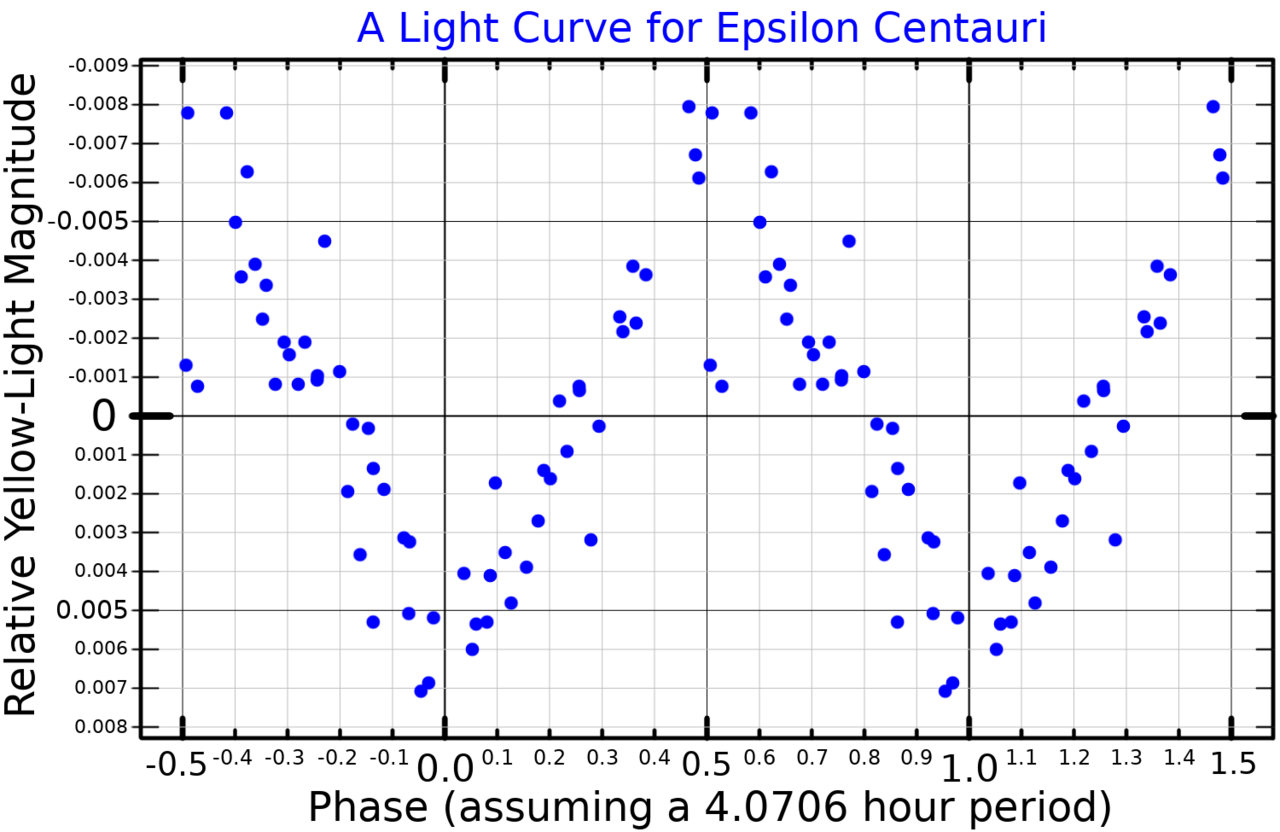
Epsilon Centauri (ε Centauri) is a massive, evolved giant star in the southern constellation of Centaurus. It is one of the brightest stars in the constellation, with a slightly variable apparent visual magnitude of +2.30, and is notable as a Beta Cephei type variable star.
- Bayer designation
- ε Centauri
- Apparent magnitude
- +2.30 (variable +2.29 to +2.31)
- Distance
- ~430 ly
- Mass
- 8.2 solar masses
- Spectral type
- B1 III
- Luminosity
- >16,000 solar luminosities
- Variable type
- Beta Cephei
- Primary period
- 0.16961 days (4 hours 4 minutes)
Lore & Background
Epsilon Centauri is a massive star with 8.2 times the mass of the Sun, and its spectrum matches a stellar classification of B1 III, indicating it is an evolved giant star. It radiates more than 16,000 times the luminosity of the Sun from its outer atmosphere at an effective temperature that gives it the blue-white hue of a B-type star. The star is classified as a Beta Cephei type variable star with a primary period of 0.16961 days (4 hours 4 minutes), completing 5.9 cycles per day. During each cycle, the brightness of the star varies from apparent magnitude +2.29 to +2.31.
This star is a proper motion member of the Lower Centaurus–Crux sub-group in the Scorpius–Centaurus OB association, the nearest such association of co-moving massive stars to the Sun. Epsilon Centauri is a relatively young star, with an age of around 16 million years. In Chinese astronomy, it forms part of an asterism called Southern Gate, along with α Centauri, and its Chinese name is Nán Mén yī.
Reader's Guide
Epsilon Centauri holds significance as a bright, variable star in the southern sky, serving as a key example of a Beta Cephei variable. Its variability, with a short period of about 4 hours and a small amplitude, provides insight into the pulsations of massive, evolved giant stars. As a member of the Lower Centaurus–Crux sub-group of the Scorpius–Centaurus OB association, it is part of the nearest region of co-moving massive stars to the Sun, offering a laboratory for studying stellar evolution in young associations. Its Chinese designation as part of the Southern Gate asterism highlights its cultural role in traditional astronomy. The star's high luminosity and mass, combined with its youth at around 16 million years, make it a valuable object for understanding the life cycles of B-type giants. Its Bayer designation and lack of an IAU-assigned proper name underscore its identity primarily through catalog designations.
Did You Know?
- Epsilon Centauri varies in brightness from magnitude +2.29 to +2.31 every 4 hours 4 minutes.
- The star has 8.2 times the mass of the Sun and is about 16 million years old.
- In Chinese astronomy, it is part of the Southern Gate asterism with α Centauri.
The Architecture of a Triple Star
The Alpha Centauri system is a remarkable example of stellar diversity packed into a single neighborhood. Its two primary components, Rigil Kentaurus and Toliman, are Sun-like stars of spectral classes G and K that gravitationally bind into a binary pair. Rigil Kentaurus carries 1.1 solar masses and radiates 1.5 times the Sun's luminosity, while Toliman is a dimmer, cooler companion at 0.9 solar masses and under half the Sun's output. Their shared orbit takes 79 years to complete, and because the path is notably elliptical, the gap between them swings from roughly 35.6 astronomical units—comparable to Pluto's distance from our Sun—down to 11.2 AU, near where Saturn circles. A third, much smaller member, Proxima Centauri, is a faint red dwarf of class M. It sits about 13,000 AU from the AB pair, a separation equivalent to roughly 430 Neptune-orbit radii, yet it holds the distinction of being the single closest star to the Sun at 4.2465 light-years. The AB pair, at 4.344 light-years, are the nearest stars a human eye can detect without aid.
A Name in Every Tongue
The naming history of this system reads like a tour through human civilization. In 1603, Johann Bayer assigned the Greek-letter designation that anchors its modern identity. The Arabic-derived name Rigil Kentaurus, meaning "the Foot of the Centaur," traces back through a Latinisation of Rijl al-Qinṭūrus, itself a rendering of the Greek Kentaurus. The constellation's mythological origin—Heracles wounding a centaur and setting it among the stars—gives the hoof its symbolic weight. Toliman, an approximation of the Arabic aẓ-Ẓalīmān ("the two male Ostriches"), entered European usage through Jacob Golius's 1669 edition of Al-Farghani's work, though old star maps often muddled which stars the name referred to. Robert Innes proposed Proxima Centauri in 1915, drawing on Latin for "the nearest of Centaurus," and the IAU later formalized all three proper names between 2016 and 2018. In Chinese astronomy the star is Nán Mén Èr, the Second Star of the Southern Gate. The Wergaia Boorong people of northwestern Victoria call it Bermbermgle, one of two courageous brothers who slew the Emu. Ethiopia's Mursi know it as Sholbi, part of a small asterism with stars in Crux and Centaurus.
A Beacon for Southern Skies
To the unaided eye, the two main stars of this system merge into a single brilliant point of light at apparent magnitude −0.27, making it the brightest star in Centaurus and the third-brightest anywhere in the night sky, surpassed only by Sirius and Canopus. Its angular separation from its companion shifts between 2 and 22 arcseconds across the roughly 80-year orbital cycle, well below the naked eye's 60-arcsecond resolution, yet binoculars or a modest telescope split the pair with ease for most of the orbit. The star plays a practical navigational role: together with Beta Centauri (Hadar), it forms the Southern Pointers, a line that sweeps toward the Southern Cross and helps observers distinguish the true Crux from the deceptively similar False Cross. Visibility is latitude-dependent. South of about 29 degrees south, the star never dips below the horizon and circles the sky all night. North of 29 degrees north, it never rises at all. Between those two latitudes, it skims low along the southern horizon, visible from places like Hermosillo or Chihuahua City but demanding a clear, unobstructed view.
Worlds Circling Our Nearest Stars
The search for planets around this system has yielded both confirmations and corrections. Proxima Centauri, the faint red dwarf, hosts two verified worlds. Proxima b is an Earth-sized body sitting within the star's habitable zone, though conditions there are considered unlikely to support life as we know it. Proxima d is a sub-Earth that hugs its parent star in a very tight orbit. A third candidate, Proxima c, described as a mini-Neptune at 1.5 astronomical units, remains disputed and has not achieved full confirmation. Around Rigil Kentaurus, a Saturn-mass object called Alpha Centauri Ab has been proposed in the habitable zone, yet its truly planetary nature is still uncertain. Toliman's story is one of retraction: a candidate called Alpha Centauri Bb was announced but definitively disproven in 2015, leaving the K-type star without any confirmed planets. The contrast is striking—the smallest, faintest member of the triple system carries the most solidly established planetary family, while the two brighter, more Sun-like stars remain shrouded in ambiguity.
Gallery
Frequently Asked Questions
What is Epsilon Centauri?
Epsilon Centauri is a blue-white giant star in the southern constellation of Centaurus, officially a B1 III spectral-type object. It stands out as one of the brightest stars you can spot in that region of the sky.
What kind of variable star is Epsilon Centauri?
It is classified as a Beta Cephei-type variable, meaning its brightness wobbles due to non-radial pulsations rippling through its outer envelope. The swing is tiny in practice, with visual magnitude drifting only between +2.29 and +2.31.
How far away is Epsilon Centauri and how bright does it look from Earth?
It sits roughly 430 light-years out and glows at an apparent visual magnitude near +2.30, which makes it easily visible to the naked eye under decent dark-sky conditions.
What are Epsilon Centauri's mass and luminosity?
The star carries about 8.2 solar masses and pumps out more than 16,000 times the Sun's luminosity, placing it firmly in the evolved-giant category rather than on the main sequence.
Why do variable-star fans and amateur astronomers care about Epsilon Centauri?
Because it is a relatively close, bright, and steady example of Beta Cephei pulsation, it serves as a handy photometric benchmark for tracking non-radial oscillation behavior in B-type giants. Its modest amplitude also makes it a forgiving target for backyard light-curve work.
More in Variable Stars, Part 7 1-24
Spotted an error? Know more?
Reader corrections go straight into our review queue. Suggest an edit · How this site is sourced