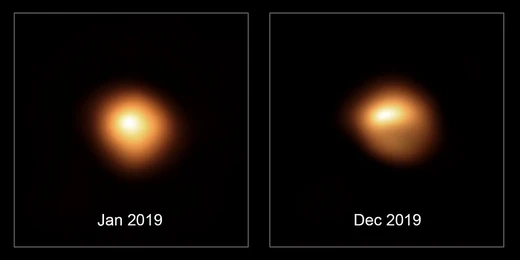
Epsilon Persei
A bright, massive triple system and Beta Cephei variable.

Brocken Inaglory · CC BY-SA 3.0
Áldu, formally designated Epsilon Persei (ε Persei), is a triple star system located in the northern constellation Perseus. Its combined apparent visual magnitude of +2.88 makes it visible to the naked eye. Parallax measurements place the system roughly 640 light-years (196 parsecs) from Earth.
The system is a spectroscopic binary, meaning the primary star's spectrum reveals radial velocity variations caused by an orbiting companion. The two components complete an orbit every 14 days, following a highly eccentric path with an eccentricity of 0.55. The secondary star has between 6% and 13% of the primary's mass, and its possible stellar classification ranges from A6 V to K1 V. A third component may exist, with an orbital period of about 9,428 days (25.8 years), but this remains unconfirmed. If it does exist, its mass would be between 51% and 139% of the primary's mass; the wide uncertainty stems from the unknown orbital inclination.
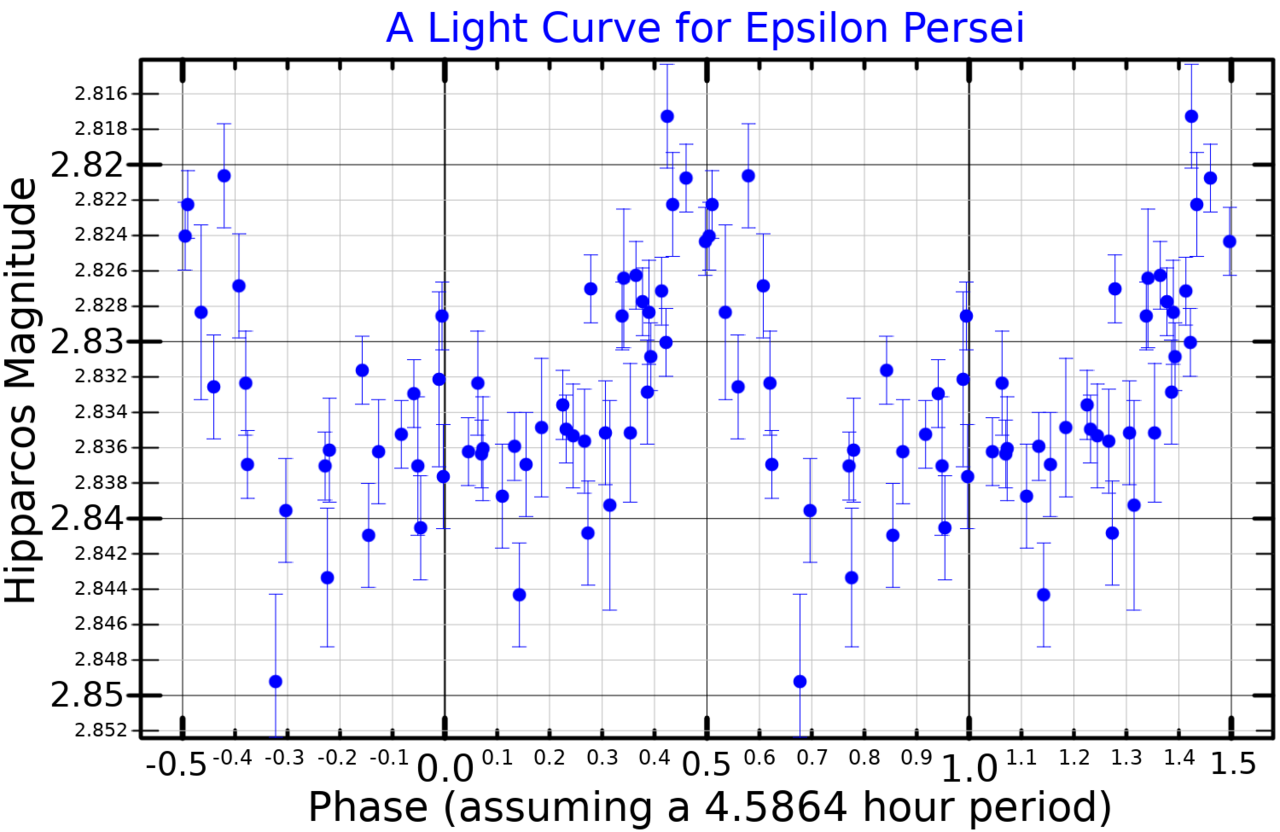
The primary star, component A, is a massive star with 12 to 16 times the Sun's mass and roughly eight times the Sun's radius. It serves as an MK spectral standard for class B0.5III, classifying it as a giant star that has evolved off the main sequence, though it has also been listed as a main-sequence star, reflecting its evolutionary state near or just past the end of core hydrogen fusion. This star radiates over 28,000 times the Sun's luminosity from its outer envelope, at an effective temperature of 26,500 K, giving it the blue-white hue typical of B-type stars. It is also a Beta Cephei variable star, with a primary pulsation period of 0.1603 days (6.24 cycles per day), and may exhibit multiple pulsation frequencies.
Several resolved companions appear in multiple star catalogues. Component B is a 9th-magnitude A2 main-sequence star considered a common proper motion companion, though the pair is too widely separated for observable orbital motion. Component C is a 14th-magnitude background star. Another star, HD 275984, is also thought to be a common proper motion companion.
In Sámi culture, Epsilon Persei is part of Sarvvis (or Sarvva), a large constellation representing a reindeer or moose that spans Cassiopeia, Perseus, and Auriga. Sarvvis is pursued by the hunter Fávdna, the star Arcturus.
- Apparent magnitude
- +2.88
- Distance
- 640 light-years (196 parsecs)
- Spectral type (primary)
- B0.5III
- Primary mass
- 12–16 solar masses
- Primary radius
- ~8 solar radii
- Primary luminosity
- >28,000 solar luminosities
- Primary effective temperature
- 26,500 K
Lore & Background
Epsilon Persei is a spectroscopic binary system, with the presence of an orbiting companion revealed by radial velocity variations in the spectrum of the primary. The two components orbit each other with a period of 14 days at a high orbital eccentricity of 0.55. The secondary component has about 6–13% of the primary's mass and may have a stellar classification in the range from A6 V to K1 V. A possible third component may have an orbital period of roughly 9,428 days (25.8 years), though this has not been conclusively demonstrated; if it exists, it would have about 51–139% of the primary's mass, with high uncertainty due to the unknown orbital inclination.
The primary component is a massive star with 12–16 times the Sun's mass and near eight times the radius of the Sun. It was chosen as an MK spectral standard for the class B0.5III, making it a giant star that has evolved away from the main sequence, though it has also been classified as a main sequence star, reflecting its evolutionary state near or slightly beyond the end of core hydrogen fusion. Component A radiates over 28,000 times the Sun's luminosity at an effective temperature of 26,500 K, giving it the blue-white hue typical of B-type stars. It is a Beta Cephei variable star with a primary pulsation period of 0.1603 days (6.24 cycles per day) and may have multiple pulsation frequencies.
Epsilon Persei has several resolved companions: component B is a 9th-magnitude A2 main sequence star considered a common proper motion companion, though they are too far apart for orbital motion to be observed; component C is a 14th-magnitude background star; and HD 275984 is thought to be another common-proper-motion companion.
Reader's Guide
Epsilon Persei holds significance as a bright, multi-component system that serves as an MK spectral standard for the B0.5III class, anchoring the classification of giant B-type stars. Its status as a Beta Cephei variable—with a primary pulsation period of 0.1603 days—makes it a key object for studying stellar pulsations in massive stars. The system's spectroscopic binary nature, with a 14-day orbit and high eccentricity, provides insights into binary evolution and mass ratios. The possible third component, if confirmed, would add complexity to the system's dynamics. In Sámi culture, Epsilon Persei is part of Sarvvis (or Sarvva), the reindeer or moose, a large constellation spanning Cassiopeia, Perseus, and Auriga, pursued by the hunter Fávdna (Arcturus). The star's formal name Áldu, approved by the IAU Working Group on Star Names, reflects the Sámi word for a female reindeer, contrasting with the male reindeer name Sarvvis given to δ Persei A. This cultural connection enriches the star's legacy beyond its astrophysical properties.
Did You Know?
- Epsilon Persei is a spectroscopic binary with an orbital period of 14 days and a high eccentricity of 0.55.
- The primary component is a Beta Cephei variable with a pulsation period of 0.1603 days.
- The star's formal name Áldu was approved by the IAU Working Group on Star Names.
- In Sámi culture, Epsilon Persei is part of the constellation Sarvvis, representing a reindeer or moose.
Orbital Architecture of a Complex System
Epsilon Persei is not a single star but a system whose internal structure has been pieced together through spectroscopic observations. The primary and its close companion trace an elliptical orbit with a period of just 14 days, and the high eccentricity of 0.55 means their separation swings dramatically over each cycle. The secondary carries only 6 to 13 percent of the primary's mass and likely falls somewhere between an A6 and K1 main-sequence classification. Beyond this inner pair, evidence hints at a third body completing a far longer revolution of roughly 9,428 days, or about 25.8 years. If confirmed, that outer companion would possess between 51 and 139 percent of the primary's mass, though the wide range reflects the fact that the orbital inclination remains unknown. The system sits at a distance of approximately 640 light-years, and its combined light reaches Earth at an apparent magnitude of +2.88, bright enough for unaided observation in the northern sky.
A Blue-White Giant at the Edge of Its Life
The dominant member of the system, designated component A, is a massive star weighing between 12 and 16 times that of the Sun while spanning nearly eight solar radii. It has been adopted as the MK spectral standard for the B0.5III class, marking it as a giant that has moved off the main sequence, though some analyses still place it at or just past the end of core hydrogen burning. Its outer envelope radiates more than 28,000 times the Sun's total luminosity at an effective temperature of 26,500 kelvin, producing the characteristic blue-white glow of B-type stars. Beyond its static properties, component A is a Beta Cephei variable whose primary pulsation cycle lasts 0.1603 days, equivalent to 6.24 oscillations per day, and it may exhibit additional pulsation frequencies on top of that fundamental mode.
A Broader Stellar Neighborhood
Looking beyond the spectroscopic pair, several additional stars appear in the vicinity of Epsilon Persei in multiple-star catalogues. Component B is a ninth-magnitude A2 main-sequence star separated by 9 arcseconds; it shares a common proper motion with the primary, suggesting a physical association, yet the angular distance is too great for any orbital interaction to be detected. Further out, a 14th-magnitude object at roughly 80 arcseconds is catalogued as component C, though it is identified as a background star rather than a true companion. At 163 arcseconds, the star HD 275984 is also thought to be a common-proper-motion companion, extending the apparent family of associated objects. Together these resolved neighbors paint a picture of a moderately rich stellar environment around a system that, at about 196 parsecs, remains one of the more accessible B-type giants for ground-based study.
The Sámi Name Áldu and Its Cultural Story
In the traditional sky lore of the Sámi people, Epsilon Persei belongs to a large constellation called Sarvvis, or Sarvva, representing a reindeer or moose that stretches across Cassiopeia, Perseus, and Auriga. This celestial animal is eternally pursued by Fávdna, the hunter identified with the star Arcturus. A curious detail in the mythology is that Sarvvis is described as a male reindeer that retains its antlers through winter, a trait that in reality belongs only to females. The Sámi word for a female reindeer is Áldu, and this is the name the IAU Working Group on Star Names formally approved for component A of Epsilon Persei on 25 December 2025. The name has since been entered into the IAU Catalog of Star Names. Notably, the companion δ Persei A received the proper name Sarvvis, linking the two stars within the same cultural narrative.
Gallery
Frequently Asked Questions
Who is Epsilon Persei (Áldu)?
Epsilon Persei, also known by its traditional name Áldu, is a triple star system located in the northern constellation Perseus. Its primary component is a B0.5III star weighing between 12 and 16 solar masses with a radius of roughly eight times the Sun's. The system's combined apparent magnitude of +2.88 makes it visible to the naked eye from dark-sky locations.
What makes Epsilon Persei a variable star?
The primary is classified as a Beta Cephei variable, meaning pressure-driven oscillations in its outer layers cause periodic brightness changes. With a luminosity exceeding 28,000 solar luminosities, these pulsations are a key feature of its observable behavior. The spectroscopic-binary companion adds radial-velocity shifts that complicate and enrich the variability signature.
What is Epsilon Persei's orbital configuration?
The primary and its companion trace a highly elliptical orbit with an eccentricity of 0.55, completing one revolution every 14 days. The secondary contributes only 6% to 13% of the primary's mass, so the barycenter sits close to the larger star. A third component rounds out the triple-star architecture.
How far away is Epsilon Persei from Earth?
Parallax measurements place the system at approximately 640 light-years, or about 196 parsecs, from our vantage point. Despite that distance, the combined light of the triple system still reaches us at magnitude +2.88, keeping it within reach of unaided observation.
Why is Epsilon Persei important to variable-star astronomy?
As a naked-eye Beta Cephei pulsator, it offers an accessible benchmark for testing models of pressure-wave oscillations in hot, massive stars. Its eccentric 14-day binary orbit and triple-star architecture also make it a valuable natural laboratory for studying stellar dynamics and gravitational interactions.
More in Variable Stars, Part 7 1-24
Spotted an error? Know more?
Reader corrections go straight into our review queue. Suggest an edit · How this site is sourced