
Kappa Scorpii
A bright spectroscopic binary and Beta Cephei variable in Scorpius.

PopePompus · CC BY-SA 4.0
Kappa Scorpii (κ Scorpii) is a binary star system located in the southern constellation Scorpius. It has an apparent visual magnitude of 2.4, making it easily visible without a telescope. Based on parallax measurements, the system is roughly 480 light-years from Earth.
The star has the traditional name Girtab, a Sumerian word for "scorpion." This name originated in Babylonian star catalogues and originally referred to an asterism that included κ Scorpii, λ Scorpii, υ Scorpii, and ι Scorpii. However, Girtab has also been used for θ Scorpii (Sargas) and ι¹ Scorpii. A 1971 NASA star catalogue listed κ Scorpii as Mula, after an Indian nakshatra (lunar mansion) in the same region. In Chinese astronomy, κ Scorpii is part of the Tail asterism (Wei), which includes μ¹, ε, ζ¹, ζ², η, θ, ι¹, ι², λ, and υ Scorpii; κ Scorpii itself is known as the Seventh Star of Tail. Among the Kamilaroi and Euahlayi Aboriginal peoples of New South Wales, Australia, the star is called Gidjirrigaa, meaning the budgerigar.
Kappa Scorpii is a spectroscopic binary: the two stars are too close together to be resolved individually by telescope. They orbit each other every 195 days with an orbital eccentricity of about 0.5. The combined spectrum matches a stellar classification of B1.5 III, where the "III" luminosity class indicates a giant star that has exhausted its core hydrogen and entered a late evolutionary stage.
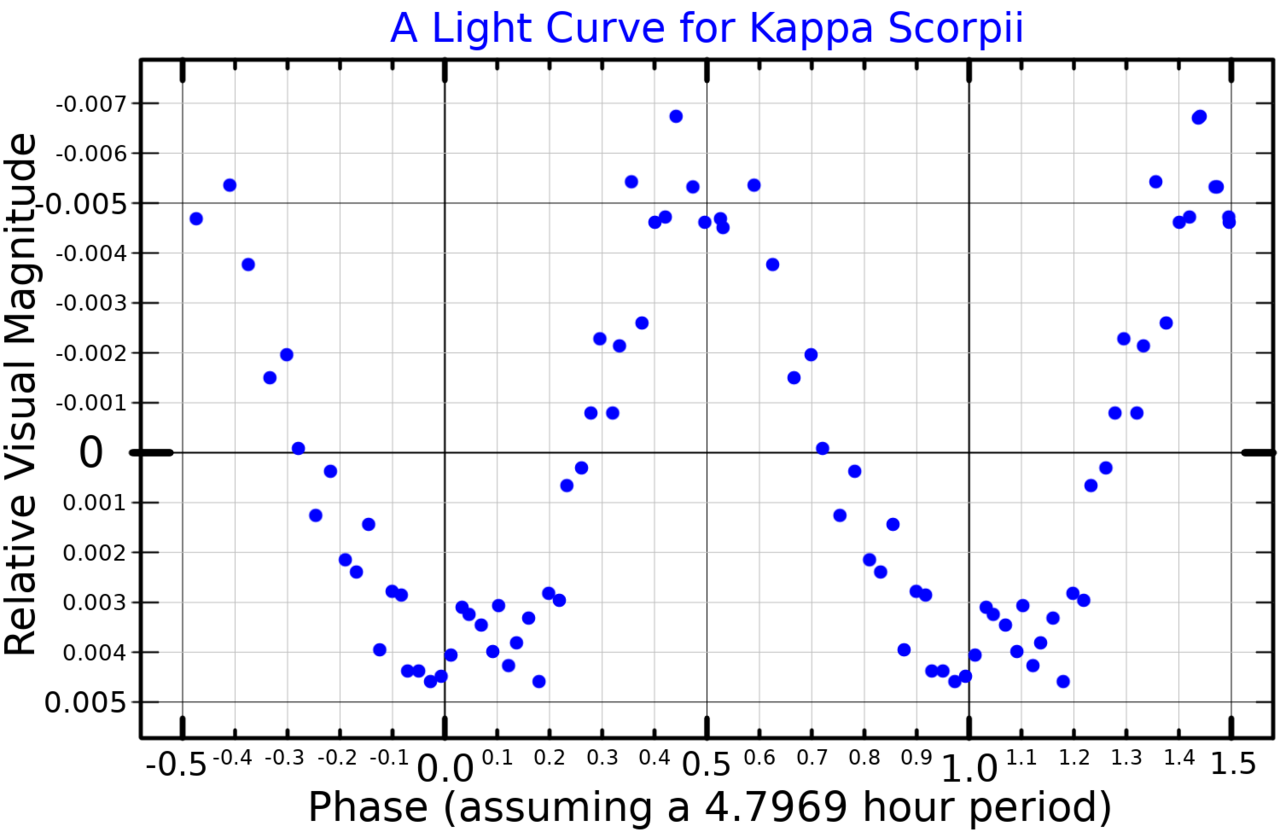
The primary component, κ Sco A, is a Beta Cephei variable star. It pulsates radially with a dominant frequency of five cycles per day (one cycle every 4.8 hours), along with secondary frequencies of about 4.85 and 5.69 cycles per day. This star has roughly 11 times the Sun's mass and nearly 7 times its radius. Its effective temperature is 23,400 K, giving it a blue-white hue. It rotates rapidly, with an estimated rotation period of 1.9 days, and its rotation axis is inclined about 40° relative to Earth's line of sight.
The secondary component, κ Sco B, is smaller than the primary but still much larger than the Sun. It has about 10 solar masses and nearly six solar radii. Its effective temperature is 18,800 K, also far hotter than the Sun's 5,778 K.
κ Scorpii appears on the flag of Brazil, where it represents the state of Paraíba.
- Apparent magnitude
- 2.4
- Distance
- ~480 ly
- Spectral type
- B1.5 III
- Orbital period
- ~195 days
- Orbital eccentricity
- ~0.5
- Primary mass
- ~11 solar masses
- Primary temperature
- 23,400 K
Lore & Background
Kappa Scorpii has been called Girtab, the Sumerian word for 'scorpion', a name that survived through Babylonian star catalogues and originally applied to an asterism comprising this star, λ Scorpii, υ Scorpii, and ι Scorpii. Other sources have used the name Girtab for θ Scorpii (Sargas) or ι1 Scorpii. The latter appeared in a 1971 NASA catalog of star names that listed κ Scorpii as Mula, after an Indian asterism (nakshatra) in the same region. In Chinese, the star is part of an asterism meaning 'Tail', consisting of κ Scorpii and several other stars; κ Scorpii itself is called 'the Seventh Star of Tail'. The Kamilaroi and Euahlayi Aboriginal peoples of New South Wales, Australia call this star Gidjirrigaa, the budgerigar.
This is a spectroscopic binary, meaning the two stars are so close together that they have not been individually resolved with a telescope. The pair orbit each other with a period of about 195 days and an eccentricity of about 0.5. The combined spectrum matches a stellar classification of B1.5 III, where the 'III' luminosity class indicates a giant star that has exhausted the supply of hydrogen at its core and is in a late evolutionary stage.
The primary component, κ Sco A, is a variable star of Beta Cephei type, undergoing radial pulsations with a dominant frequency of five cycles per day (4.8 hours per cycle). There are overlapping secondary pulsation frequencies of about 4.85 and 5.69 cycles per day. This star has about 11 times the mass of the Sun and nearly 7 times the Sun's radius, with an effective temperature of 23,400 K, giving it a blue-white hue. It is rotating rapidly, with an estimated period of only 1.9 days and an axis of rotation inclined by about 40° to the line of sight from Earth. The secondary component, κ Sco B, is smaller than the primary but still much larger than the Sun, with about 10 times the solar mass and nearly six times the solar radius, and an effective temperature of 18,800 K.
Reader's Guide
Kappa Scorpii appears on the flag of Brazil, symbolising the state of Paraíba. Its cultural significance extends across multiple traditions: the Sumerian name Girtab links it to ancient Babylonian asterisms, while the Indian nakshatra name Mula and the Chinese designation as the Seventh Star of Tail reflect its role in non-Western astronomy. The Aboriginal name Gidjirrigaa (the budgerigar) further underscores its place in Indigenous Australian sky knowledge. As a spectroscopic binary and Beta Cephei variable, the system provides insights into stellar evolution and pulsation. The primary's rapid rotation and multiple pulsation frequencies make it a subject of interest for studies of stellar structure and dynamics. Its brightness (magnitude 2.4) ensures it remains a prominent naked-eye object, bridging ancient lore and modern astrophysical inquiry.
Did You Know?
- Kappa Scorpii is a spectroscopic binary with an orbital period of about 195 days.
- The primary component is a Beta Cephei variable pulsating with a dominant frequency of five cycles per day.
- The star appears on the flag of Brazil, representing the state of Paraíba.
- The Kamilaroi and Euahlayi peoples of Australia call it Gidjirrigaa, meaning 'budgerigar'.
A Bright Binary in the Southern Sky
Kappa Scorpii is a binary star system located in the southern constellation of Scorpius, easily spotted by the unaided eye thanks to its apparent visual magnitude of 2.4. Parallax measurements place the system at an estimated distance of roughly 480 light-years, or about 150 parsecs, from Earth. Despite its brightness, the two stellar components are so tightly bound that they have never been individually resolved through a telescope, making it a spectroscopic binary. The pair traces an elliptical orbit around a common barycenter with a period of approximately 195 days and an eccentricity of about 0.5, meaning their separation varies noticeably throughout each cycle. The combined light from both stars produces a spectrum that matches a B1.5 III classification, where the luminosity class signals the presence of a giant star that has already burned through the hydrogen fuel at its core and is progressing into a later evolutionary phase. This combination of naked-eye visibility, binary architecture, and advanced stellar evolution makes Kappa Scorpii a compelling target for both amateur observers and professional astrophysicists studying post-main-sequence dynamics.
A Name Worn Across Civilizations
The naming history of Kappa Scorpii reads like a palimpsest of human astronomy stretching back millennia. In Sumerian, the star was known as Girtab, a word meaning "scorpion," a label that persisted through Babylonian star catalogues. Originally, Girtab referred not to a single star but to an asterism grouping Kappa Scorpii together with Lambda, Upsilon, and Iota Scorpii, though some later sources reassigned the name to Theta Scorpii (Sargas) or Iota-1 Scorpii. A 1971 NASA catalog of star names listed Kappa Scorpii as Mula, drawing on an Indian nakshatra asterism in the same celestial region. In Chinese astronomy, the star belongs to the asterism Wěi Xiù, meaning "Tail," which encompasses eleven stars across Scorpius. Within that grouping, Kappa Scorpii holds the specific designation Wěi Xiù qī, or "the Seventh Star of Tail." Meanwhile, the Kamilaroi and Euahlayi Aboriginal peoples of New South Wales, Australia, recognize the star as Gidjirrigaa, the budgerigar. These layered names illustrate how a single point of blue-white light has served as a cultural anchor for civilizations separated by oceans and millennia.
Pulsing Giants in a Tangled Dance
The primary component, designated Kappa Sco A, is a variable star of Beta Cephei type, meaning it undergoes radial pulsations that cause its brightness to fluctuate in a regular rhythm. Its dominant pulsation frequency is five cycles per day, corresponding to a period of roughly 4.8 hours, with overlapping secondary frequencies near 4.85 and 5.69 cycles per day adding complexity to the light curve. This star packs about 11 times the mass of the Sun and swells to nearly seven solar radii, while its outer envelope radiates at an effective temperature of 23,400 kelvin, lending the system its characteristic blue-white color. It spins extraordinarily fast, completing one rotation in just 1.9 days, with its rotational axis tilted approximately 40 degrees relative to our line of sight. Its companion, Kappa Sco B, is somewhat smaller yet still dwarfs our Sun, carrying roughly ten solar masses and nearly six solar radii at an effective temperature of 18,800 kelvin. Together, these two massive, hot stars orbit one another in a 195-day elliptical path, their combined spectrum blending into a single B1.5 III signature that defies telescopic separation.
From Ancient Asterisms to a National Flag
Beyond its physical properties, Kappa Scorpii carries a quiet but enduring cultural footprint that spans continents. The star's most prominent modern political association is its appearance on the flag of Brazil, where it symbolizes the state of Paraíba, one of the country's northeastern states. This inclusion places an ancient point of light in the southern sky into the daily visual vocabulary of millions of Brazilians. The star's cultural reach extends further still: Sumerian and Babylonian astronomers wove it into their scorpion imagery under the name Girtab, Indian astronomers incorporated it into the nakshatra system as part of Mula, and Chinese star-lore assigned it a precise ordinal position within the eleven-star Tail asterism. In Australia, the Kamilaroi and Euahlayi peoples of New South Wales see in it the budgerigar, Gidjirrigaa. These diverse identifications—scorpion, tail, bird, state emblem—demonstrate how a single binary system at 480 light-years has served as a shared reference point for navigation, storytelling, and identity across cultures that never knew of one another.
Gallery
Frequently Asked Questions
What is Kappa Scorpii and where can I find it in the sky?
Kappa Scorpii is a bright B1.5 III star system situated in the southern constellation Scorpius. It shines at a visual magnitude of 2.4, so it is readily visible to the naked eye from southern-hemisphere sites without any optical aid.
What is the traditional name Girtab and where did it originate?
Girtab is a Sumerian word meaning "scorpion" that first appeared in ancient Babylonian star catalogues. It originally labelled a four-star asterism stretching across κ, λ, υ, and ι Scorpii, though the same name has also been attached to θ Scorpii and ι¹ Scorpii in later usage.
What type of variable star is Kappa Scorpii?
It is classified as a Beta Cephei variable, exhibiting short-period radial pulsations that cause small, rapid changes in brightness. Because it is simultaneously a spectroscopic binary, astronomers must disentangle the pulsation signal from the orbital Doppler shifts of the two components.
What are the key orbital characteristics of the Kappa Scorpii binary?
The two stars trace a markedly elliptical orbit with an eccentricity of roughly 0.5, completing one revolution in about 195 days. The primary component carries approximately eleven solar masses, making it a massive B-type star.
How far away is Kappa Scorpii and how was that distance determined?
Parallax measurements place the system at roughly 480 light-years from Earth. At that range and its 2.4 magnitude, it remains one of the brighter naked-eye stars in the Scorpius sky region.
More in Variable Stars, Part 7 1-24
Spotted an error? Know more?
Reader corrections go straight into our review queue. Suggest an edit · How this site is sourced