
Lockheed MQM-105 Aquila
First U.S. Army small battlefield drone, cancelled after development.
Last updated

ZLEA · CC BY-SA 4.0
The Lockheed MQM-105 Aquila, meaning "Eagle," was the first small drone built for the U.S. battlefield, designed in the 1970s to mark targets for the Army. Its origins trace to 1972, when DARPA started the Remotely Piloted Aerial Observation/Designation System program, which included three prototypes: PRAIRIE, Calare, and Aequare. PRAIRIE, made by Philco Ford, carried a TV camera and a laser designator, successfully guiding a laser bomb to a truck. Calare came from Melpar, launching off a truck roof and landing on skids on a prepared strip.
Aequare, from JHU/APL, was a delta-wing craft launched from a small cart with a bungee cord. Since DARPA could not build operational systems, the concept passed to the Army Aviation Systems Command, which in 1975 put the next phase—a System Technology Demonstrator—up for bids. Lockheed won as the low bidder. From 1975 to 1979, this RPV-STD effort produced a non-stealthy, tailless aircraft with anhedral wingtips, launched by a pneumatic launcher and caught in a net stretched across a trampoline-like frame.
It used an unsecured data link. Between December 1975 and November 1977, the system flew 149 flights—35 by the contractor and 114 by the Army. After this phase, the Aviation Systems Command worked with the Artillery Branch to define requirements for a field-ready system. In 1979, the command issued a Full Scale Engineering Development request for proposals.
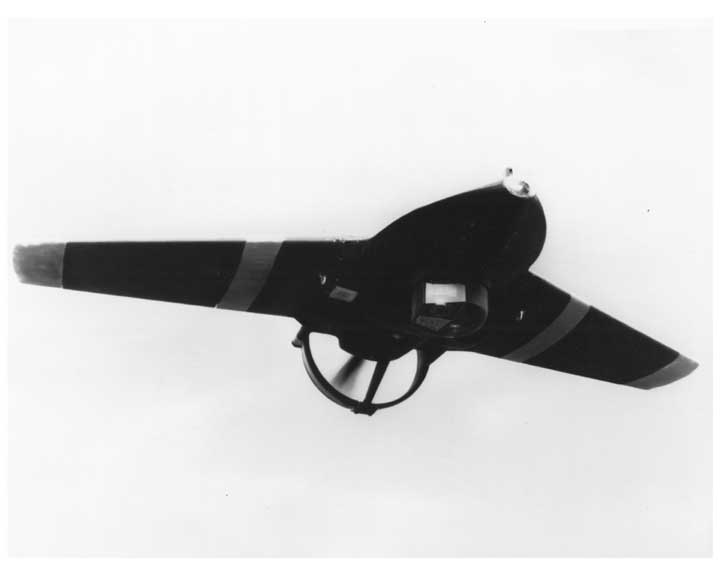
Lockheed Missile and Space Division won the contract later that year, agreeing to deliver 22 air vehicles, 4 Ground Control Stations, 3 Launch Systems, 3 Recovery Systems, and support hardware. This TADAR program produced a stealthy, tailless aircraft powered by a Herbrandson piston engine with a 26-inch pusher propeller. Its Westinghouse payload—a TV imager and laser designator—sat in a belly turret, intended for use with M712 Copperhead artillery shells and AGM-114 Hellfire missiles. In 1984, development began on a Ford Aerospace FLIR/laser designator payload.
Secure communications came from a joint Army/Air Force program called MICNS. A near-infrared source on the nose allowed automatic recovery into the net. The Aquila launched hydraulically from an All American Engineering catapult mounted on a 5-ton truck. The recovery system, built by Dornier, was a vertical net held by an inverted "h" frame, also on a 5-ton truck.
Background
The modern history of the Army's battlefield drone efforts began in 1972, when DARPA began the Remotely Piloted Aerial Observation/Designation System program which included PRAIRIE, Calare, and Aequare. DARPA passed the concept to the Army Aviation Systems Command, which proceeded with a System Technology Demonstrator (STD). In 1975 Lockheed won the STD contract, producing a non-stealthy tailless air vehicle with anhedral wing tips, launched by a pneumatic launcher and recovered in a net. From December 1975 to November 1977 the RPV-STD flew 149 flights.
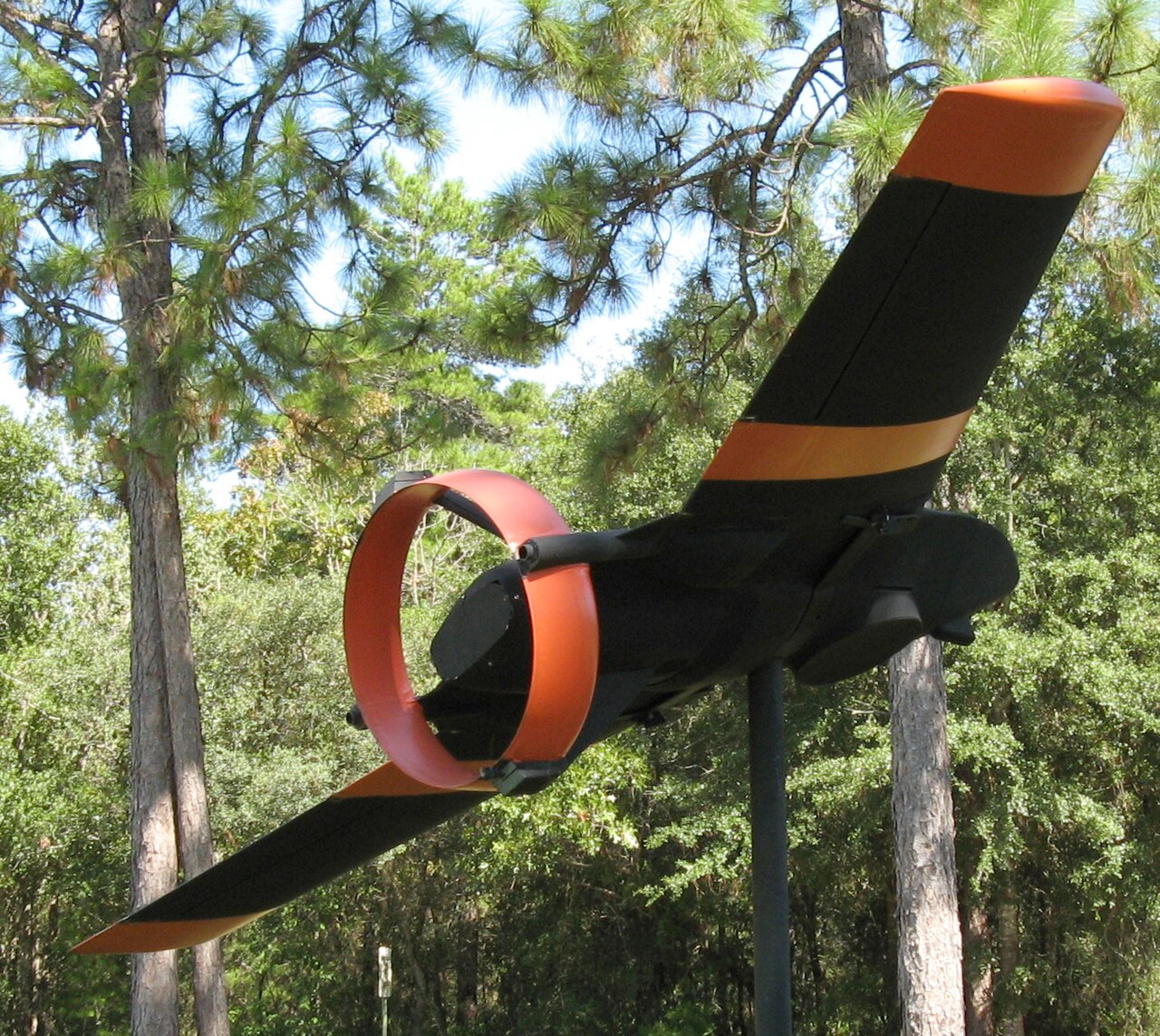
In 1979 Lockheed won the Full Scale Engineering Development contract for the MQM-105 Aquila, which became a stealthy tailless aircraft with a Herbrandson piston engine and a 26-inch pusher propeller. The Westinghouse payload was a television imager/laser designator in a belly turret, intended for use with the M712 Copperhead artillery round and the AGM-114 Hellfire missile. A Ford Aerospace FLIR/laser designator payload began development in 1984. The Aquila was hydraulically launched from a 5-ton truck and recovered by a Dornier-built vertical net on another 5-ton truck.
The Ground Control System, also on a 5-ton truck, accommodated three operators. Due to delays in the secure MICNS data link, a Block I configuration flew 17 flights in 1982 and was assigned to an Early Operational Capability unit from July 1983 to July 1984. The complete MQM-105 began contractor flight testing in December 1983. Government Developmental Testing II began in May 1985 but was suspended in September 1985 after failing 21 of 149 performance specifications.
A Lockheed Test-Fix-Test effort resolved major problems, and DT IIA ran from February to May 1986. Operational testing ran from October 1986 through March 1987. The program was cancelled in 1987 despite an Army request for production. Residual assets were used in US Army/South Korea war games in 1988.
Frequently Asked Questions
When did the first MQM-105 Aquila prototype fly?
The program's prototype achieved its maiden flight in December 1983, roughly eleven years after DARPA kicked off the broader Remotely Piloted Aerial Observation/Designation System effort in 1972. That early DARPA initiative had spawned three competing prototypes—PRAIRIE, Calare, and Aequare—whose concepts fed into the final Aquila design.
How many Aquila systems were actually delivered to the Army?
The original contract envisioned 780 airframes paired with 72 complete launcher-recovery-control-station sets, but the program was wound down long before that scale was reached. In the end, only 22 air vehicles, four ground control stations, and three each of launch and recovery systems made it into Army hands.
Why was the MQM-105 Aquila program cancelled?
The Aquila was terminated after the development and limited-testing phase, so it never transitioned into full operational fielding with the Army. Its cancellation left a gap in small, dedicated battlefield target-designation drones for U.S. forces until later unmanned systems eventually filled that niche.
More in Unmanned Aerial Vehicles by Country
Sources
Compiled from Wikipedia and the sources listed below. Text from Wikipedia is available under CC BY-SA 4.0; this entry is adapted from it.
- Wikipedia: Lockheed MQM-105 Aquila (CC BY-SA 4.0).
Spotted an error? Know more?
Reader corrections go straight into our review queue. Suggest an edit · How this site is sourced