
NASA Centurion
Third-generation solar-electric flying wing for high-altitude research.
Last updated

NASA Armstrong Flight Research Center / NASA/Tom Tschida · Public domain
The NASA Centurion was the third in a line of solar- and fuel-cell-powered unmanned aerial vehicles developed by AeroVironment under NASA's Environmental Research Aircraft and Sensor Technology (ERAST) program. Its purpose was to advance technologies for high-altitude, long-duration aircraft that could function as atmospheric satellites, conducting atmospheric research and serving as communications relays. It was derived from the NASA Pathfinder Plus and later led to the NASA Helios.
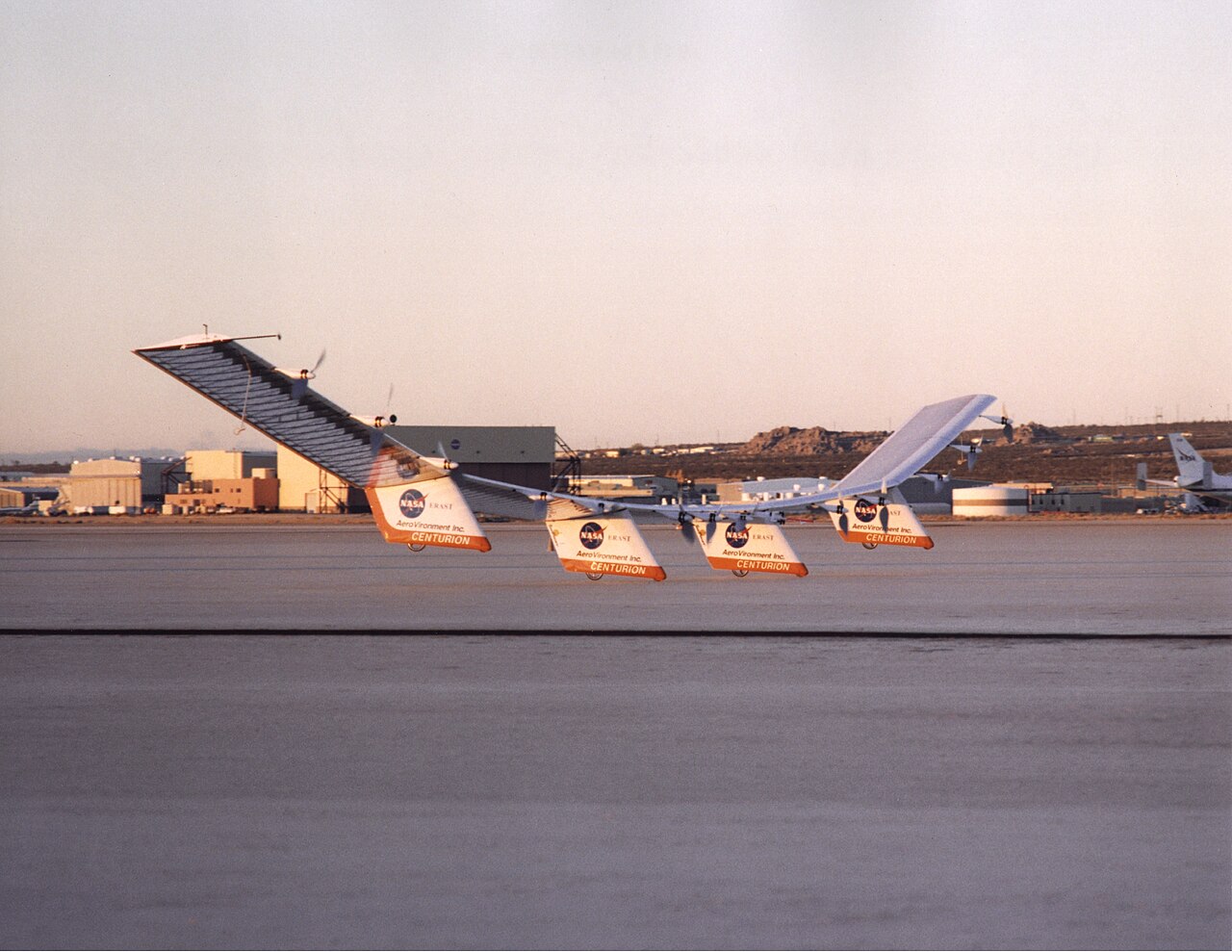
The Centurion was originally designed to meet the ERAST project's goal of reaching 100,000 feet on solar power. Program managers considered a design based on the Pathfinder and Pathfinder Plus to be the lowest-risk way to achieve that altitude. A quarter-scale model was first test-flown at El Mirage Dry Lake on March 4, 1997.
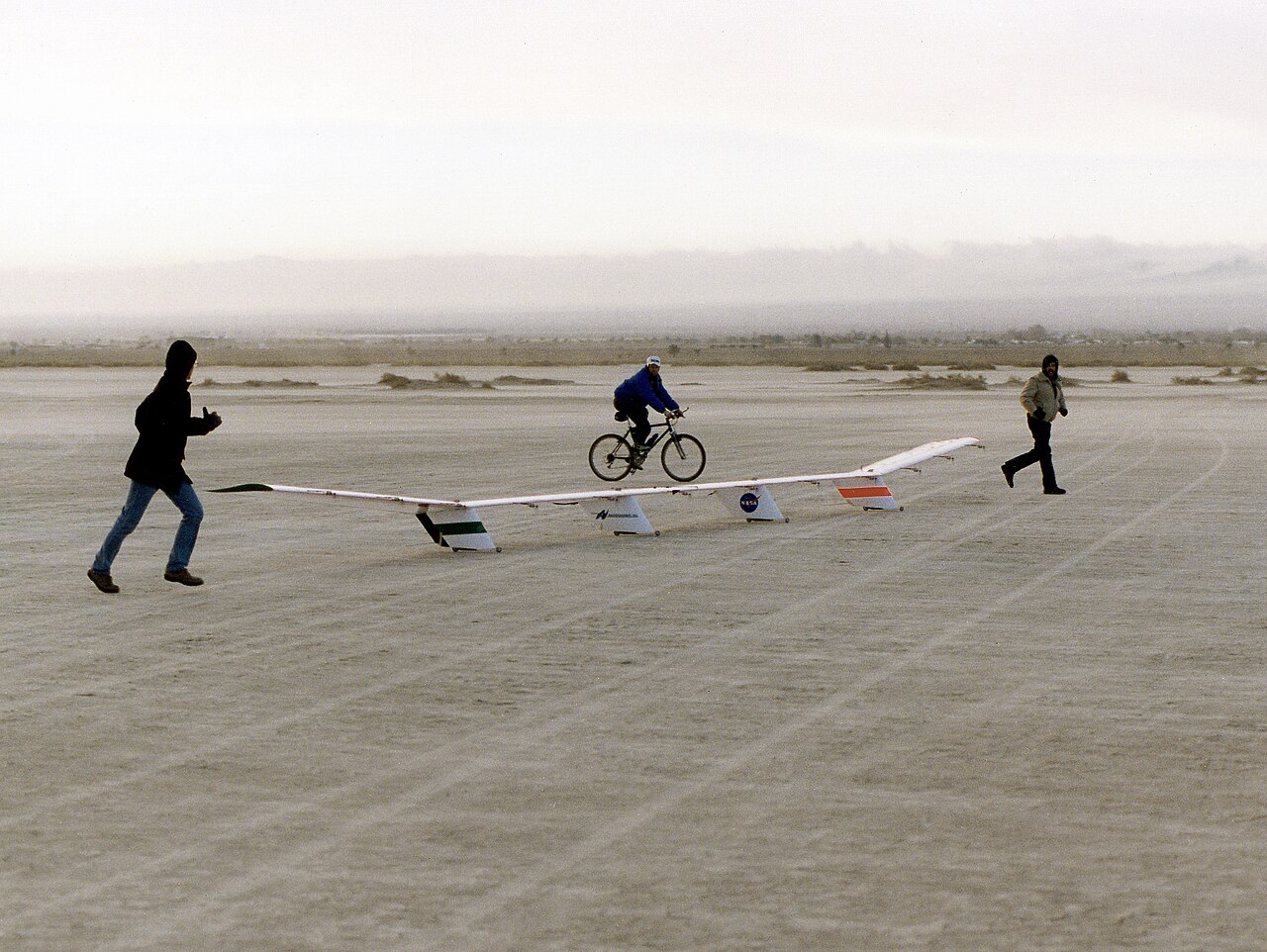
The full-size Centurion made its maiden flight at Rogers Dry Lake on November 10, 1998, lasting 1 hour and 24 minutes. It weighed 1,385 pounds, including a 150-pound steel anvil suspended on its centerline to simulate a payload. That flight was nearly flawless, followed by a second flight on November 19 before a crowd of VIPs and media, lasting 1 hour and 29 minutes. The third and final low-altitude test flight occurred on December 3, when the vehicle was loaded to its maximum gross weight of 1,806 pounds to test its carrying capacity.
This flight lasted 30 minutes, shortened due to expected high winds. All three flights ran on battery power and confirmed the design's handling, performance, and structural integrity. After these tests, NASA decided to expand the aircraft into the Helios Prototype, with work beginning in January 1999.
Aircraft description
The Centurion resembled the Pathfinder in appearance but had a much longer wingspan of 206 feet. Its structure was strengthened to carry payloads of up to 600 pounds more efficiently. The wing used a redesigned high-altitude airfoil, and the number of motors increased to 14. The number of underwing pods—housing batteries, flight control components, ballast, and landing gear—rose to four.
Frequently Asked Questions
What is the NASA Centurion?
The NASA Centurion is a third-generation solar-electric flying wing built by AeroVironment under NASA's ERAST program. It was engineered to loiter at extreme altitudes for long stretches, essentially acting as a stationary atmospheric satellite for research and communications-relay duties.
What are the key specs of the NASA Centurion?
The airframe spans 206 feet tip to tip, carries 14 motors, and mounts four underwing pods, all within a maximum gross weight of 1,806 pounds. Its hybrid solar-cell and fuel-cell power system was chosen to sustain the long-duration high-altitude endurance the program demanded.
Where does the NASA Centurion sit in the ERAST lineage?
It was the third aircraft in the series, evolving directly from the earlier NASA Pathfinder Plus design. It in turn paved the way for the NASA Helios, which carried the 100,000-foot ambition further.
More in Unmanned Aerial Vehicles by Country
Sources
Compiled from Wikipedia and the sources listed below. Text from Wikipedia is available under CC BY-SA 4.0; this entry is adapted from it.
- Wikipedia: NASA Centurion (CC BY-SA 4.0).
Spotted an error? Know more?
Reader corrections go straight into our review queue. Suggest an edit · How this site is sourced