
Northrop Grumman MQ-8 Fire Scout
Unmanned autonomous helicopter for reconnaissance, fire support, and targeting.
Last updated

gpjt · CC BY-SA 2.0
The Northrop Grumman MQ-8 Fire Scout is an unmanned helicopter that operates autonomously, built for the United States Armed Forces. It handles reconnaissance, situational awareness, aerial fire support, and precision targeting for ground, air, and naval units.
The first version, the RQ-8A, came from the Schweizer 330, while the upgraded MQ-8B was based on the Schweizer 333. A larger variant, the MQ-8C, uses the Bell 407 as its foundation. As of February 2018, the U.S. Navy had 23 MQ-8Bs in service, but the MQ-8B was retired in October 2022.
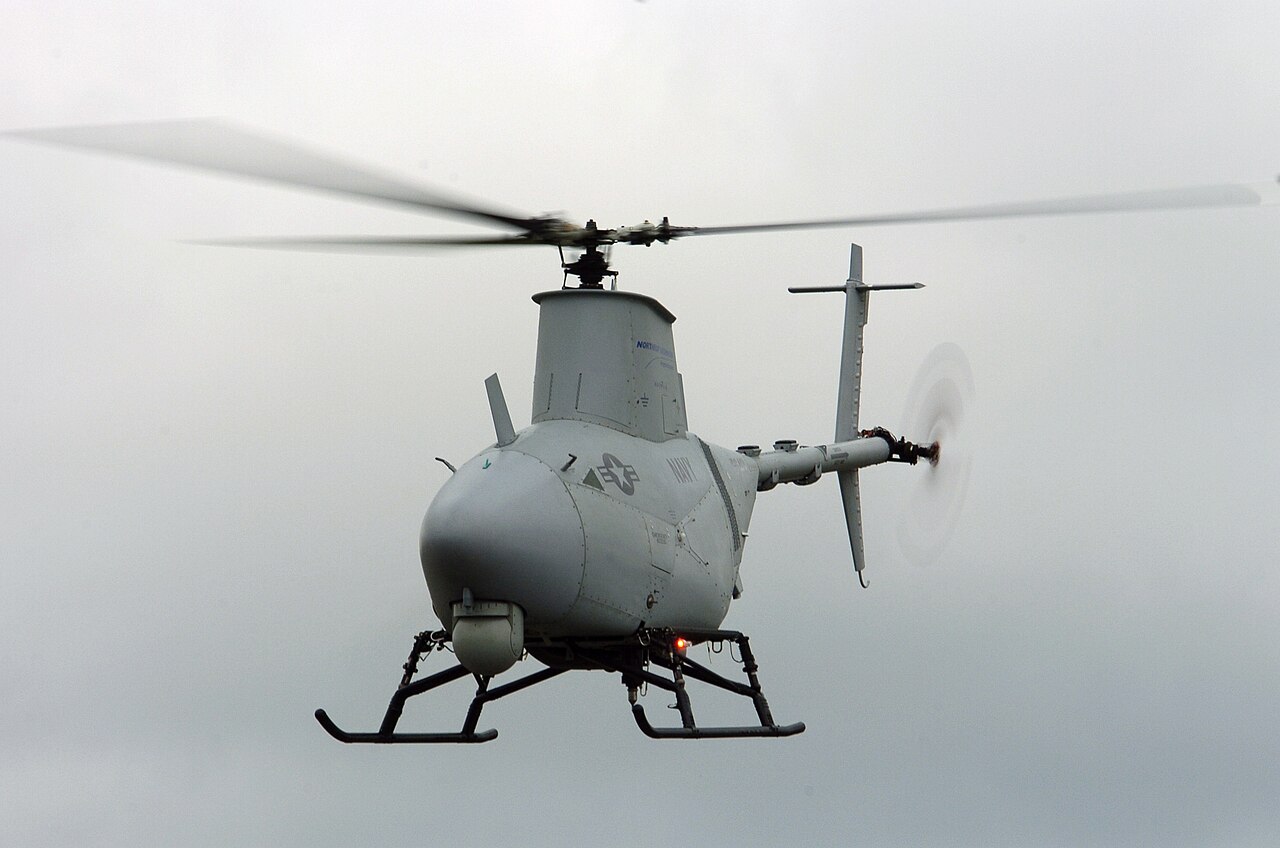
RQ-8A
The Navy started looking for a second-generation UAV after retiring its RQ-2 Pioneers. The requirements called for a vertical takeoff and landing aircraft with a 200-pound payload, a 125-mile range, three hours of endurance at 20,000 feet, and the ability to land on a ship in 29 mph winds. The UAV also needed to fly 190 hours before scheduled maintenance.
Three finalists competed in the VTOL-UAV program: Bell, Sikorsky, and a team of Teledyne Ryan and Schweizer Aircraft. The Ryan-Schweizer design won in spring 2000. Named the RQ-8A Fire Scout, it was derived from the Schweizer 330SP, a three-passenger turbine helicopter, but with a new fuselage, fuel system, and UAV electronics and sensors.
The first prototype was initially flown with a pilot and made its first autonomous flight in January 2000. It used a Rolls-Royce 250-C20 turbine engine running on JP-8 or JP-5 jet fuel, the latter having a higher flashpoint for safer shipboard use.
The Fire Scout was planned to carry a sensor ball turret with electro-optic and infrared cameras plus a laser range finder. Control came via a data link based on the Northrop Grumman RQ-4 Global Hawk, with line-of-sight range up to 172 miles. The control system could be installed on a ship or in a Humvee for Marine Corps use.
MQ-8B
In December 2001, the Navy decided the Fire Scout didn’t meet its needs and cut production funding, but development continued. Northrop Grumman offered improved versions to other customers. The U.S. Army became interested and awarded a contract for seven improved RQ-8B evaluation machines in late 2003.
In 2006, the designation changed to MQ-8B. This version has a four-blade main rotor instead of the RQ-8A’s three-blade rotor, reducing noise and improving lift and performance. The four-blade design had already been tested on prototypes.
Background
The Fire Scout originated from a US Navy requirement for a vertical takeoff and landing UAV to replace the RQ-2 Pioneer. The Navy specified a payload capacity of 90 kg, a range of 125 miles, an endurance of three hours at 20,000 ft, and the ability to land on a ship in a 29 mph wind.
The Ryan-Schweizer design won the competition in spring 2000. The RQ-8A prototype first flew autonomously in January 2000, powered by a Rolls-Royce 250-C20 turbine engine running on JP-8 or JP-5 jet fuel. Although the Navy cut production funding in December 2001, development continued, and the US Army awarded a contract for seven improved RQ-8B evaluation machines in late 2003, later redesignated MQ-8B in 2006.
The MQ-8B features a four-blade main rotor for reduced noise and improved lift, stub wings for armament carriage, and a payload capacity of up to 700 lb for short-range missions. It can carry Hellfire missiles, Viper Strike glide weapons, and APKWS laser-guided rockets.
The Navy ordered eight Sea Scout MQ-8B derivatives for evaluation, and in 2009 approved low-rate initial production. The MQ-8B complements manned aviation detachments on Air Capable ships and is deployed with MH-60R or MH-60S detachments. It received the RDR-1700 maritime surveillance radar in 2012 and the AN/ZPY-4(V)1 radar in 2013, and was to receive the COBRA mine-detection sensor in 2017.
The VTUAV Competition and Birth of the Fire Scout
The US Navy, after retiring its RQ-2 Pioneers, issued a requirement for a next-generation vertical takeoff and landing unmanned aircraft. The specification called for a 90 kg payload, 125-mile range, three hours of on-station endurance at 20,000 feet, and the ability to land on a ship in 29 mph winds, with 190 hours between scheduled maintenance. Three teams competed in what was designated the VTUAV program: Bell, Sikorsky, and a Teledyne Ryan–Schweizer Aircraft partnership. In spring 2000, the Ryan-Schweizer entry was selected.
The resulting RQ-8A was built around the Schweizer 330SP three-seat turbine helicopter, reworked with a new fuselage, fuel system, and UAV electronics. The prototype first flew autonomously in January 2000, powered by a Rolls-Royce 250-C20 engine running on JP-8 or JP-5 jet fuel. Control was handled through a data link derived from the RQ-4 Global Hawk program, with line-of-sight range of 172 miles, and the ground station could be shipboard or mounted on a Humvee for Marine use.
The Army's Brief Stewardship and the MQ-8B
After the Navy cut production funding in December 2001, the program nearly stalled. Northrop Grumman continued development and pitched improved variants to other services. The U.S. Army, seeing value in the platform, awarded a contract for seven evaluation airframes in late 2003. The upgraded MQ-8B, redesignated in 2006, featured a four-blade main rotor replacing the RQ-8A's three-blade design, reducing noise while boosting lift and gross takeoff weight by 500 pounds to 3,150 pounds.
Stub wings added aerodynamic benefit and provided hardpoints for Hellfire missiles, Viper Strike glide weapons, and pods of the Advanced Precision Kill Weapon System laser-guided 70 mm rockets. The Army also envisioned using the aircraft to deliver up to 200 pounds of emergency supplies to forward troops. Production of flight-test airframes began at Northrop Grumman's Moss Point, Mississippi facility in April 2006, and the first MQ-8B flew on 18 December 2006 at NAS Patuxent River. However, in January 2010 the Army exited the program, concluding that the RQ-7 Shadow could satisfy its requirements.
A Short but Purposeful Service Life
The Fire Scout's operational career, while relatively brief, was marked by steady integration into Navy aviation detachments. The MQ-8B was designed to complement manned MH-60R and MH-60S helicopter detachments aboard Air Capable ships, freeing crewed aircraft for other missions while providing reconnaissance, situational awareness, aerial fire support, and precision targeting for ground, air, and sea forces. With planned additions of radar, AIS, and weapons, the unmanned helicopter was expected to mirror many MH-60R capabilities.
By February 2018, 23 MQ-8Bs were in active Navy service. The program also spawned a larger variant, the MQ-8C, based on the Bell 407 airframe, reflecting the Navy's desire for greater payload and range. Ultimately, the MQ-8B was retired from service in October 2022, closing a chapter that had begun with the VTUAV competition in 2000 and carried the Fire Scout through Army evaluation, Navy low-rate production, and a decade of operational deployment.
Frequently Asked Questions
What is the Northrop Grumman MQ-8 Fire Scout?
It is an unmanned helicopter developed for the U.S. military that flies without a pilot on board. Its mission set covers reconnaissance, situational awareness, aerial fire support, and precision targeting in support of ground, air, and naval units.
What variants of the MQ-8 Fire Scout have been built?
The program began with the RQ-8A, which was derived from the Schweizer 330 airframe. The upgraded MQ-8B switched to a Schweizer 333 base, and the larger MQ-8C variant is built around a Bell 407 platform.
What are the MQ-8B Fire Scout's physical dimensions and first flight date?
The MQ-8B stands 9.71 feet tall, spans 6.2 feet in width, and stretches 23.95 feet in length. It made its inaugural flight on December 18, 2006.
What major autonomous-flight milestones did the Fire Scout program achieve?
The helicopter completed its first fully autonomous flight in January 2000, proving it could navigate and maneuver without a human pilot. Five years later, in January 2006, it executed the first autonomous shipboard landing, demonstrating reliable operations in a confined naval deck environment.
Is the MQ-8B Fire Scout still flying with the U.S. Navy?
No, the Navy retired the MQ-8B in October 2022. At its peak, the fleet included 23 MQ-8Bs as of February 2018, but all were eventually removed from active service.
More in Unmanned Aerial Vehicles by Country
Sources
Compiled from Wikipedia and the sources listed below. Text from Wikipedia is available under CC BY-SA 4.0; this entry is adapted from it.
- Wikipedia: Northrop Grumman MQ-8 Fire Scout (CC BY-SA 4.0).
- Word definitions: the Codexery glossary, each quoted from its Wikipedia article.
Spotted an error? Know more?
Reader corrections go straight into our review queue. Suggest an edit · How this site is sourced