
Lockheed Martin Desert Hawk
A quiet foam UAV for base perimeter protection, launched by bungee cord.
Last updated

Julie Feinstein · CC BY 2.0
The Lockheed Martin Desert Hawk is a miniature unmanned aerial vehicle (UAV) designed for base perimeter protection. It was developed by Lockheed Martin's Skunk Works under a quick-reaction contract for the United States Air Force Force Protection Airborne Surveillance System (FPASS) Program, with the first system delivered in the early summer following a late-winter 2002 contract. The Desert Hawk is notable for its rapid development, leveraging technology from the MicroStar MAVs, and for its quiet electric propulsion and foam construction.
Background
The Desert Hawk was conceived in late winter 2002 under a quick-reaction contract issued by the United States Air Force's FPASS Program. The program was run by the Electronic Systems Center. Because the design leveraged prior technology and studies from the MicroStar MAVs, the first system was delivered by early summer of the same year.
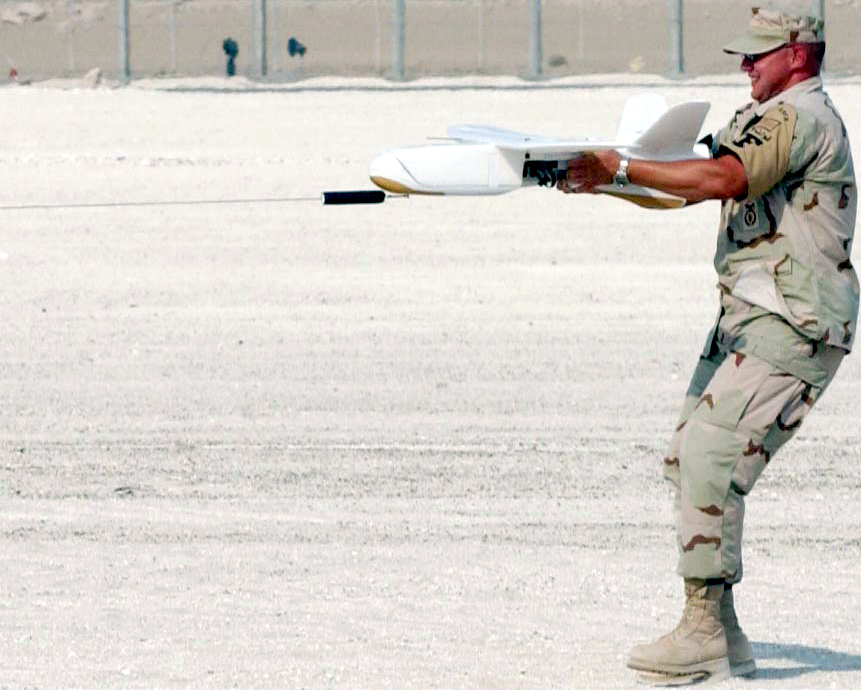
The airframe is made mostly of plastic foam, resembling hobby-grade model airplanes, and is powered by an electric motor driving a pusher propeller, making it very quiet in flight. It is launched using a bungee cord and carries three small CCD cameras. The UAV flies mostly under autonomous control, with the operator monitoring its activity via a laptop computer.
In 2007, the U.S. Air Force FPASS office switched all of its UAV systems over to the RQ-11B Raven. The Desert Hawk has also been used by the 32nd Regiment Royal Artillery of the British Army as a tactical surveillance system, and has seen service in Afghanistan and Mali. It has since been replaced by the more capable and rugged Desert Hawk III.
More in Unmanned Aerial Vehicles by Country
Sources
Compiled from Wikipedia and the sources listed below. Text from Wikipedia is available under CC BY-SA 4.0; this entry is adapted from it.
- Wikipedia: Lockheed Martin Desert Hawk (CC BY-SA 4.0).
Spotted an error? Know more?
Reader corrections go straight into our review queue. Suggest an edit · How this site is sourced