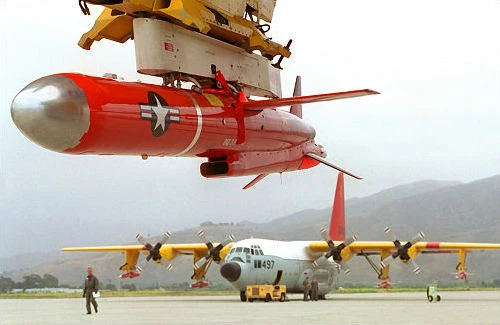
Lockheed Aequare
Air-launched UAV developed for target designation in high-threat environments.
Last updated
The Lockheed Aequare, whose name comes from the Latin word for "to equalize," was an unmanned aerial vehicle built by the Lockheed Missiles and Space Company for the U.S. Air Force. Designed to be launched from an F-4 Phantom II fighter-bomber, it carried a remote sensor package and a laser designator to assist the aircraft that released it. The system underwent testing in the mid-1970s but was never put into active service.
Development began in 1973 when the Defense Advanced Research Projects Agency awarded Lockheed a contract to create an expendable, miniature, air-launched remotely piloted vehicle (later called an unmanned aerial vehicle) for the Air Force. Its purpose was to locate and mark targets for strike planes in dangerous environments. The aircraft, built under subcontract by Windecker Industries, had a folding 7-foot wing and a pusher ducted fan powered by a McCulloch MC-101 engine. It was meant to be released from an SUU-42 flare dispenser, which would be dropped from an F-4 Phantom II at about 24,000 feet and descend by parachute.
Once the main parachute deployed, the Aequare would separate, start its engine, and fly under radio command from a ground station. Imagery and telemetry were sent through a datalink, with the launching F-4 acting as a relay using the CTU-2 datalink pod. The vehicle carried cameras for reconnaissance and a laser designator so the launching F-4 or other aircraft could attack targets it identified.
Operational history
The Aequare first flew in mid-1975, and between 15 and 20 prototypes were built. After flight trials ended in March 1976, no production followed. A later variant, called SAVIOR (Small Aerial Vehicle for Observation, Intelligence, and Reconnaissance), was jointly developed by Lockheed and Windecker. It combined the Aequare’s fuselage and engine with a new fixed wing and landing gear, and was used to study autopilot design and launch-and-recovery techniques for unmanned aerial vehicles.
More in Unmanned Aerial Vehicles by Country
Sources
Compiled from Wikipedia and the sources listed below. Text from Wikipedia is available under CC BY-SA 4.0; this entry is adapted from it.
- Wikipedia: Lockheed Aequare (CC BY-SA 4.0).
Spotted an error? Know more?
Reader corrections go straight into our review queue. Suggest an edit · How this site is sourced