
James L. Kraft
Canadian-American entrepreneur who patented processed cheese and founded Kraft Foods.

Unknown author · Public domain
James Lewis Kraft was a Canadian-American entrepreneur and inventor who founded the company that became Kraft Foods Inc., a major multinational food and beverage conglomerate. He is best known for developing a patented process for emulsifying and sterilizing cheese that allowed it to be shipped long distances without refrigeration, making him one of the first to patent a processed cheese.
Quick Facts
- Birth Name
- James Lewis Kraft
- Birth Date
- 1874-12-11
- Birth Place
- Stevensville, Ontario, Canada
- Death Date
- 1953-02-16
- Death Place
- Chicago, Illinois, US
- Resting Place
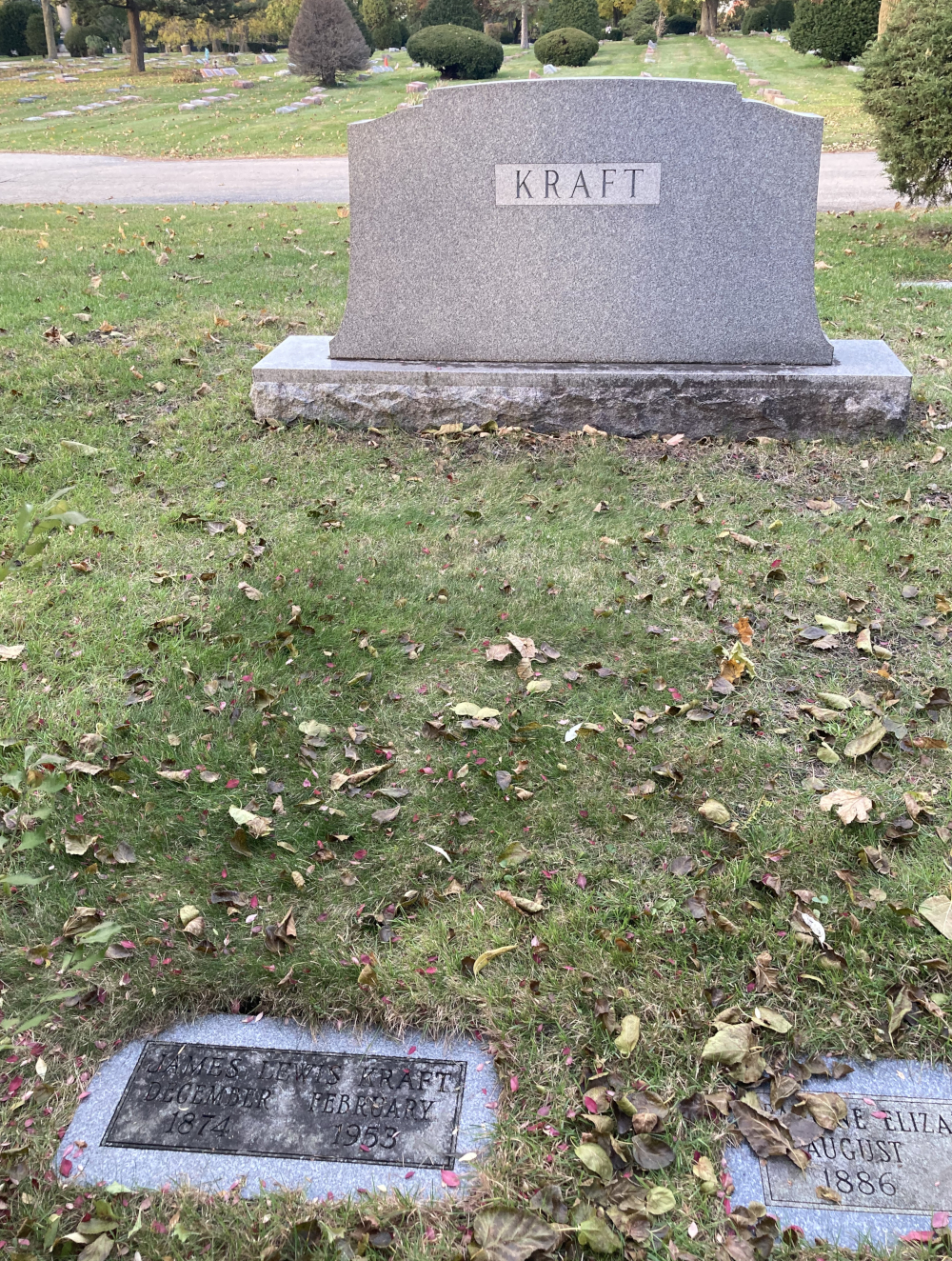
- Memorial Park Cemetery, Skokie, Illinois, US
- Known For
- Kraft Foods Inc
- Spouse
- Pauline Kraft
- Children
- 1
Facts from the source article.
Lore & Background
J. L. Kraft was born on December 11, 1874, near Stevensville, Ontario, to Mennonite parents. He immigrated to Buffalo, New York, in 1902 and worked as secretary and treasurer of the Shefford Cheese Company. After his partners dissolved their agreement while he was on a business trip to Chicago, Kraft used his remaining $65 to rent a horse and wagon and began buying cheese wholesale to sell to local grocers. In 1903 he established J.L. Kraft & Bros. Company, which later became Kraft Foods Inc.
In 1914 the company opened its first cheese manufacturing plant in Stockton, Illinois. Kraft developed and patented an emulsifying and sterilizing process for cheese in 1916 that prevented spoilage and enabled long-distance shipping. During World War I, the U.S. government provided cheese in tins to its armed forces, greatly increasing Kraft's business. He served as the company's president from 1909 until his death in 1953.
Kraft was also an amateur jewelry maker who collected unpolished jade, shaped and polished it into rings, and gave them as awards to outstanding employees. He wrote a book titled Adventure in Jade and was an avid jade collector, though he did not own jade mines. He was deeply involved in the North Shore Baptist Church in Chicago and was a strong proponent of religious education for young people.
Reader's Guide
James L. Kraft's significance lies in his transformation of cheese from a perishable local product into a shelf-stable, mass-distributed commodity. His 1916 patent for pasteurizing cheese without requiring refrigeration revolutionized the dairy industry, allowing cheese to be shipped across long distances and stored for extended periods. This innovation helped establish Kraft Foods as one of North America's leading food producers. The company introduced iconic products such as Miracle Whip in 1933 at the Century of Progress World's Fair. Kraft's business acumen and marketing techniques drove the company's growth, and his legacy continues through the multinational food conglomerate that succeeded his original firm. His personal interests—jade jewelry making, religious involvement, and a summer estate called Kraftwood in Wisconsin—illustrate a multifaceted life beyond business. The Kraft family farm in Stevensville, Ontario, still exists, and his birthplace was designated under the Ontario Heritage Act in 2003.
Did You Know?
- Kraft's birth name was James Lewis Kraft with one f, and he never changed the spelling.
- He used his remaining $65 to rent a horse and wagon to start his cheese distribution business after his partners dissolved their agreement.
- Kraft was an avid jade collector and wrote a book on jewelry called Adventure in Jade, but he did not own jade mines.
- He built a summer estate called Kraftwood along Lake Mashkinosiew in Wisconsin, where he hosted the president of the Orange Crush company.
The Farm Boy Who Dismantled Time
Born in a farmhouse in Greenfield Township, Michigan, on July 30, 1863, the young Henry was the son of an Irish-born father and a mother of Belgian heritage who had been raised by neighbors after losing her own parents. He finished only eighth grade at a one-room school and never attended high school. Two events in 1875 shaped his path: receiving a pocket watch from his father and watching a Nichols and Shepard road engine, which he remembered as the first self-propelled vehicle he had ever encountered. By fifteen, he had built a local reputation for disassembling and reassembling neighbors' timepieces dozens of times. His mother's death in 1876 devastated him; he later wrote that his attachment to the farm was really a love for her. In 1879, at sixteen, he left for Detroit to apprentice as a machinist, working first at James F. Flower & Brothers and later at the Detroit Dry Dock Company. Returning to Dearborn in 1882, he became skilled with the Westinghouse portable steam engine and began building in his workshop—a steam wagon, a four-cycle engine in 1887, and by 1892 a two-cylinder motor car with bicycle wheels and a three-gallon fuel tank. Over the following years he drove that machine roughly a thousand miles, then went on to construct three more in his home shop.
From Edison's Shop to the Model T
In 1891, Ford took a position as an engineer at the Edison Illuminating Company in Detroit, and his promotion to Chief Engineer in 1893 gave him the financial stability and free time to pursue his gasoline-engine experiments full-time. That work culminated in 1896 with the Ford Quadricycle, a self-propelled automobile he test-drove on June 4 of that year. At a meeting of Edison executives that same year, he met Thomas Edison, who endorsed his experimentation and encouraged him to keep building. After earlier business ventures failed, Ford finally incorporated the Ford Motor Company in 1903. The 1908 launch of the Model T is widely credited with transforming both personal transportation and American manufacturing. In 1911 he received a patent for the transmission mechanism used in the Model T and other cars. As sole owner of the company, he became one of the wealthiest individuals on earth, and the production philosophy he pioneered—later called Fordism—made automobile ownership accessible to middle-class families for the first time.
A Vision of Consumer Peace
Ford's business philosophy extended well beyond the assembly line. He was among the first major industrialists to adopt a five-day work-week, and he genuinely believed that widespread consumerism could serve as a force for global peace. His relentless drive to reduce costs produced a cascade of innovations: a franchise dealership system that spread car sales across North America and into major cities on six continents, along with numerous technical improvements in manufacturing. His personal life reflected a quieter rhythm; he married Clara Jane Bryant on April 11, 1888, and for a time supported them both through farming and operating a sawmill. They had one son, Edsel, born in 1893. Even as an adult, Ford retained a streak of old-fashioned devotion—he walked four miles to his Episcopal church every Sunday at the age of twenty. His marriage and the modest sawmill years underscore that the man who would reshape global industry once made his living with an axe and a plow.
Pacifist, Propagandist, and Reluctant Heir
Ford's later years were marked by sharp contradictions. During the early years of World War I he espoused pacifism, yet his company simultaneously became a major supplier of weapons. He championed the League of Nations, yet in the 1920s he used his newspaper The Dearborn Independent and the book The International Jew to promote antisemitic rhetoric. When World War II loomed, he opposed American entry and served on the board of the America First Committee. The death of his son Edsel in 1943 forced Ford back into the company, but his frailty left him unable to make decisions, and he quickly fell under the influence of subordinates. In 1945 he handed control to his grandson, Henry Ford II. He died on April 7, 1947, leaving the bulk of his fortune to the Ford Foundation and the company's governance to his family. The man who had once walked four miles to church now presided over an empire of steel and oil, his legacy inseparable from both his generosity and his bigotry.
Gallery
Frequently Asked Questions
Who is James L. Kraft?
James Lewis Kraft was a Canadian-American entrepreneur and inventor who built the business that eventually grew into Kraft Foods Inc., one of the largest food and beverage conglomerates in the world. He is widely remembered as the pioneer behind commercially processed cheese.
What is James L. Kraft most famous for?
He is best known for patenting a method of emulsifying and sterilizing cheese, which made it the first practical processed cheese product. This breakthrough let the product travel long distances without needing refrigeration, fundamentally changing how cheese was distributed.
What exactly did Kraft patent regarding cheese?
Kraft developed a patented process that combined emulsification with sterilization, transforming fresh cheese into a shelf-stable, uniform product. He is recognized as one of the earliest inventors to secure a patent for this type of processed cheese.
Why was Kraft's cheese process a big deal in the early 20th century?
Before his invention, cheese was highly perishable and difficult to transport over long distances, limiting its market reach. By making cheese stable without refrigeration, Kraft opened up national and eventually global distribution channels for the product.
What company did James L. Kraft found?
He founded the enterprise that evolved into Kraft Foods Inc., a multinational food and beverage company. The business grew from his original cheese-processing operation into a major global conglomerate spanning many product categories.
More in Tycoons And Industrialists 1-20
Spotted an error? Know more?
Reader corrections go straight into our review queue. Suggest an edit · How this site is sourced