
James Gamble (industrialist)
Irish-American co-founder of Procter & Gamble.

Kepper66 · CC BY-SA 3.0
James Gamble (3 April 1803 – 29 April 1891) was an Irish-American soap industrialist who co-founded the Procter & Gamble Company in 1837 with his brother-in-law, English candlemaker William Procter. Born in Ireland and emigrating to the United States as a teenager, Gamble established himself as a soap maker in Cincinnati, Ohio, before partnering with Procter to create one of the most enduring consumer goods companies in American history.
Quick Facts
- Birth Date
- 3 April 1803
- Birth Place
- Enniskillen, Ireland
- Death Date
- 29 April 1891 · 1803 · 4 · 3
- Death Place
- Cincinnati, Ohio, US
- Occupation
- Soapmaker, industrialist / co-founder of Procter & Gamble
- Relatives
- William Procter (brother-in-law)
Facts from the source article.
Lore & Background
James Gamble was born on 3 April 1803 at the Graan near Enniskillen in County Fermanagh, Ireland, and attended Portora Royal School. His father, George Gamble, a Methodist minister, decided with his family to escape the depression in Ireland, emigrating to the United States in 1819. The Gambles arrived in Cincinnati, Ohio, on a flat boat down the Ohio River destined for Illinois, but stopped in Cincinnati when James was seized with an illness. Staying in the city, his father established a nursery, and Gamble apprenticed as a soap maker. Cincinnati was then a major pig-butchering center, producing large amounts of pig fat used for making candles and soap. He attended Kenyon College and manufactured soap on his own in 1828.
Gamble went into business with William Procter after they became related by marriage. Gamble's wife Elizabeth Ann Norris was the sister of Procter's wife Olivia Norris. The pair's father-in-law, Alexander Norris, first suggested that the two go into business together in 1837, and consequently Procter & Gamble was born. Within 20 years, the company had a $1-million turnover and secured a contract to supply soap for the Union Army.
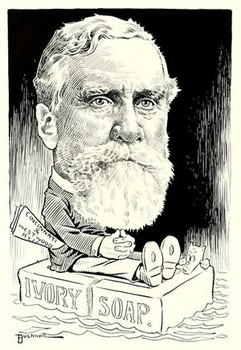
Gamble died at his residence in Cincinnati on 29 April 1891 from natural causes and is interred in Spring Grove Cemetery. Procter, who preceded Gamble in death, is also buried there. Gamble and his wife Elizabeth had ten children, including James Norris Gamble, who became Vice President of Procter & Gamble and devised the formula for Ivory soap, and David Gamble, who built the Gamble House in Pasadena, California. As one of Cincinnati's biggest proponents of Methodism, Gamble was a prominent member of Westwood Methodist Church and donated money to construct Methodist churches throughout Greater Cincinnati.
Reader's Guide
James Gamble's significance lies in his role as co-founder of Procter & Gamble, a company that grew from a small soap and candle partnership into a global consumer goods giant. His partnership with William Procter, suggested by their father-in-law, capitalized on Cincinnati's abundant pig fat supply from the meatpacking industry. The company's early success, reaching a $1-million turnover within 20 years and securing a Union Army contract during the American Civil War, established a foundation for long-term growth. Gamble's legacy is also carried by his son James Norris Gamble, who invented Ivory soap, and his son David, whose Gamble House became an architectural landmark. His Methodist faith influenced his philanthropy, funding church construction in Greater Cincinnati. The company he co-founded remains a major force in household products, making Gamble a key figure in American industrial history.
Did You Know?
- James Gamble emigrated from Ireland to the United States in 1819 with his family, settling in Cincinnati after he fell ill during the journey.
- Gamble's son James Norris Gamble devised the formula for Ivory soap and served as Vice President of Procter & Gamble.
- Gamble's grandson William married Franzeska Wilhelmina Nast, the first woman to graduate from German Wallace College in Berea, Ohio.
A Banking Dynasty and a Restless Youth
Born in Paris in 1933, James Goldsmith descended from the Goldschmidt family, Frankfurt-based Jewish bankers active in international finance since the sixteenth century and long-standing rivals of the Rothschilds. His great-grandfather had founded the B. H. Goldschmidt bank, and his grandfather, a multi-millionaire, relocated the family to London in 1895. By James's birth, his father Frank had Anglicised the surname, built a luxury-hotel empire, and served as a Conservative MP. The Paris life ended abruptly in 1940. Fleeing the Nazi invasion, the family escaped on the last overloaded ship out of France, abandoning their hotels and most possessions. They resettled in the Bahamas, and young James attended St. Andrew's College in Canada, where he ran a small enterprise trapping rabbits, skunks, and mink. Back in England he passed through Millfield and Eton before quitting at sixteen in 1949, after a ten-pound three-horse accumulator at Lewes racecourse netted him eight thousand pounds. He declared to his boarding house that someone of his financial standing had no business still being a schoolboy. He then took over his brother Teddy's Paris firm selling a rheumatism remedy and electrical fittings, and later completed National Service as a Gunner in the Royal Artillery, earning an officer's commission.
The Food-Industry Raider
Throughout the 1950s and 1960s, Goldsmith built a reputation as a high-stakes operator in food and retail, repeatedly flirting with bankruptcy. He secured the British franchise for Alka-Seltzer, introduced generic prescription drugs to the UK market, and co-founded Mothercare with Selim Zilkha before selling his stake. His boldest move came in 1965, when, backed by Sir Isaac Wolfson, he acquired Cavenham Foods, a group with twenty-seven million pounds in turnover but negligible profits. He added bakeries, confectioners, and small retail chains, then rationalised operations and closed inefficient plants. By 1971, profits had reached two million pounds. In June of that year he launched a fiercely contested bid for Bovril, a far larger conglomerate owning Marmite, Ambrosia, and Jaffajuice, plus dairies and Argentine cattle ranches. The founding family resisted, and the financial press attacked him relentlessly. Beechams and Rowntree Mackintosh considered rival offers but withdrew. After winning, Goldsmith sold the dairies and ranches, recouping nearly the entire thirteen-million-pound cost, and later sold the brand names to Beecham for thirty-six million. He also acquired Allied Distributors, which included the Lipton shops. As scrutiny intensified, he began routing transactions through private companies registered in France, Hong Kong, and the Cayman Islands.
Eurosceptic Politics and the Referendum Party
Goldsmith's foray into formal politics arrived in 1994, when he was elected to represent a French constituency as a Member of the European Parliament. His political identity was inseparable from his Euroscepticism. In the United Kingdom, he founded the short-lived Referendum Party, which became one of the earliest organised campaigns arguing for Britain to leave the European Union. The party's brief existence reflected Goldsmith's broader pattern of deploying his considerable wealth and public profile to push causes that challenged the political establishment. As a French-British financier with deep roots in both countries, he occupied a unique position to frame the European question in terms that resonated with voters on both sides of the Channel. His political activity, though brief, positioned him as an early voice in what would become a dominant strand of British politics in the decades that followed.
A Man at War with the Press
Few figures in British business history provoked as much sustained hostility from the media as Goldsmith. The tabloid press consistently labelled him a predator who greenmailed companies and stripped their assets, characterisations he denied with vigour. He maintained that his interventions made companies leaner, ousted lazy management, and boosted returns for shareholders. The financial press was equally combative, particularly during the Bovril bid, where he was attacked relentlessly. As journalists grew increasingly sceptical of his methods in dealing with the assets of publicly quoted companies, Goldsmith shifted his operations into private vehicles registered in France, Hong Kong, and the Cayman Islands, a move that only deepened suspicions. His career was punctuated by ongoing clashes with the British press, frequently escalating into litigation or the credible threat of it. This perpetual adversarial relationship with the media shaped the public perception of a man who saw himself as an efficient moderniser but was widely regarded as a predatory opportunist.
Gallery

Frequently Asked Questions
Who is James Gamble (industrialist)?
James Gamble was an Irish-American soap manufacturer born in 1803 in County Fermanagh, Ireland. He is best remembered as the co-founder of the Procter & Gamble Company, which he launched in 1837 together with his brother-in-law William Procter.
How did James Gamble co-found Procter & Gamble?
After building his own soap-making trade in Cincinnati, Ohio, Gamble merged his operation with that of English candlemaker William Procter, who was married to Gamble's sister. The 1837 partnership combined their complementary product lines into a single firm that would go on to become a cornerstone of American consumer goods.
What was James Gamble's background before founding P&G?
Gamble was born in the small village of Graan near Enniskillen, Ireland, and crossed the Atlantic as a teenager. He settled in Cincinnati, where he honed his craft as a soap maker and established a local reputation before entering the Procter partnership.
Why is James Gamble important in industrial history?
By joining forces with Procter, Gamble helped create a company that has operated continuously for nearly two hundred years, making it one of the most durable commercial enterprises in U.S. history. His decision to pool a soap business with a candle business demonstrated an early model of diversified consumer-brand manufacturing.
When and where did James Gamble die?
James Gamble died on 29 April 1891 in Cincinnati, Ohio, at the age of eighty-eight. He outlived the early years of the firm he co-founded and saw it grow far beyond the small soap-and-candle shop it originally was.
More in Tycoons And Industrialists 1-20
Spotted an error? Know more?
Reader corrections go straight into our review queue. Suggest an edit · How this site is sourced