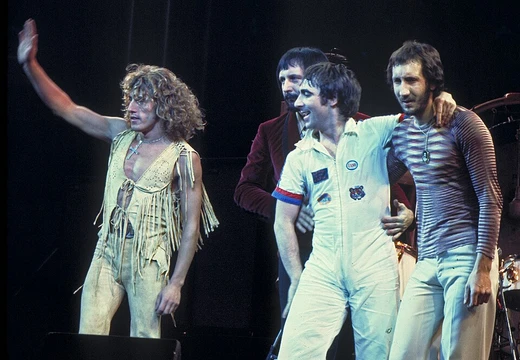
Who's Greatest Hits
Four men, a wall of sound, and every hook that made a nation sing along.

via Wikipedia: Who's Greatest Hits · Fair use
Who's Greatest Hits is a compilation album collecting The Who's most celebrated singles and standout tracks across their recording career. It serves as a definitive introduction to the band for new listeners and a nostalgic touchstone for fans who lived through the Mod era, the rock-opera period, and the stadium-rock era.
While The Who's full discography spans concept albums and extended suites, a greatest-hits collection distils their identity into a handful of explosive, anthemic moments—the power chords, the shouted hooks, the drum fills that defined a generation of British rock.
Quick Facts
- Artist
- the Who
- Released
- May 1983
- Length
- 50:47
- Label
- MCA
- Producer
- Glyn Johns
Facts from the source article.
Lore & Background
The Who emerged from the London Mod scene of the early 1960s, building a reputation for ferocious live shows in which they would destroy their instruments on stage. That theatrical destruction became as much a part of their identity as the music itself. Their early singles—raw, driving, and drenched in feedback—announced a band that cared less about polish than about sheer kinetic energy, and that energy carried them through the British Invasion and into the American consciousness.
By the late 1960s, Pete Townshend's ambition had outgrown the three-minute single format. The rock operas Tommy and later Quadrophenia redefined what a rock record could be, yet the band never abandoned the punchy, hook-driven song. A greatest-hits collection captures that duality: the stadium-shaking epics alongside the tight, three-minute bursts of pure rock 'n' roll that made dance floors erupt.
Keith Moon's untimely death in 1978 and John Entwistle's passing in 2002 cast long shadows over the band's later years, but the recordings on a compilation like this one remain frozen in the peak of their four-man synergy—Daltrey's bellows of a voice, Townshend's windmill strum, Entwistle's thunderous bass lines, and Moon's chaotic, thunderous drumming all locked in a single, incandescent moment.
Reader's Guide
Who's Greatest Hits is a compilation drawing from The Who's peak recording years, spanning their mid-1960s Mod-era singles through the 1970s. The sonic identity is unmistakable: Townshend's jagged, feedback-laden guitar work, Daltrey's raw baritone, Entwistle's muscular bass, and Moon's explosive, almost percussive drumming. What sets the collection apart is the range—tightly wound three-minute rockers sit beside the sweeping, multi-part suites that made the band a progressive-rock landmark.
Standout tracks that anchor the collection include: "My Generation," the defiant anthem that became the band's signature; "You Really Got Me," a feedback-drenched early single that helped define electric rock; "Baba O'Riley," the synth-and-guitar hybrid that became a global hit; "Won't Get Fooled Again," the thundering closer to their rock opera that remains a stadium staple; and "Pinball Wizard," the narrative centerpiece of Tommy that showcases the band's theatrical storytelling.
Critical reception of Who compilations has generally been warm, praising the sheer energy and the curation of the band's most accessible material. Production notes from the original sessions reveal Townshend's obsessive attention to guitar tone and Moon's tendency to play at volumes that threatened to blow studio monitors. The collection stands as the most efficient gateway into a band whose full catalogue demands hours, yet whose essential impact can be felt in a single, perfect three-minute burst of noise and melody.
Did You Know?
- The Who's early live shows were so destructive that venues began charging them damage fees, and the band eventually built the destruction into a ritual, smashing instruments on stage as a set-ending spectacle.
- Pete Townshend developed his signature 'windmill' guitar strum in part as a way to play rhythm and lead simultaneously while keeping his eyes closed, a habit born from his near-blindness in one eye.
- Keith Moon was known for filling hotel rooms with explosives, setting the lobby on fire, and once allegedly detonating a bathroom in a London hotel—his drumming style mirrored that same chaotic, explosive energy.
- The band's rock opera Tommy was initially met with skepticism by critics who couldn't categorize it, yet it went on to sell millions and influenced countless concept albums that followed.
More in Albums & EPs
Elsewhere in The Who
Spotted an error? Know more?
Reader corrections go straight into our review queue. Suggest an edit · How this site is sourced