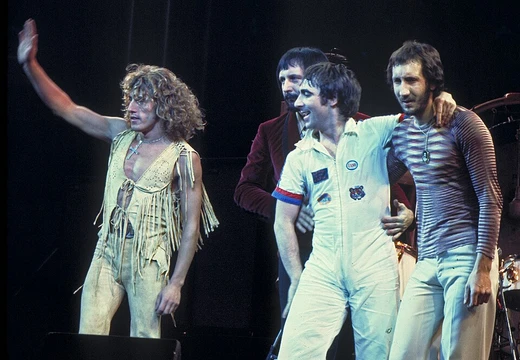
A Quick One
A quick one: infidelity, confession, and forgiveness in a single, euphoric medley.
"A Quick One, While He's Away" is the sprawling, euphoric medley that anchors The Who's 1966 album A Quick One. Composed by Pete Townshend and produced by Shel Talmy, it stitches together several shorter movements—"Do You Think It's Alright?", "I'm Free", "I Can See the Light", and "Go, Go, Go"—into a single continuous journey. In the narrative, the medley tells a story of a woman who cheats on her absent lover, only to confess and be forgiven; it is not connected to Tommy. As the longest sequence on the album, it functions as a dramatic turning point in the song cycle, blending operatic ambition with raw rock energy. For fans, it remains one of The Who's most joyous and physically infectious stretches of music, a wall of driving guitars, handclaps, and shouted exhortations that transforms a simple tale into a collective, cathartic experience.
Quick Facts
- Artist
- the Who
- Released
- 9 December 1966
- Recorded
- 30 August – November 1966
- Studio
- IBC, Regent and Pye (all London)
- Genre
- Rock
- Label
- Reaction (UK); Decca (US)
- Producer
- Kit Lambert
Facts from the source article.
Lore & Background
In the world of A Quick One, the medley unfolds as a mini-opera about a woman whose lover has been away for a year. She is seduced by a traveling salesman (Ivor the Engine Driver) and, upon her lover's return, confesses her infidelity. The medley opens with the tentative, almost pleading question of "Do You Think It's Alright?", as the woman's friends wonder if she can handle the situation. Then the floor drops, the bass kicks in, and the story progresses through "I Can See the Light" and "Go, Go, Go"—a call to action, a release, a resolution. The entire sequence operates as a single emotional arc: hesitation, confession, transcendence, and explosive release. Musically, Townshend built the medley as a contrast machine. The quiet, fingerpicked passages sit directly against the four-on-the-floor drive of the dance tracks, and the vocal delivery shifts from whispered uncertainty to shouted, almost manic joy. It is the album's emotional peak not because it is the loudest or most complex, but because it is the most felt—the moment the mini-opera stops telling you about the characters and lets you feel what it is to be alive in a room full of other people moving to the same beat.
Reader's Guide
Think of "A Quick One" as a four-act miniature opera compressed into roughly six minutes. Act one is the threshold: a quiet, almost conversational guitar figure and a half-asked question, as if the band is checking whether the audience is ready to step into the room. Act two is the drop—"I'm Free"—where the production turns percussive and relentless, handclaps and off-beat guitar locks creating a groove that feels like it was built for a mosh pit before mosh pits had a name. Act three, "I Can See the Light", strips the arrangement back to shimmering arpeggios and a vocal that hovers between a hymn and a lullaby. It is the emotional core: the moment the character stops resisting and starts receiving. The production here is more spacious, more reverbed, as if the disco has become a cathedral for one verse. Act four is pure kinetic release. "Go, Go, Go" stacks the guitars, doubles the tempo feel, and pushes the vocal into a shouted, almost barking register. The medley ends not with a fade but with a hard stop, as if the lights just snapped off and the band walked out. Within Tommy, this sequence is the hinge. Everything before it is diagnosis and isolation; everything after it is consequence and escalation. Sonically, it sits between the sparse, almost chamber-music intimacy of "I'm Sorry" and the operatic bombast of "Pinball Wizard," serving as the album's emotional and rhythmic fulcrum. It is the track that proves a rock opera can make you want to dance before it makes you want to weep.
Track listing
Side one
| No. | Title | Writer(s) | Length |
|---|---|---|---|
| 1 | Run Run Run | Pete Townshend | |
| 2 | Boris the Spider | John Entwistle | 2:28 |
| 3 | I Need You | Keith Moon | 2:24 |
| 4 | Whiskey Man | John Entwistle | 2:57 |
| 5 | Heat Wave | Brian Holland, Lamont Dozier, Edward Holland | 1:54 |
| 6 | Cobwebs and Strange | Keith Moon | 2:29 |
| Total length | 14:54 | ||
Side two
| No. | Title | Writer(s) | Length |
|---|---|---|---|
| 1 | Don't Look Away | Pete Townshend | 2:51 |
| 2 | See My Way | Roger Daltrey | 1:52 |
| 3 | So Sad About Us | Pete Townshend | 3:01 |
| 4 | A Quick One, While He's Away" / I. "Her Man's Been Gone" (0:23) / II. "Crying Town" (1:37) / III. "We Have a Remedy" (1:32) / IV. "Ivor the Engine Driver" (1:42) / V. "Soon Be Home" (1:26) / VI. "You Are Forgiven (2:30) | Pete Townshend | 9:10 |
| Total length | 16:54 | ||
Side one
| No. | Title | Length |
|---|---|---|
| 1 | Run Run Run | 2:44 |
| 2 | Boris the Spider | 2:30 |
| 3 | I Need You | 2:25 |
| 4 | Whiskey Man | 2:57 |
| 5 | Cobwebs and Strange | 2:31 |
| 6 | Happy Jack | 2:11 |
| Total length | 15:18 | |
Track listing from the source article.
Did You Know?
- The medley was inspired by Pete Townshend's desire to create a mini-opera, predating Tommy by three years.
- The medley's title track, 'A Quick One, While He's Away,' is often cited as a precursor to the rock opera format, with its multi-movement structure and narrative arc.
More in Albums & EPs
Elsewhere in The Who
Spotted an error? Know more?
Reader corrections go straight into our review queue. Suggest an edit · How this site is sourced