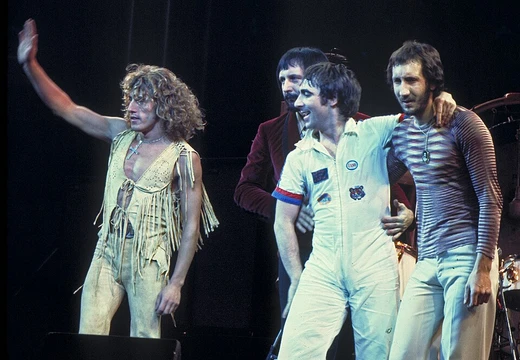
Quadrophenia
A mod's desperate search for self, echoed twice until the echo swallows the man.
Quadrophenia is The Who's landmark 1973 rock opera, a double-sided concept album that follows the fractured inner life of Jimmy Caulfield, a young mod navigating the streets of 1964 England. Written almost entirely by Pete Townshend and self-produced by the band, it stands as the group's most ambitious narrative statement—a sprawling, emotionally raw portrait of a teenager desperate for identity, community, and meaning in a world that keeps slipping through his fingers. The album's structure is deceptively simple: Side One tells Jimmy's story in seven songs, and Side Two replays those same seven as a kind of haunted echo, as if the events are looping in his mind. This mirroring device turns the record into a psychological spiral rather than a linear plot, and it cemented Quadrophenia as a touchstone for the rock-opera form and for the mod subculture it dramatizes.
Quick Facts
- Artist
- the Who
- Released
- 26 October 1973
- Recorded
- May–June 1972; May–September 1973
- Studio
- Olympic
- Ramport and Ronnie Lane's Mobile Studio
- London
- Genre
- Hard rock; art rock
- Length
- 81:42
- Label
- Track (UK); Track/MCA (US)
Facts from the source article.
Lore & Background
The story of Quadrophenia is less a plot in the conventional sense than a psychological dissection. Jimmy Caulfield is a young man in a small English town, drawn into the mod world—its scooters, its sharp suits, its tight-knit camaraderie—because it offers him a template for who he might be. He falls in love, he finds a crew, he embraces the rituals of the subculture. But every attachment he forms feels provisional, every belonging borrowed. The album's central tension is that the more Jimmy tries to pin down an identity, the more it dissolves, and the more the world around him seems to fracture into competing, incompatible selves. Central to the narrative is the figure of the Drowned Girl, a mysterious young woman who drowns and becomes, for Jimmy, a kind of impossible muse and symbol. She represents the unattainable, the beautiful thing that is already gone before you can reach it. Her presence haunts the album's emotional core, and her death becomes the catalyst that pushes Jimmy's already unstable sense of self toward a full psychological break. The mod-versus-rocker rivalry, the scooter rides, the sharp tailoring—all of it is surface. Beneath, the album is about a boy who cannot hold still long enough to become a person. The decision to replay the entire first side on Side Two is the album's most radical structural choice. It suggests that Jimmy's experience is not a story with an ending but a loop he is trapped inside, reliving the same disappointments and small triumphs until the distinctions between memory and present dissolve. The final track, a long, aching ballad, functions as both a farewell and a resignation: the music swells, the character does not resolve, and the listener is left in the same suspended, unresolved space Jimmy occupies.
Reader's Guide
Quadrophenia is a sonic world built on repetition as a psychological tool. Side One moves through Jimmy's day with a driving, mod-inflected energy: the opening numbers pulse with the rhythmic urgency of a Vespa engine, the guitars cutting through in sharp, staccato bursts that evoke the tailored precision of the subculture. The production is dense and layered, with Townshend's guitar work shifting between clean, arpeggiated figures and the band's signature wall-of-sound crashes, while Daltrey's vocal delivery ranges from bright, almost boyish optimism to a raw, cracking desperation. The bass lines are propulsive and melodic, the drumming locked in a steady, almost mechanical groove that mirrors the mod aesthetic of controlled, precise motion. Side Two is where the album becomes something else entirely. The same seven songs return, but the emotional temperature has shifted. The performances feel more urgent, more desperate, as if Jimmy is reliving the events and they are no longer safe. The production leans heavier, the dynamics more extreme, and the reprises carry an undertone of déjà vu that makes the familiar melodies feel haunted. The closing ballad stretches into a long, aching coda where the instrumentation thins to almost nothing, leaving Daltrey's voice exposed and vulnerable, the music dissolving into a kind of beautiful, unresolved silence. It is the album where the band's theatrical ambitions and their rock-and-roll instincts fully merge, and it remains the clearest expression of Townshend's interest in using popular music as a vehicle for psychological storytelling.
Track listing
Side one
| No. | Title | Length |
|---|---|---|
| 1 | I Am the Sea | 2:09 |
| 2 | The Real Me | 3:21 |
| 3 | Quadrophenia | 6:14 |
| 4 | Cut My Hair | 3:45 |
| 5 | The Punk and the Godfather | 5:11 |
| Total length | 20:40 | |
Side two
| No. | Title | Length |
|---|---|---|
| 1 | I'm One | 2:38 |
| 2 | The Dirty Jobs | 4:30 |
| 3 | Helpless Dancer (Roger's theme) | 2:34 |
| 4 | Is It in My Head? | 3:44 |
| 5 | I've Had Enough | 6:15 |
| Total length | 19:41 | |
Side three
| No. | Title | Length |
|---|---|---|
| 1 | 5:15 | 5:01 |
| 2 | Sea and Sand | 5:02 |
| 3 | Drowned | 5:28 |
| 4 | Bell Boy (Keith's theme) | 4:56 |
| Total length | 20:27 | |
Track listing from the source article.
Did You Know?
- The album's structure—Side Two replaying Side One's seven songs—was a deliberate artistic choice to suggest that Jimmy's experience is a psychological loop rather than a linear narrative with a clean ending.
- A full-length film adaptation of the album's story was produced in 1979, bringing the mod world, the scooter rides, and Jimmy's psychological journey to the screen in a visually lavish, cinematic treatment.
More in Albums & EPs
Elsewhere in The Who
Spotted an error? Know more?
Reader corrections go straight into our review queue. Suggest an edit · How this site is sourced