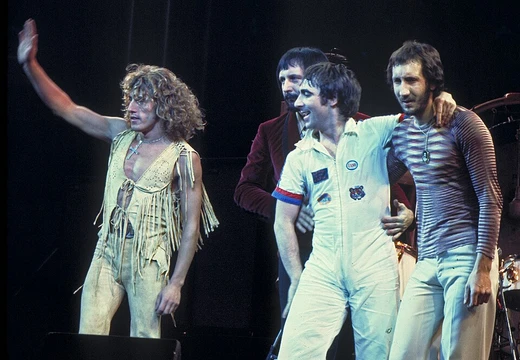
My Generation
A stuttering, feedback-drenched anthem that captured the frustration of a generation and became the Who's signature song.
"My Generation" is a song by the English rock band the Who, written by guitarist and primary songwriter Pete Townshend, from their debut album of the same name (1965). It was released as a single on 29 October 1965, reaching number two in the United Kingdom (tied with 1966's "I'm a Boy" as their highest-charting single in their home country) and number 74 in the United States. The song also appeared in a standard-length performance on their live album Live at Leeds (1970). One of the band's signature songs, "My Generation" was placed number 11 by Rolling Stone on its list of the "500 Greatest Songs of All Time" in 2004 and 2010, re-ranked number 232 in the 2021 edition. It was included in the Rock and Roll Hall of Fame's "500 Songs that Shaped Rock and Roll" and inducted into the Grammy Hall of Fame for being "historical, artistic and significant".
Quick Facts
- Artist
- the Who
- B-side
- "Shout and Shimmy" (UK), "Out in the Street" (US)
- Released
- 29 October 1965 (UK), 20 November 1965 (US)
- Recorded
- 13 October 1965
- Studio
- IBC, London
- Genre
- Rock
- hard rock
- proto-punk
- power pop
- Length
- 3:18
- Label
- Brunswick 05944 (UK); Decca 31877 (US)
Lore & Background
Townshend reportedly wrote the song on a train and is said to have been inspired by the Queen Mother, who is alleged to have had Townshend's 1935 Packard hearse towed off a street in Belgravia because she was offended by the sight of it during her daily drive through the neighbourhood. Townshend has also credited Mose Allison's "Young Man Blues" as the inspiration for the song, saying "Without Mose I wouldn't have written 'My Generation'." The Who re-recorded the song for the Ready Steady Who EP in 1966; ultimately it was not included, and remained unissued until the 1994 box set Thirty Years of Maximum R&B. The main difference between this version and the original is that it is heavily abridged and instead of the hail of feedback which closes the original, the band play a chaotic rendition of Edward Elgar's "Land of Hope and Glory". No official release credits Elgar as co-writer. Townshend told Rolling Stone in 1985 that 'My Generation' was "very much about trying to find a place in society." On a later interview for Good Morning America, in 1989, the band was discussing the upcoming 1989 tour to celebrate the 20th anniversary of Tommy, and Townshend talked about the famous line "I hope I die before I get old." He said that, for him, when he wrote the lyrics, "old" meant "very rich." The song's lyrics comprise a distilled statement of youthful rebellion. The song's melody and composition is considered a forebear to punk rock. One of the most quoted—and patently rewritten—lines in rock history is "I hope I die before I get old," famously sneered by lead singer Roger Daltrey. For the band the song was the basis for an extended medley or improvisation, going on as long as fifteen minutes, as evinced by the version appearing on Live at Leeds. Live recordings from 1969 to 1970 include snippets of music from Tommy as well as parts of what would become "Naked Eye". Townshend's demo version of the song (together with a demo of "Pinball Wizard") appeared on a flexi disc included in the original edition of the book The Who: Maximum R&B by Richard Barnes.
Reader's Guide
The song was released as a single on 29 October 1965, reaching No. 2 in the UK, the Who's highest-charting single in their home country and No. 74 in America. The song has been said by NME to have "encapsulated the angst of being a teenager", and has been characterised as a "nod to the Mod counterculture". NME journalist Larry Bartleet in 2015 rated the Who's recording ten points out of ten. Cash Box described it as a "rollicking, blues-drenched handclapper which sez [sic] that today's kids have more rights than their elders think." Record World said that "The young generation will find that this generates good times." In 2012, Paste ranked the song number six on their list of the 20 greatest The Who songs, and in 2022, Rolling Stone ranked the song number three on their list of the 50 greatest The Who songs. Rolling Stone named the song the eleventh greatest song on its 500 Greatest Songs of All Time list in 2004 and 2011, re-ranked to number 232 in the 2021 edition. In 2009, VH1 named it the thirty-seventh Greatest Hard Rock Song. It is also part of The Rock and Roll Hall of Fame's 500 Songs that Shaped Rock and Roll and is inducted into the Grammy Hall of Fame for "historical, artistic and significant" value. Credits are according to Pete Townshend: Roger Daltrey – lead vocals; Pete Townshend – electric guitar, backing vocals; John Entwistle – bass guitar, backing vocals; Keith Moon – drums.
Did You Know?
- The bass solo was played on a Fender Jazz Bass after Entwistle switched from his Danelectro for a thicker sound.
- The song's progression stays largely in G, with a bridge moving to C, rather than modulating through A and B♭.
More in Songs & Singles
Elsewhere in The Who
Spotted an error? Know more?
Reader corrections go straight into our review queue. Suggest an edit · How this site is sourced