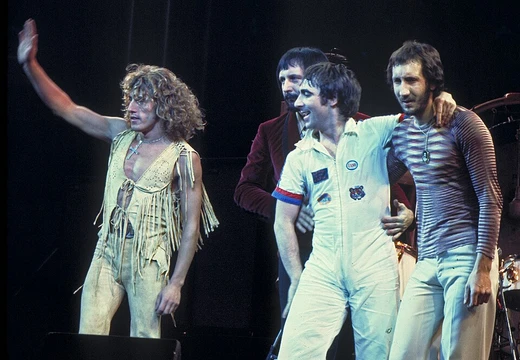
It's Hard
A band still finding its footing after loss, grinding out grit and resolve one chord at a time.
It's Hard is the 1982 studio album by The Who, marking a period of creative recalibration for the band in the wake of Keith Moon's 1978 death. Produced by Muff Winwood, it represents the quartet of Roger Daltrey, Pete Townshend, John Entwistle, and Kenney Jones attempting to reassert their identity after the turbulent late-1970s. While it lacks the mythic scope of their classic-era masterworks, the record carries a raw, working-class urgency that resonates with fans who appreciate the band at their most stripped-down and emotionally direct. In the broader arc of The Who's discography, It's Hard sits between the double-live experiment of Double Trouble and the more ambitious Kick Out the Jams, serving as a bridge between the post-Moon adjustment period and the band's eventual return to form. It is a record of effort, of a group grinding through the machinery of songwriting and recording while still mourning the absence that reshaped their dynamic forever.
Quick Facts
- Artist
- the Who
- Released
- September 1982
- Recorded
- June 1982
- Studio
- Turn Up-Down Studio at Glyn Johns' home in Surrey, England
- Genre
- Rock; hard rock
- Label
- Polydor; Warner Bros.
- Producer
- Glyn Johns
Facts from the source article.
Lore & Background
The creative landscape for It's Hard was shaped by absence. Keith Moon's death in 1978 had upended the band's internal chemistry, and by the time sessions began in 1982, the group had been navigating a new four-piece configuration for nearly four years. Kenney Jones, the former Small Faces drummer, had filled the seat but the shadow of Moon's explosive presence lingered in every take. The songs on this album carry that weight: they are less about spectacle and more about the daily grind of keeping the machine running, of showing up and playing through the grief. Pete Townshend, who had been wrestling with his own creative identity since the Quadrophenia era, channeled much of his energy into the band's broader artistic projects during this stretch. What emerged on It's Hard is a set of songs that feel more like collective workshop output than singular visionary statements. That is not a criticism in itself; it reflects a band choosing solidarity over solo brilliance, and the result has a democratic, almost communal energy that distinguishes it from their earlier, more auteur-driven records. Muff Winwood's production brought a cleaner, more mid-1980s sheen to the mix, smoothing some of the rough edges that characterized earlier Who recordings. For longtime fans, this can feel like a loss of texture, but it also allowed the songs' melodies and hooks to breathe in a way that the denser, multi-tracked productions of the 1970s sometimes obscured. The album is a document of a band in transition, still vital, still fighting, but no longer writing with the same ferocious certainty that defined their golden years.
Reader's Guide
It's Hard is a sonic landscape of mid-tempo determination. Where earlier Who records swung between thunderous rock operas and jagged power-pop, this album settles into a more consistent groove: four-on-the-floor rhythms, driving bass lines, and vocal melodies that lean into Daltrey's lower, more conversational register. The production is cleaner, the mixes more spacious, and the overall effect is of a band playing in a room rather than constructing a cathedral. Thematically, the record orbits the idea of perseverance under pressure. The title track itself is a blunt, insistent anthem about not giving up, and that spirit threads through the lighter, more melodic numbers as well. There is a workmanlike honesty to the songwriting here that contrasts with the more theatrical, concept-driven material of the mid-1970s. It sounds like a band that has stopped performing for the audience and started playing for each other. It is the album you put on when you want The Who to feel like four people in a room, making music because they need to, not because the world demands it.
Track listing
| No. | Title | Writer(s) | Length |
|---|---|---|---|
| 1 | Athena | 3:46 | |
| 2 | It's Your Turn | John Entwistle | 3:39 |
| 3 | Cooks County | 3:46 | |
| 4 | It's Hard | 3:39 | |
| 5 | Dangerous | Entwistle | 3:17 |
| 6 | Eminence Front | 5:37 |
Track listing from the source article.
Did You Know?
- Muff Winwood, known for his work with Traffic and later his own solo career, produced the album, bringing a smoother, more mid-1980s production sensibility to the Who's sound.
- The album was released in the same year as Kick Out the Jams, meaning fans received two Who records in 1982, a rare double-dip in the band's output.
More in Albums & EPs
Elsewhere in The Who
Spotted an error? Know more?
Reader corrections go straight into our review queue. Suggest an edit · How this site is sourced