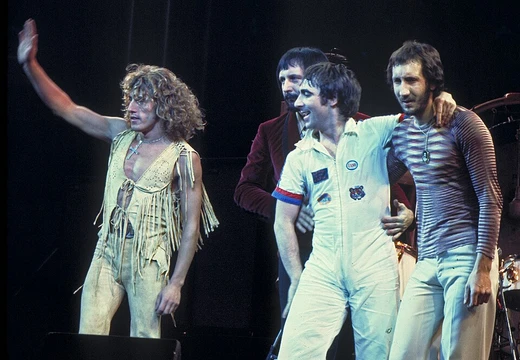
The Who by Numbers
A band of four men trying to subtract the noise and add up to something real.
The Who by Numbers is the fifth studio album by the English rock band The Who, released in early 1975. Marking a significant departure in both sound and production, the record was helmed by producer Kim Fowley and represents the band at a crossroads—post-rock-opera, post-touring exhaustion, and deep into a period of creative reinvention. It is the album that delivered their most iconic single, "Baba O'Riley," and a suite of songs interrogating technology, consumer culture, and the cold arithmetic of modern life. In the broader arc of The Who's discography, the album sits between the theatrical sprawl of their rock operas and the raw, stripped-down energy of their late-70s and 80s work. It is a record that sounds simultaneously futuristic and weary, polished and searching, and it remains a touchstone for fans who hear the band questioning whether the very concept of "The Who" still holds meaning in an age of numbers and noise.
Quick Facts
- Artist
- the Who
- Released
- 3 October 1975
- Recorded
- April – 12 June 1975
- Studio
- Shepperton Studios' soundstage (Shepperton, Surrey, England) using Ronnie Lane's Mobile Studio
- Genre
- Rock, country rock
- Label
- Polydor (UK); MCA (US)
- Producer
- Glyn Johns
Facts from the source article.
Lore & Background
By the time The Who entered the studio in 1974 to record what would become The Who by Numbers, the band had already dismantled the grand narrative architecture of their rock operas. The Tommy era was behind them, the quadraphonic experiments of The Who Sell Out had alienated some fans, and the members were navigating a very different cultural moment—one saturated with early digital culture, corporate branding, and a creeping sense that human identity was being reduced to data points. The album's very title is a wry nod to The Who by Design, as if to say: we designed it, but now we're just counting what's left. Working with producer Kim Fowley, a figure known for his eccentric, genre-bending sensibilities, the band leaned into a sleeker, more synth-tinged sound while retaining the thunderous drumming of Keith Moon and the angular guitar work of Pete Townshend. The result is an album that feels like a control room: precise, slightly cold, but with moments of genuine warmth breaking through the panels. Songs like "Go to the Mirror" and "So Sad About Us" channel a profound loneliness, as though the band is looking at their own reflection in a screen and finding it unfamiliar. The album's cultural footprint was cemented by "Baba O'Riley," a track that married a hypnotic, almost mechanical guitar riff with a lyrical meditation on a guru figure and the futility of seeking meaning through authority. It became The Who's most recognizable single and a staple of rock radio, a song that sounds like it was written in 1975 but could have been composed in 2025. For fans, the album endures as the sound of a band at its most introspective, questioning whether the noise they made was ever more than a number in a chart.
Reader's Guide
The Who by Numbers is a control room rendered in sound. Where earlier albums opened like theater curtains, this one boots up like a machine: clean, precise, and humming with low-frequency tension. Kim Fowley's production strips away the orchestral bloat of the mid-70s and replaces it with a lean, almost clinical sheen—drums that snap like circuit boards, bass lines that groove with a detached, almost robotic confidence, and guitar tones that shimmer with a cold, metallic edge. Thematically, the album is a slow walk through a shopping mall at closing time. "Baba O'Riley" is the fluorescent-lit corridor: hypnotic, repetitive, and faintly unsettling. "Go to the Mirror" and "So Sad About Us" are the quiet back rooms where the lights flicker and the music gets genuinely, achingly tender. It is where the band stopped performing a story and started asking whether the story was real. For the listener, it is the sound of four people in a room, counting their fingers, trying to remember what they were counting for.
Track listing
Side one
| No. | Title | Length |
|---|---|---|
| 1 | Slip Kid | 4:29 |
| 2 | However Much I Booze | 5:03 |
| 3 | Squeeze Box | 2:41 |
| 4 | Dreaming from the Waist | 4:08 |
| 5 | Imagine a Man | 4:00 |
| Total length | 20:21 | |
Side two
| No. | Title | Writer(s) | Length |
|---|---|---|---|
| 1 | Success Story | John Entwistle | 3:20 |
| 2 | They Are All in Love | 3:00 | |
| 3 | Blue Red and Grey | 2:47 | |
| 4 | How Many Friends | 4:06 | |
| 5 | In a Hand or a Face | 3:25 | |
| Total length | 16:38 | ||
Track listing from the source article.
Did You Know?
- The album's title is a deliberate play on the band's 1973 record The Who by Design, as if to suggest that after designing their mythology, they were now simply tallying what remained.
- Producer Kim Fowley was a figure far more associated with novelty and genre experimentation than with rock, making his collaboration with The Who one of the more unexpected pairings in the band's history.
More in Albums & EPs
Elsewhere in The Who
Spotted an error? Know more?
Reader corrections go straight into our review queue. Suggest an edit · How this site is sourced