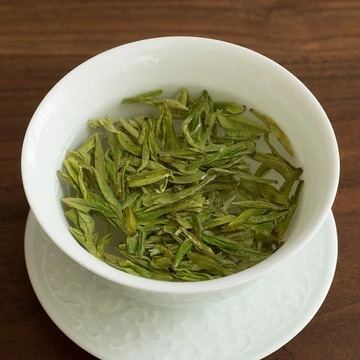
Green tea
Green tea is an unoxidized tea originating in ancient China.

Green tea comes from the leaves and buds of the *Camellia sinensis* plant, but unlike oolong or black teas, it skips the withering and oxidation steps. It first appeared in China around the late 1st millennium BC, and over time, its cultivation and processing spread across East Asia. There are many types of green tea, each shaped by the specific *C. sinensis* variety, where it’s grown, how it’s tended, the processing method used, and when it’s harvested. Drinking green tea might slightly lower blood pressure and boost alertness, but it doesn’t offer proven health benefits. Too much green tea extract, however, can harm the liver, interfere with prescription drugs, and cause stomach upset.
**History** Legend traces tea drinking back to China’s mythical Emperor Shennong. A key historical work is *The Classic of Tea* (茶經), written by Lu Yu between 618 and 907 AD. Another important text, *The Book of Tea* (Kissa Yōjōki), was penned by Zen priest Eisai in 1211; it discusses how green tea affects five vital organs, describes the plant’s shape, flowers, and leaves, and offers guidance on growing and processing the leaves.
**Steeping, Brewing, and Serving** Brewing green tea typically uses about 2 grams of leaves per 100 mL of water (or roughly 1 teaspoon per 150 mL cup). Water temperature ranges from 61°C to 87°C, and steeping time from 30 seconds to three minutes. Lower-quality teas are often steeped hotter and longer, while higher-quality ones are steeped cooler and shorter, usually two to three times. Premium teas like gyokuro call for more leaves and multiple short steeps. Overheating or steeping too long releases excess tannins, making the brew bitter and astringent, no matter the leaf quality. Warming the pot beforehand and adding hot water gradually while drinking also affect the taste.
**Production** In 2013, global green tea production hit about 1.7 million tonnes, with predictions it would double by 2023. By 2015, China supplied 80% of the world’s green tea, with exports rising 9% annually to 325,000 tonnes that year. The US was the top importer of Chinese green tea in 2015, taking in 6,800 tonnes (up 10% from 2014), while Britain imported 1,900 tonnes (a 15% increase).
**Growing, Harvesting, and Processing** How green tea is grown and processed varies by the desired type, which helps retain polyphenols and volatile compounds that influence aroma and flavor. Plants are either sun-grown or shade-grown, pruned into rows to encourage regular shoot growth, and typically harvested three times a year: first flush in late April to early May, second from June to July, and third from late July to early August (sometimes a fourth harvest occurs). Spring’s first flush yields the best leaves and highest prices. After picking, processing can be artisanal (sun-drying, basket or charcoal firing, pan-firing) or modern (oven-drying, tumbling, steaming). The resulting crude tea, called *aracha*, is stored in 30- or 60-kilogram paper bags under low-humidity refrigeration at 0–5°C. It’s not yet refined; a final firing happens before blending, selection, and packaging. This re-firing throughout the year extends shelf life and improves flavor, with first-flush tea from May storing well until the next harvest. After re-drying, the tea is sifted and graded by size, then blended by tasters and packed for sale.
**Import of Radioactive Japanese Tea** On June 17, 2011, at Paris’s Charles de Gaulle airport, French authorities found 1,038 becquerels per kilogram of radioactive cesium in tea leaves from Shizuoka Prefecture, Japan—more than double the EU limit of 500 Bq/kg. France rejected the 162 kilograms of leaves. Shizuoka’s governor, Heita Kawakatsu, argued that steeping the leaves would dilute the radioactivity to about 10 Bq/kg, even if the leaves had 1,000 Bq/kg, a claim backed by local tests. Japanese Minister for Consumer Affairs and Food Safety Renhō noted on June 3, 2011, that *aracha* is sometimes sold as furikake and eaten directly, so inspecting tea leaves, including *aracha*, was important for consumer safety. In 2018, the US Food and Drug Administration updated its import status on Japanese products potentially contaminated by radionuclides.
Lore & Background
Tea consumption has legendary origins in China during the reign of mythological Emperor Shennong.
Reader's Guide
Green tea is processed from Camellia sinensis leaves without withering or oxidation, retaining maximum polyphenols and volatile organic compounds. Its production involves growing conditions (sun or shade), harvesting three times per year (first flush in spring yields best quality), and processing via artisanal methods (sun-drying, basket or charcoal firing, pan-firing) or modern methods (oven-drying, tumbling, steaming). While green tea may slightly lower blood pressure and improve alertness, current scientific evidence does not support most health benefit claims, and excessive intake of green tea extracts can cause liver damage and other side effects.
Did You Know?
- Green tea originated in China in the late 1st millennium BC.
- Excessive intake of green tea extracts can cause liver damage and other side effects.
Frequently Asked Questions
Who is Green tea?
Green tea is an unoxidized infusion prepared from the young leaves and buds of the Camellia sinensis plant. Unlike oolong or black teas, it skips the withering and oxidation steps, which keeps its color, flavor, and antioxidant profile distinctly different.
What are Green tea's powers/role?
Its defining trait is the absence of oxidation, giving it a grassy, delicate taste and a high concentration of catechins. Depending on the cultivar, harvest timing, and processing method, it can range from a light sencha to a roasted gyokuro or a stone-pounded Long Jing.
Where does Green tea come from?
It traces its roots to China in the late first millennium BC, and from there its cultivation spread across East Asia. By the mid-2010s, China alone accounted for roughly 80 percent of the world's green-tea market, with the United States as its second-largest importer.
How does Green tea's story end?
It doesn't—it is still being grown and consumed worldwide, with global output hitting around 1.7 million tonnes in 2013. Its narrative continues through new cultivars, regional styles, and ongoing research into its health benefits.
More in Tea 1-15
Spotted an error? Know more?
This is a living reference — every entry is fact-audited, and reader corrections feed straight into our audit queue. Suggest an edit · See this site's audit record