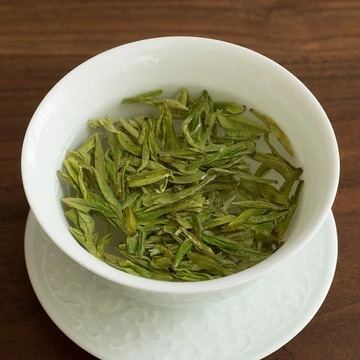
Darjeeling tea
A tea from the Eastern Himalayas with protected geographical indication.

Darjeeling tea comes from the *Camellia sinensis* var. *sinensis* plant, cultivated and processed in West Bengal’s Darjeeling and Kalimpong districts. Since 2004, “Darjeeling tea” has been a registered geographical indication, limited to products from specific estates in those areas. While most of the leaves are made into black tea, some estates now also offer green, white, and oolong varieties.
Leaves are harvested by plucking the top two leaves and the bud, from March through November, a period split into four flushes. The first flush yields the first leaves after winter dormancy, producing a light, floral tea with slight astringency, also suitable for white tea. The second flush comes after leafhoppers and camellia tortrix attack the plant, giving the tea a distinctive muscatel aroma. The monsoon flush, with warm, wet weather, grows leaves quickly but with less flavor, often used for blending. The autumn flush produces teas similar to the second flush but more subdued.
Tea plants first appeared in the Darjeeling region in the mid-1800s. The British, seeking an alternative to Chinese tea, tried growing both the newly discovered *assamica* variety and the *sinensis* variety in several Indian areas. The sloped drainage, cool winters, and cloud cover favored *sinensis*. The British set up many plantations, mostly staffed by Gorkhas and Lepchas from Nepal and Sikkim. After independence, the estates were sold to Indian businesses and regulated under Indian law. The Soviet Union then became the main consumer of Darjeeling tea. As its reputation for quality grew, marketing shifted toward Western Europe, with many estates gaining organic, biodynamic, and fairtrade certifications, while the Tea Board of India pushed for authentication and international promotion.
**History**
*Camellia sinensis* was first planted in the Darjeeling area in 1841 by Archibald Campbell, an East India Company employee working to develop a hill station for British officials in Kolkata. At the time, the British wanted a tea source outside China, having recently discovered a second variety in Assam’s wilderness and smuggled seeds and plants from China. The Chinese variety (*sinensis*) was planted at Saharanpur Botanical Gardens and propagated in other Himalayan gardens, where Campbell got seeds from Kumaun via Nathaniel Wallich. After initial success, Campbell moved to Lebong, where in 1846 he and others planted both *sinensis* and *assamica*. A year after the first three Company experimental tea gardens were planted in 1852—at Tukvar, Steinthal, and Alubari—they reported 2,000 tea plants, and Robert Fortune was sent to assess the hills’ suitability for tea cultivation. Both varieties grew, but *sinensis* thrived because *assamica* preferred warmer, wetter conditions, while *sinensis* had been selectively bred for higher elevations. The first commercial tea gardens appeared in 1856, and by 1866 there were 39, including Makaibari Tea Estate, which built the region’s first processing factory for withering and oxidation—essential for the product to survive the long journey to Kolkata and then Britain. The success of *assamica* in nearby Dooars-Terai gardens spurred infrastructure investments that extended into the Darjeeling Himalayan hill region, bringing more machinery and supplies. Darjeeling’s population grew from under 100 in the 1830s to 95,000 people with 100 tea gardens by 1885, mostly Indian Gorkha and Lepcha migrants from Nepal and Sikkim, aided by the Darjeeling Himalayan Railway, steamships, and the Suez Canal, which cut shipping times.
After nationalizing the East India Company, the British only leased land to tea garden owners on 30-year terms, allowing only 40% for tea crops, 40% left natural, and 20% for housing and facilities. After Indian independence in 1947, the British sold their stakes to Indians, and the 1953 Tea Act placed the industry under the Tea Board of India. More land was opened for tea at the expense of natural areas, and pesticides and fertilizers were introduced, boosting yields from 7.8 to 10 million kilograms between 1950 and 1960, though soil stability suffered. Despite a limited exemption for the tea industry under the 1973 Foreign Exchange Regulations Act, new foreign ownership limits made Indian nationals the majority owners of Darjeeling tea estates. As the Soviet Union replaced the United Kingdom as India’s largest tea customer, Darjeeling gardens added *assamica* plantings to suit Soviet preferences.
Production methods shifted again in the 1990s, when Western Europe and Japan replaced the collapsed Soviet Union as Darjeeling’s main customers, and new garden managers introduced biodynamic agriculture. In 1988, Makaibari became India’s first tea estate to gain organic certification, followed by Tumsong, and later the first to receive biodynamic certification.
- type
- Tea
- origin
- Darjeeling and Kalimpong districts, West Bengal, India
- plant_variety
- Camellia sinensis var. sinensis
- first_planted
- 1841
- geographical_indication
- 2004
- primary_processing
- Black tea (also green, white, oolong)
Lore & Background
Camellia sinensis was first planted in the Darjeeling area in 1841 by Archibald Campbell, who was working for the East India Company. The British were seeking a source of tea outside of China and had both discovered a second variety (assamica) in Assam and smuggled seeds from China. The Chinese variety (sinensis) was planted in Saharanpur Botanical Gardens and propagated in other Himalayan gardens. Campbell acquired seeds from Kumaun via Nathaniel Wallich.
Reader's Guide
The tea is harvested from March to November in four flushes: first flush produces a light floral tea with slight astringency; second flush, after leafhopper and camellia tortrix attack, yields a distinctive muscatel aroma; monsoon flush leaves are less flavorful and used for blending; autumn flush is similar to but more muted than second flush. The tea industry in Darjeeling shifted after Indian independence, with British stakes sold to Indians and the 1953 Tea Act placing it under the Tea Board of India. In the 1990s, as Western Europe and Japan became principal customers, many estates adopted organic, biodynamic, and fairtrade certifications. The Tea Board of India pursues authentication and international promotion of Darjeeling teas.
Did You Know?
- Darjeeling tea was first planted in 1841 by Archibald Campbell of the East India Company.
- The tea leaves are harvested by plucking the top two leaves and the bud from March to November.
- Second flush leaves are harvested after attack by a leafhopper and the camellia tortrix, creating a muscatel aroma.
Frequently Asked Questions
Who is Darjeeling tea?
It is a specialty tea cultivated from Camellia sinensis var. sinensis in the Darjeeling and Kalimpong districts of West Bengal, India, high in the Eastern Himalayas.
What are Darjeeling tea's powers/role?
It is predominantly crafted as a black tea, though select estates also produce green, white, and oolong varieties. Its high-altitude growing environment gives it a distinctive character that sets it apart from other teas.
How does Darjeeling tea's story end?
As of 2004, the name is locked behind a registered geographical indication, so only teas grown on approved estates within those two districts may legally carry the Darjeeling title.
Why is Darjeeling tea important?
First planted back in 1841, it went on to become one of the world's most recognized specialty teas and eventually earned legal protection for its name.
When was Darjeeling tea first introduced?
The earliest tea plants were established in the Darjeeling district in 1841, marking the start of its long production history in the region.
More in Tea 1-15
Spotted an error? Know more?
This is a living reference — every entry is fact-audited, and reader corrections feed straight into our audit queue. Suggest an edit · See this site's audit record