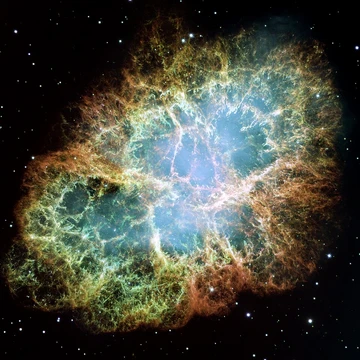
Kepler's Supernova
The last Milky Way supernova seen by the naked eye.
Last updated
Kepler's Supernova (SN 1604) was a Type Ia supernova that occurred in the Milky Way, in the constellation Ophiuchus. It is the most recent supernova in the Milky Way to have been unquestionably observed by the naked eye, appearing in 1604 at a distance no farther than 6 kiloparsecs (20,000 light-years) from Earth. Named for the German astronomer Johannes Kepler, who described it in his work De Stella Nova, it was the second supernova observed in a generation, following SN 1572 seen by Tycho Brahe.
Lore & Background
Visible to the naked eye, Kepler's Star was brighter at its peak than any other star in the night sky, with an apparent magnitude of −2.5. It remained visible during the day for over three weeks.
Records of its sighting exist in European, Chinese, Korean, and Arabic sources. The first recorded observation in Europe was by Lodovico delle Colombe in northern Italy on 9 October 1604. Kepler began his observations on 17 October while working at the imperial court in Prague for Emperor Rudolf II, and tracked the object for an entire year, leading to the supernova being named after him despite not being its first observer.
Astronomers of the time, including Kepler, were concerned with observing a conjunction of Mars, Jupiter, and Saturn, which they saw as linked to the Star of Bethlehem. Cloudy weather prevented Kepler from making observations of the conjunction, though Wilhelm Fabry, Michael Maestlin, and Helisaeus Roeslin observed it on 9 October without recording the supernova. The supernova sparked controversies: Delle Colombe defended an Aristotelian view of cosmology after Galileo Galilei used the supernova to challenge the Aristotelian system, and Kepler criticized Roeslin's astrological prognostications in De Stella Nova.
Reader's Guide
The supernova remnant of SN 1604 was discovered in 1941 at the Mount Wilson Observatory as a dim nebula with a brightness of 19 mag. Only filaments are visible in optical light, but it is a strong radio and X-ray source. Distance estimates place it between 3 and more than 7 kiloparsecs (10,000 to 23,000 light-years), with a consensus distance of about 5 kiloparsecs as of 2021. The available evidence supports a Type Ia supernova: the integrated X-ray spectrum resembles that of Tycho's supernova remnant, the oxygen-to-iron abundance is roughly solar (unlike core-collapse scenarios), no surviving central source has been identified, and historical brightness records are consistent with Type Ia events.
Evidence exists for interaction of the supernova ejecta with circumstellar matter from the progenitor star, which is unexpected for Type Ia but has been observed in some cases. A bow shock to the north is believed to have been created by mass loss prior to the explosion.
Observations are consistent with interaction with a bipolar planetary nebula belonging to one or both progenitor stars. The remnant is not spherically symmetric, likely because the progenitor was a runaway star system. A remnant rich in nitrogen and silicon indicates the system consisted of a white dwarf with an evolved companion that had likely already passed through the asymptotic giant branch stage.
More in Supernova Remnants
Sources
Compiled from Wikipedia and the sources listed below. Text from Wikipedia is available under CC BY-SA 4.0; this entry is adapted from it.
- Wikipedia: Kepler's Supernova (CC BY-SA 4.0).
Spotted an error? Know more?
Reader corrections go straight into our review queue. Suggest an edit · How this site is sourced