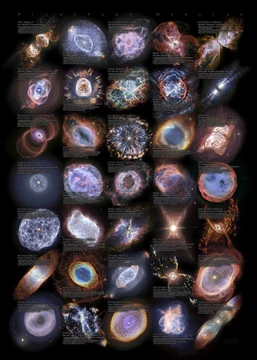
Planetary nebula
Expanding shells of ionized gas from dying intermediate-mass stars.

A planetary nebula is a type of emission nebula consisting of an expanding, glowing shell of ionized gas ejected from red giant stars late in their lives. The term is a misnomer because they are unrelated to planets, originating from the planet-like round shape observed through early telescopes. All planetary nebulae form at the end of the life of a star of intermediate mass, about 1-8 solar masses, and are relatively short-lived phenomena lasting perhaps a few tens of millennia.
- First discovered nebula
- Dumbbell Nebula (M27)
- First observer of dumbbell nebula
- Charles Messier
- Date of first observation
- July 12, 1764
- First spectroscopic observer
- William Huggins
- First nebula spectroscopically observed
- Cat's Eye Nebula
- Date of first spectroscopic observation
- August 29, 1864
- Progenitor star mass range
- 0.8 to 8.0 solar masses
Lore & Background
The first planetary nebula discovered was the Dumbbell Nebula, observed by Charles Messier on July 12, 1764, and listed as M27. Early observers with low-resolution telescopes noted that these objects resembled giant planets like Uranus. In January 1779, Antoine Darquier de Pellepoix described the Ring Nebula as 'very dim but perfectly outlined; it is as large as Jupiter and resembles a fading planet'. William Herschel later described such objects as seeming to be planets 'of the starry kind' and assigned them to Class IV of his catalogue, eventually listing 78 'planetary nebulae', though most are in fact galaxies.
The nature of planetary nebulae remained unknown until spectroscopic observations in the mid-19th century. On August 29, 1864, William Huggins analyzed the spectrum of the Cat's Eye Nebula and found emission lines, including a bright line at 500.7 nanometres that did not correspond to any known element. This was initially attributed to a hypothetical element called 'nebulium', but in the 1920s physicists showed it was due to forbidden lines from oxygen and nitrogen ions in extremely low-density gas. The central stars of planetary nebulae are very hot, and spectroscopic observations show all planetary nebulae are expanding, leading to the understanding that they are a final stage of stellar evolution.
Reader's Guide
Planetary nebulae are significant because they represent a late stage in the life cycle of intermediate-mass stars, including the Sun, which is expected to form a planetary nebula at the end of its life. They play a crucial role in the chemical evolution of the Milky Way by expelling elements into the interstellar medium from stars where those elements were created. Observations of planetary nebulae in more distant galaxies yield useful information about their chemical abundances. Starting in the 1990s, Hubble Space Telescope images revealed that many planetary nebulae have extremely complex and varied morphologies; about one-fifth are roughly spherical, but the majority are not spherically symmetric. The mechanisms producing such a wide variety of shapes are not yet well understood, but binary central stars, stellar winds, and magnetic fields may play a role. Technological improvements, including space telescopes and charge-coupled devices, have allowed more accurate determinations of nebular temperatures, densities, and elemental abundances. Under the Morgan-Keenan spectral classification scheme, planetary nebulae are classified as Type-P, though this notation is seldom used in practice.
Did You Know?
- The term 'planetary nebula' originated from their planet-like round shape observed through early telescopes, first used by William Herschel in the 1780s.
- The bright emission line at 500.7 nanometres in planetary nebula spectra was initially attributed to a hypothetical element called 'nebulium' before being identified as a forbidden line of oxygen.
- About one-fifth of planetary nebulae are roughly spherical, but the majority are not spherically symmetric.
The Misnomer That Stuck
The name "planetary nebula" is, by modern understanding, a complete misnomer—these objects have nothing to do with planets. Yet the label persists in astronomical terminology to this day. The origin traces back to early telescopic observations in the late 18th century, when astronomers saw round, planet-like disks in their instruments. In January 1779, French astronomer Antoine Darquier de Pellepoix noted that the Ring Nebula appeared "as large as Jupiter and resembles a fading planet." A few years later, William Herschel, who had himself discovered Uranus, found the Saturn Nebula and described it as a curious object he could not categorize. He wrote to Jérôme Lalande in 1785 that these bodies had disks of equal brightness, round or slightly oval, well-defined in outline—resembling planets yet far too faint to be one. Herschel ultimately catalogued 78 such objects, though most turned out to be galaxies. The term he adopted became permanently embedded in the field, surviving even as our understanding of these objects grew far beyond a simple planet-like appearance.
A Brief, Brilliant Finale
Planetary nebulae represent the dramatic final act of stars with intermediate masses, roughly between one and eight times the mass of our Sun. At the end of their lives, these red giant stars shed their outer atmospheres, creating an expanding shell of ionized gas that glows brilliantly. Once the envelope has fully dissipated, the exposed core—termed a planetary nebula nucleus—radiates intense ultraviolet light that ionizes the surrounding ejected material. Absorbed ultraviolet photons then excite the nebulous gas, producing the vivid colors visible to observers. What makes this phase remarkable is its brevity: planetary nebulae persist for only a few tens of thousands of years, a fleeting interval compared to the billions of years stars spend in other evolutionary stages. The Sun itself is expected to undergo this transformation at the end of its own life cycle, shedding its outer layers and briefly illuminating the local interstellar medium before the core cools and fades.
The Forbidden Line Mystery
For nearly sixty years after William Huggins first dispersed the light of the Cat's Eye Nebula through a prism in 1864, astronomers were baffled by a bright emission line at 500.7 nanometres that matched no known element. Unlike stellar spectra, which showed a continuum with dark absorption lines, planetary nebulae displayed a handful of bright emission lines against a dark background. The 500.7 nm line was so prominent that scientists initially proposed a new element, "nebulium," by analogy with helium's earlier discovery in solar spectra. But nebulium was never isolated on Earth. The breakthrough came in the early 20th century when Henry Norris Russell suggested the line belonged to a familiar element in unusual conditions. By the 1920s, physicists demonstrated that in extremely low-density gas, electrons can occupy metastable energy levels that would normally be disrupted by collisions. Transitions from these levels in nitrogen and oxygen ions produce the mysterious line and others like it. These so-called "forbidden lines" could only appear in the rarefied gas of nebulae, revealing their extraordinarily tenuous composition.
Shaping the Galaxy's Chemistry
Beyond their visual splendor, planetary nebulae serve as vital engines of chemical evolution in the Milky Way. As dying stars expel their outer layers, they release elements forged in their cores into the surrounding interstellar medium, enriching the gas from which future stars and planets will form. Observations of planetary nebulae in more distant galaxies provide astronomers with valuable data about chemical abundances across cosmic distances, offering a window into how composition changes over time. Yet the physical structures themselves remain only partially understood. Beginning in the 1990s, images from the Hubble Space Telescope revealed that many planetary nebulae possess extraordinarily complex and varied morphologies. Only about one-fifth are roughly spherical; the vast majority display asymmetric shapes and intricate features. The mechanisms responsible for this diversity are not yet fully resolved, though binary central stars, stellar winds, and magnetic fields are all suspected contributors to the sculpting of these glowing shells.
Frequently Asked Questions
What exactly is a planetary nebula?
A planetary nebula is a glowing, expanding shell of ionized gas that a red giant star sheds near the end of its life. It is classified as an emission nebula and is powered by the star's remaining hot core.
Why are they called "planetary" if they have nothing to do with planets?
Early astronomers peering through small telescopes saw these objects as tiny round disks that resembled planets, so the name stuck. The label is actually a misnomer, as these objects are completely unrelated to planetary bodies.
Who first spotted a planetary nebula and when?
Charles Messier recorded the Dumbbell Nebula (M27) on July 12, 1764, making it the first planetary nebula ever documented. This observation launched the era of cataloguing these glowing shells.
How long does a planetary nebula phase actually last?
These are brief cosmic events, typically persisting for only a few tens of thousands of years before the gas fully disperses into the surrounding interstellar medium. In astronomical terms, they are fleeting phenomena.
What kind of star produces a planetary nebula?
Only intermediate-mass stars, roughly between one and eight times the Sun's mass, go through this shedding phase. More massive stars end as supernovae, while lower-mass stars never reach the red giant stage required to eject their outer shells.
More in Planetary Nebulae 1-24
Spotted an error? Know more?
Reader corrections go straight into our review queue. Suggest an edit · How this site is sourced