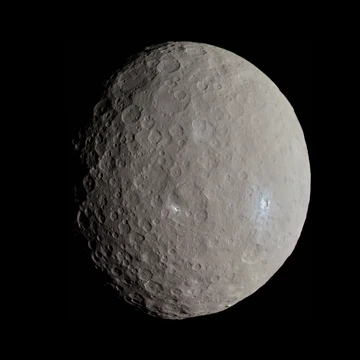
Earth
The only known planet with liquid surface water and life.

Earth, the third planet from the Sun, is the only known celestial body to support life. This is possible because it is an ocean world—the sole planet in the Solar System with liquid water on its surface. The global ocean covers 70.8% of Earth’s crust, while the remaining 29.2% is land, mostly gathered in the land hemisphere as continental masses. Much of this land is humid and covered with vegetation, though vast ice sheets at the polar deserts hold more water than all of Earth’s groundwater, lakes, rivers, and atmospheric water put together. The crust is made of slowly shifting tectonic plates; their interactions create mountain ranges, volcanoes, and earthquakes. A liquid outer core generates a magnetosphere that shields the planet from most solar winds and cosmic radiation.
Earth’s atmosphere is dynamic, sustaining surface conditions and blocking most meteoroids and ultraviolet light. It is mainly nitrogen and oxygen, with abundant water vapor that forms clouds covering most of the planet. This water vapor acts as a greenhouse gas, along with others like carbon dioxide, trapping energy from sunlight to keep liquid water and vapor stable. This maintains an average surface temperature of 14.76 °C (58.57 °F), at which water stays liquid under normal pressure. Differences in solar energy captured between regions—such as the equator receiving more than the poles—drive atmospheric and ocean currents, creating a global climate system with varied climate zones and weather phenomena like precipitation, which enables cycles of carbon and nitrogen.
Earth is an ellipsoid with a circumference of about 40,000 kilometers (24,900 miles). It is the densest planet in the Solar System and, among the four rocky planets, the largest and most massive. Overall, it ranks as the sixth largest object in the Solar System, after the Sun and the outer planets. Earth orbits the Sun at a distance of about eight light-minutes (1 AU), completing one revolution in a year (roughly 365.25 days). It rotates on its axis in slightly less than a day (about 23 hours and 56 minutes). Its axis is tilted relative to the perpendicular of its orbital plane, producing seasons. Earth has one permanent natural satellite, the Moon, which orbits at 384,400 km (238,855 mi)—1.28 light-seconds—and is about a quarter of Earth’s width.
Quick Facts
- Adjectives
- Earthly · Terrestrial · Terran · Tellurian
- Symbol
- and
- Epoch
- J2000
- Time Periastron
- 3 January 2026
- Eccentricity
- 0.0167086
- Period
- 365.256363004 d
- Satellites
- 1, the Moon
Facts from the source article.
Lore & Background
Earth formed about 4.5 billion years ago from gas and dust in the early Solar System. The formation of the ocean and the subsequent development of life occurred during the first billion years of Earth's history. Life spread globally and has been altering Earth's atmosphere and surface, leading to the Great Oxidation Event two billion years ago. Humans emerged 300,000 years ago in Africa and have spread across every continent on Earth.
Earth has a dynamic atmosphere composed primarily of nitrogen and oxygen, with water vapor widely present forming clouds that cover most of the planet. The water vapor acts as a greenhouse gas, together with carbon dioxide, maintaining the current average surface temperature of 14.76 °C. Differences in captured energy between geographic regions drive atmospheric and ocean currents, producing a global climate system with different climate regions and weather phenomena such as precipitation.
Earth's crust consists of slowly moving tectonic plates that interact to produce mountain ranges, volcanoes, and earthquakes. It has a liquid outer core that generates a magnetosphere capable of deflecting most destructive solar winds and cosmic radiation. Earth is orbited by one permanent natural satellite, the Moon, which helps stabilize Earth's axis, causes tides, and gradually slows Earth's rotation.
Reader's Guide
Earth is the densest planet in the Solar System and, of the four rocky planets, it is the largest and most massive. Overall, it is the sixth largest object in the Solar System after the Sun and the outer planets. Its axis of rotation is tilted with respect to the perpendicular to its orbital plane around the Sun, producing seasons. The Moon's gravity helps stabilize Earth's axis, causes tides, and gradually slows Earth's rotation; Earth's gravitational pull has already made the Moon's rotation tidally locked, keeping the same near side facing Earth.
Humans depend on Earth's biosphere and natural resources for their survival, but have increasingly impacted the planet's environment. Humanity's current impact on Earth's climate and biosphere is unsustainable, threatening the livelihood of humans and many other forms of life, and causing widespread extinctions. The name Earth has cognates in every Germanic language, and historically has been written in lowercase, though capitalization is used when referencing it alongside other heavenly bodies. The name Terra is occasionally used in scientific writing and science fiction, while Tellus has been used in poetry to denote personification of the Earth.
Did You Know?
- Earth is the only astronomical object known to harbor life.
- Almost all of Earth's water is contained in its ocean, which covers 70.8% of Earth's crust.
- Earth's axis of rotation is tilted, producing seasons.
- The Moon orbits Earth at 384,400 km (238,855 mi)—1.28 light seconds—and is roughly a quarter as wide as Earth.
The 2006 Reclassification Storm
In January 2005, astronomers identified a trans-Neptunian object later named Eris, initially believed to be slightly larger than Pluto itself. Informal reports even dubbed it the tenth planet, and the classification question exploded into a heated public and scientific debate. At the IAU General Assembly in August 2006, the body's first draft proposal would have listed Charon, Eris, and Ceres alongside the traditional eight planets. Widespread objection from the astronomical community forced a rapid rewrite. Uruguayan astronomers Julio Ángel Fernández and Gonzalo Tancredi stepped forward with an alternative: create an intermediate category for objects massive enough to be gravitationally rounded yet unable to clear their orbital neighborhoods of smaller debris. Under this revised framework, Pluto, Ceres, and Eris were all removed from the planet roster. NASA publicly committed to the new guidelines that same year, and Mike Brown, the discoverer of Eris, endorsed the reduction to eight planets. Yet the decision left a lasting scar of disagreement across the field.
Geological Vitality and the Push to Understand
Long dismissed as inert rocks, dwarf planets have proven to be geologically dynamic worlds. In 2015, two landmark missions confirmed this expectation: NASA's Dawn spacecraft arrived at Ceres, while New Horizons flew past Pluto, revealing active surfaces on both bodies. This finding has made planetary geologists especially eager to study these small worlds. Astronomers broadly agree that at least nine objects qualify as dwarf planets, listed roughly by decreasing diameter as Pluto, Eris, Haumea, Makemake, Gonggong, Quaoar, Sedna, Ceres, and Orcus, with Salacia remaining a borderline tenth candidate. Seven of these nine possess at least one known moon, a fact that enables scientists to measure their masses and estimate densities. Those numbers feed directly into geophysical models aimed at uncovering each world's internal structure. Only Sedna stands apart, having been neither visited by a spacecraft nor found to host any satellites, leaving its true mass shrouded in uncertainty.
From Ceres to Charon: A Shifting Understanding
The story of how we came to recognize dwarf planets stretches back to 1801, when Ceres was first spotted between Mars and Jupiter. For decades it was counted among the planets, and by around 1851 the tally had ballooned to twenty-three before astronomers began coining the word asteroid to set the smaller bodies apart. Pluto's 1930 discovery restored a tidy nine-planet Solar System, and for nearly fifty years most scientists assumed Pluto outmassed Mercury. That assumption shattered in 1978 with the detection of its moon Charon, which finally allowed an accurate mass measurement. Pluto turned out to be only about one-twentieth the mass of Mercury, roughly one-fifth that of Earth's Moon, and far smaller than anyone had imagined. Its eccentric orbit and high inclination further set it apart from the other planets. Then, in the 1990s, a flood of new objects emerged from the Kuiper belt sharing Pluto's orbital traits, reframing it as merely the largest member of a whole new family rather than a unique world.
The Naming Tangle and Ongoing Disagreement
No single label has ever satisfied everyone. Beyond dwarf planet, the literature offers planetoid, meso-planet (reserved for objects sized between Mercury and Ceres), quasi-planet, and plutoid (specific to the trans-Neptunian region). Ironically, the phrase dwarf planet was originally coined to describe the smallest of the true planets, not the largest sub-planetary bodies, and many planetary astronomers still use it in that older sense. The term even appears as a synonym for asteroid as far back as 1838. The disagreement extends well beyond nomenclature. Alan Stern, who directed NASA's Pluto mission, has consistently rejected the IAU's 2006 definition, arguing that orbital characteristics should not determine whether an object is a planet. Before the IAU vote, he had proposed splitting the Solar System into überplanets (the eight dominant worlds) and unterplanets (the dwarf planets), treating both as legitimate planets. As late as 2011 he still called Pluto a planet, extending that status to Ceres, Eris, and the larger moons. Protests against the reclassification have taken the form of bumper stickers and T-shirts, a reminder that the debate remains deeply personal for many in the field.
More in Planets and Dwarf Planets 1-24
Spotted an error? Know more?
Reader corrections go straight into our review queue. Suggest an edit · How this site is sourced