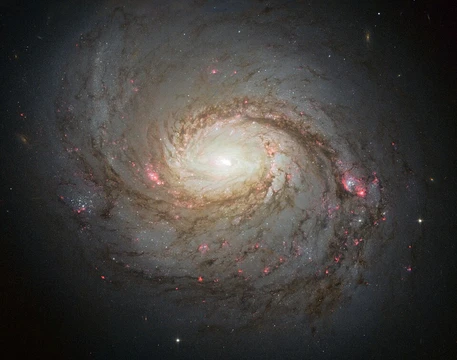
Milky Way
The barred spiral galaxy containing the Solar System.

The Milky Way is the barred spiral galaxy that contains the Solar System. Its name derives from its appearance from Earth as a hazy band of light in the night sky, formed by stars in other arms too distant to be individually resolved by the naked eye. It is notable as the galaxy that includes Earth and as one of countless galaxies in the universe, a fact confirmed only in the 1920s.
Quick Facts
- Epoch
- J2000
- Ra
- 17 · 45 · 40.03599
- Dec
- −29 · 00 · 28.1699
Facts from the source article.
Lore & Background
The Milky Way is a barred spiral galaxy with a D25 isophotal diameter estimated at 26.8 ± 1.1 kiloparsecs (87,400 ± 3,600 light-years), but only about 1,000 light-years thick at the spiral arms. Recent simulations suggest that a dark matter area, also containing some visible stars, may extend up to a diameter of almost 2 million light-years. It has several satellite galaxies and is part of the Local Group, which is part of the Virgo Supercluster, itself a component of the Laniakea Supercluster. The Solar System is located at a radius of about 27,000 light-years from the Galactic Center, on the inner edge of the Orion Arm. The innermost 10,000 light-years form a bulge and one or more bars. The Galactic Center is an intense radio source known as Sagittarius A*, a supermassive black hole with a mass of 4.100 (± 0.034) million solar masses. The oldest stars in the Milky Way are nearly as old as the universe itself.
Galileo Galilei first resolved the band of light into individual stars with his telescope in 1610. Until the early 1920s, most astronomers thought the Milky Way contained all the stars in the universe. Following the 1920 Great Debate between Harlow Shapley and Heber Doust Curtis, observations by Edwin Hubble in 1923 showed that the Milky Way was just one of many galaxies.
In mythology, the Babylonian epic poem Enūma Eliš describes the Milky Way as created from the severed tail of the primeval salt water dragon Tiamat, set in the sky by Marduk. In Greek mythology, the Milky Way is produced from the spilled milk of Hera while breastfeeding Heracles. The name 'Milky Way' derives from its appearance as a dim, unresolved, 'milky' glowing band, a translation of the Classical Latin via lactea, from Hellenistic Greek γαλαξίας κύκλος, meaning 'milky circle'. Other common names include 'Birds' Path' in several Uralic and Turkic languages, 'River of Heaven' in Japanese and Chinese, and 'Silver River' in East Asia.
Reader's Guide
The Milky Way is visible as a hazy band of white light, some 30° wide, arching in the night sky. The light originates from the accumulation of unresolved stars and other material located in the direction of the galactic plane. Brighter regions appear as star clouds, the most conspicuous being the Large Sagittarius Star Cloud, a portion of the central bulge. Dark regions such as the Great Rift and the Coalsack are areas where interstellar dust blocks light from distant stars. The Milky Way has a relatively low surface brightness; its visibility can be greatly reduced by light pollution or moonlight. It should be visible if the limiting magnitude is approximately +5.1 or better and shows great detail at +6.1. Maps of artificial night sky brightness show that more than one-third of Earth's population cannot see the Milky Way from their homes due to light pollution. As viewed from Earth, the visible region of the galactic plane occupies an area of the sky that includes 30 constellations. The Galactic Center lies in the direction of Sagittarius, where the Milky Way is brightest. The galactic plane is inclined by about 60° to the ecliptic and tilted at an angle of 63° to the celestial equator. The Milky Way was traditionally used as a guide by pilgrims traveling to Santiago de Compostela, hence the name 'The Road to Santiago'.
Did You Know?
- The Milky Way is estimated to contain 100–400 billion stars and at least that number of planets.
- Galileo Galilei first resolved the Milky Way's band of light into individual stars in 1610.
More in Spiral Galaxies, Part 2 1-24
Spotted an error? Know more?
Reader corrections go straight into our review queue. Suggest an edit · How this site is sourced