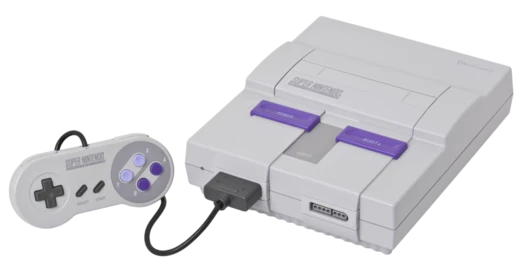
The Legend of the Mystical Ninja
A 1991 action-adventure blending platforming and town exploration.
Konami released The Legend of the Mystical Ninja for the Super Nintendo in 1991. It later appeared on the Wii, Wii U, and 3DS Virtual Console, and in 2026 as part of the Ganbare Goemon! Daishūgō compilation.
Quick Facts
- Developer
- Konami
- Designer
- Shigeharu Umezaki
- Programmer
- Nobuhiro Matsuoka
- Yasuo Okuda
- Toshinori Shimono
- Koji Yoshida
- Artist
- Takeshi Fujimoto
- Setsu Muraki
- Kumiko Ogawa
- Takeo Yakushiji
- Composer
- Kazuhiko Uehara; Harumi Ueko
- Series
- Ganbare Goemon
- Platforms
- Super NES, Game Boy Advance
- Genre
- Action-adventure
Facts from the source article.
Gameplay
The two characters, though equipped with different weapons and learning different attacks, are functionally identical. Their primary short-range weapons have three levels and are improved in range by collecting grey cats left by defeated enemies. Both characters start with thrown weapons that decrease money when used, and can acquire bombs by purchasing them in stores or winning them in mini-games. Each character can learn four Judo abilities that are functionally identical between them: Level 1 provides an animal companion for ramming enemies; Level 2 damages all enemies on screen; Level 3 grants temporary flight; Level 4 unleashes a powerful repetitive attack. Most stages, called Warlock Zones, are split into two sections. The first involves town exploration where players gather information, buy items, learn Judo attacks, play mini-games, earn money, and more. Notable mini-games include a recreation of the first level of Gradius, air hockey, trivia, dice games, and a lottery. The second section is a platforming segment where players fight minor enemies and defeat a boss. In two-player mode, characters can work together by having one ride the other piggy-back style: the rider controls attacks while the carrier controls movement and jumping.
Plot
Players control Goemon and Ebisumaru, called Kid Ying and Dr. Yang respectively in non-Japanese releases. After noticing odd occurrences in their hometown of Oedo—a Ghost Woman at the local temple and ghost animals emerging from it at night—the duo investigates. Defeating the Ghost Woman reveals her to be Kurobei, a ninja cat, who explains she sought strong people to help her. She offers them money and directs them to find her boss, Koban, on Shikoku Island. There, they encounter Hyotoko dancers during a festival, some of whom townspeople suspect. After defeating the Lantern Man, leader of the evil dancers, they rescue Koban, who informs them that Princess Yuki, daughter of the Emperor, is believed kidnapped by the Otafu Army, a group of mimes and clowns counterfeiters. Koban’s ninja cat clan could not investigate due to devices that disable their shapeshifting powers. He directs the pair to Awaji Island, where they find the army has set up an anachronistic amusement park. They travel across the park to Yamato, discovering the army has been recruiting townspeople. Invading the Otafu HQ and defeating its leaders frees the ninja Yae, who tells them the Otafu Army never had Yuki, but a wise man in Iga may help. The Old Wise Man’s palace in Iga is guarded by robotic clockwork ninjas; after fighting through to his chamber, he tells them the White Mirror in the Dragon Pond of Izumo can find what they seek. He shoots them there via his Miracle Transport Machine, a cannon. To save the princess, the protagonists travel through different regions of Japan gathering clues.
Reception
Famitsu reported that The Legend of the Mystical Ninja sold 51,680 copies in its first week and 521,205 copies during its lifetime in Japan. Micom BASIC Magazine ranked the game second in popularity in its October 1991 issue, and a 1993 readers' poll by Super Famicom Magazine gave it a 24.78/30 score, placing it tenth among Super Famicom titles. The game received generally favorable reviews from critics. In 2010, it was included in the book 1001 Video Games You Must Play Before You Die. GamesRadar ranked it the 45th best SNES game, praising its soundtrack, graphics, and challenge. Total! rated it 79th on its Top 100 SNES Games in 1995, calling it a mixture of arcade action and role playing that was enjoyable. IGN listed the game 32nd in its Top 100 SNES Games of All Time. Electronic Gaming Monthly noted that the game did not catch on much in the U.S. but was popular in Japan.
Legacy
Three direct sequels were released for the Super Famicom: Ganbare Goemon 2: Kiteretsu Shōgun McGuiness in 1993, Ganbare Goemon 3: Shishi Jūrokubē no Karakuri Manjigatame in 1994, and Ganbare Goemon Kirakira Dōchū: Boku ga Dancer ni Natta Wake in 1995. The Legend of the Mystical Ninja was released for the Wii Virtual Console in 2007, the Wii U Virtual Console in 2013 (2014 in Europe and Australia), and the New 3DS Virtual Console in 2016. It was also included in the Super Famicom Mini console's lineup, released exclusively in Japan on October 5, 2017.
More in Super Nintendo Entertainment System Game Library
Spotted an error? Know more?
Reader corrections go straight into our review queue. Suggest an edit · How this site is sourced