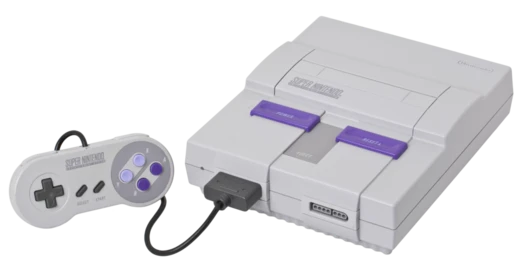
Jikkyō Oshaberi Parodius
Konami developed the fourth entry in the Parodius series, titled Jikkyō Oshaberi Parodius.[1]
Quick Facts
- Developer
- Konami
- Series
- Parodius
- Modes
- Single-player, multiplayer
- Platforms
- Super Famicom
- Sega Saturn
- PlayStation
Facts from the source article.
Making and release
The game's plot is set in 1996, when Mr. Parodius calls upon his eldest son Takosuke to get him the legendary takoyaki made only once every 128 years.[2] A port for the Sega Saturn was released in Japan on December 13, 1996, adding two-player simultaneous play and the ability to toss allies.[3] A port for the PlayStation was released in Japan on December 20, 1996, also adding two-player play and an "Accident" mode with polygonal enemies.[4] The PlayStation version added a second female announcer voiced by Noriko Ohara.[4]
Voice samples and a threefold increase in clock speed relative to the console were made possible by the Super Accelerator-1 chip installed in Jikkyō Oshaberi Parodius.[5] A compilation for the PlayStation Portable, released in Japan on January 25, 2007, included Jikkyō Oshaberi Parodius: Forever With Me.[6]
What the cited sources add
Sakurai, the game planner, said Jikkyō Oshaberi Parodius was like a side-story and wanted audiences to not think of it as just a copy of the original Parodius.[7] Hirokazu Hamamura of Famicom Tsūshin said the screen was so flashy it was hard to concentrate on shooting.[8] A reviewer in Fun Generation said the improvements in the new version were "rather marginal" while the game remained the crowning conclusion of the series.[9] Kurt Kalata from Hardcore Gaming 101 noted that the game's release coincided with the conclusion of the 16-bit era, which resulted in ports to 32-bit platforms.[10]
Total! writer Tim Weaver described the game as gorgeous and colorful, with sprites exhibiting high attention to detail.[8] According to a Saturn Fan reviewer, the audio commentary, large character roster, and amusing parodies compensated for any lack of originality in the gameplay.[11]
References
- Wikipedia, "Jikkyō Oshaberi Parodius" (CC BY-SA 4.0), which cites: Weaver 1996, p. 63-64; Kalata 2015; Saturn Fan 1996, p. 172 (original not read by us) en.wikipedia.org
- Wikipedia, "Jikkyō Oshaberi Parodius" (CC BY-SA 4.0), which cites: Konami 1995, p. 2-3; Konami 1995, p. 2-3; Konami 1995, p. 2-3; Konami 1995, p. 2-3 (original not read by us) en.wikipedia.org
- Wikipedia, "Jikkyō Oshaberi Parodius" (CC BY-SA 4.0), which cites: Tsūshin Pin Watanabe Hada 1996, p. 32; Tsūshin Pin Watanabe Hada 1996, p. 32 (original not read by us) en.wikipedia.org
- Wikipedia, "Jikkyō Oshaberi Parodius" (CC BY-SA 4.0), which cites: Kalata 2015; Noda Uchisawa Combatant Maruko Yoshida 1996, p. 39; Kalata 2015; Kalata 2015; Ikugata Terasaki 1996, p. 183; Saturn Fan 1996, p. 172; Kalata 2015 (original not read by us) en.wikipedia.org
- Wikipedia, "Jikkyō Oshaberi Parodius" (CC BY-SA 4.0), which cites: Amusement Industry 1995, p. 85; Play 1996, p. 91; Kalata 2015; Tsuki 2021; Arsenault 2017, p. 133; Groves 1996, p. 41 (original not read by us) en.wikipedia.org
- Wikipedia, "Jikkyō Oshaberi Parodius" (CC BY-SA 4.0), which cites: Kalata 2015; Konami; Kalata 2015 (original not read by us) en.wikipedia.org
- Wikipedia, "Jikkyō Oshaberi Parodius" (CC BY-SA 4.0), which cites: Konami 1997, p. 93-94; Kalata 2015; Groves 1996, p. 41 (original not read by us) en.wikipedia.org
- Wikipedia, "Jikkyō Oshaberi Parodius" (CC BY-SA 4.0), which cites: Weaver 1996, p. 63-64; Weidner Hellert 1996, p. 39; Tsūshin Seizan Watanabe Sakai 1995, p. 30 (original not read by us) en.wikipedia.org
- Wikipedia, "Jikkyō Oshaberi Parodius" (CC BY-SA 4.0), which cites: Tsūshin Pin Watanabe Hada 1996, p. 32; Bınzenhöfer Hellert 1997, p. 69 (original not read by us) en.wikipedia.org
- Wikipedia, "Jikkyō Oshaberi Parodius" (CC BY-SA 4.0), which cites: Tsūshin Seizan Watanabe Sakai 1995, p. 30; Kalata 2015; Konami 1997, p. 93-94 (original not read by us) en.wikipedia.org
- Wikipedia, "Jikkyō Oshaberi Parodius" (CC BY-SA 4.0), which cites: Ikugata Terasaki 1996, p. 183; Tsūshin Pin Watanabe Hada 1996, p. 32; Noda Uchisawa Combatant Maruko Yoshida 1996, p. 39; Ikugata Terasaki 1996, p. 183; Inagaki Sunman Tetsu 1996, p. 272; Ikugata Terasaki 1996, p. 183 (original not read by us) en.wikipedia.org
Each numbered sentence above was checked against the source it cites before publication. Sentences citing Wikipedia adapt text from the English Wikipedia article Jikkyō Oshaberi Parodius (contributors), used under CC BY-SA 4.0; this entry is available under the same licence. Other sources were used for facts only; no text or images are copied from them.
More in Super Nintendo Entertainment System Game Library
Spotted an error? Know more?
Reader corrections go straight into our review queue. Suggest an edit · How this site is sourced