Contra III: The Alien Wars
Run and gun through six stages of alien invasion.
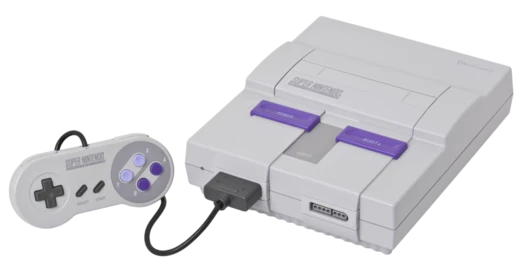
Contra III: The Alien Wars is a 1992 run and gun game developed and published by Konami for the Super Nintendo Entertainment System. It is the third home console entry in the Contra series and the first to be directed by Nobuya Nakazato. The game was retitled Super Probotector: Alien Rebels in PAL regions, where the player characters were replaced with robots.
Quick Facts
- Publisher
- Konami
- Series
- Contra
- Platforms
- Super NES
- Game Boy
- Game Boy Advance
- Genre
- Run and gun
- Modes
- Single-player, multiplayer
- Director
- Nobuya Nakazato
- Programmer
- Mitsuru Yaida; Hideyuki Suganami
- Producer
- Kazumi Kitaue
Facts from the source article.
Gameplay
Contra III is a side-scrolling run and gun game. Players control commandos Bill Rizer and Lance Bean fighting an alien invasion on Earth. It supports single-player or two-player cooperative play. The six stages consist of four side-scrolling levels and two overhead-perspective stages that use the Super NES's Mode 7 rendering. In side-scrolling stages, the player runs, jumps, and shoots enemies. In overhead stages, the player navigates to find and destroy predetermined targets, with the ability to rotate the screen. Each stage ends with a boss, and some have mid-stage bosses. The player loses a life upon contact with enemies, their projectiles, or falling into pits. The player carries two machine guns that can be swapped and upgraded with power-ups dropped from flying pods, including homing missiles, torpedoes, a flamethrower, a laser, and a spread shot. Bombs and a temporary barrier shield may also appear. The player can perform a spinning jump that fires both guns, but both weapons are at risk of being lost upon death. The Japanese version offers unlimited continues and a different final boss appearance on normal difficulty.
Development
Contra III was developed by Konami under director Nobuya Nakazato, his first work on the series after informal playtesting of Super C. Nakazato found the original arcade Contra difficult due to its vertical screen but enjoyed the Famicom port. His team worked in Konami's new Tokyo offices, seated next to the arcade team that developed Contra, and shared progress with them. Early coverage referred to the game as Contra IV, but Nintendo Power reported the name change to Contra III at Winter CES 1992. Nakazato wanted to emphasize a low-budget movie theme, asking the sound team to change music as stages progressed for a cinematic style. He added comical elements, such as a sequence where the player hangs from flying missiles, to make the action less realistic. This sequence strained the Super NES's sprite capabilities, so the team used background tiles for the helicopter and missiles, employing raster scrolling to make them appear as foreground sprites. Nakazato aimed to avoid mundane enemy-boss patterns by ensuring something interesting happened every three screen scrolls, giving the game a dense, boss-rush feel. He believed Contra III's fast-paced action countered the trend toward slow-paced strategy and role-playing games on home consoles.
Reception
Contra III received considerable praise for its visuals and sound design. Critics commended its use of Mode 7, sprite scaling, and sprite rotation as well-integrated with gameplay. Electronic Gaming Monthly wrote that these effects pushed the Super NES hardware's limits. Computer and Video Games and Electronic Gaming Monthly admired the Mode 7 top-down stages and boss design. The soundtrack was praised as a combination of orchestral and rock music, with Mean Machines comparing it to ActRaiser. Gun and explosion sound effects enhanced the atmosphere, though Mean Machines noted they sometimes drowned out the music. Gameplay was found enjoyable and challenging, with Computer and Video Games calling it a cross between Strider and Midnight Resistance. Electronic Gaming Monthly named it Game of the Month, saying it matched arcade quality. Retrospective reviews from IGN and GameSpot called it arguably the best Contra installment and one of the best in the series, noting its satisfying difficulty but short length. USgamer wrote it was practically synonymous with SNES ownership. Eurogamer called it exemplary and debatably one of the best games in its genre. Official Nintendo Magazine ranked it 51st among greatest Nintendo games in 2009.
Ports and rereleases
Contra III: The Alien Wars has seen multiple rereleases through Nintendo’s digital storefronts. It hit the Wii Virtual Console in Japan and North America during January 2007, while Europe got Super Probotector that same month. The Wii U Virtual Console followed in November 2013 for Japan and North America, with the standard Contra III arriving in Europe by January 2014. In May 2016, North American and European players could download it from the Nintendo 3DS eShop, but only for the New Nintendo 3DS. The game was also part of the 2017 Super NES Classic Edition. The Contra: Anniversary Collection, released in June 2019 across Nintendo Switch, PlayStation 4, Xbox One, and Windows, included both Contra III and Super Probotector. A free update later added the Japanese version; in Japan, the compilation initially offered the Japanese and European editions but skipped the North American one. Factor 5 handled a Game Boy port, which came out in September 1994 in Japan and November in North America, with Europe getting it as Probotector 2 in October. This version drops some levels, weapon swapping, and the spinning attack, but gains color graphics and better sound when played on a Super Game Boy. Critics praised it as a strong conversion, with GamesMaster calling it a major achievement, though Electronic Gaming Monthly took issue with the control scheme when using a Super NES controller.
Frequently Asked Questions
What platforms is Contra III: The Alien Wars available on?
Contra III: The Alien Wars was released for Super NES, Game Boy and Game Boy Advance.
Who composed the music for Contra III: The Alien Wars?
The music for Contra III: The Alien Wars was composed by Miki Higashino, Masanori Adachi and Tappi Iwase.
More in Super Nintendo Entertainment System Game Library
Spotted an error? Know more?
Reader corrections go straight into our review queue. Suggest an edit · How this site is sourced