Mega Man 7
Mega Man returns on the SNES with new Robot Masters.
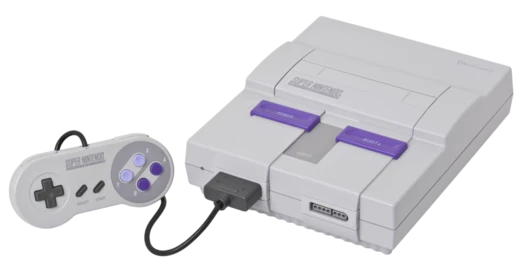
Mega Man 7 is a 1995 action game developed and published by Capcom for the Super Nintendo Entertainment System. It is the seventh game in the original Mega Man series and the only numbered title in that series released on the SNES. The game updates the graphics and sound of the 8-bit NES titles for the more powerful hardware.
Quick Facts
- Developer
- Capcom
- Director
- Yoshihisa Tsuda
- Producer
- Tokuro Fujiwara
- Designer
- Yoshihisa Tsuda
- Ryo Miyazaki
- Masayoshi Kurokawa
- Artist
- Keiji Inafune
- Hayato Kaji
- Toshifumi Onishi
- Kazunori Tazaki
- Tatsuya Yoshikawa
- Programmer
- Shinya Ikuta
- Keiji Kubori
- Kazuhiro Tsuchiya
- Composer
- Toshihiko Horiyama
- Yuko Takehara
- Makoto Tomozawa
- Series
- Mega Man
Facts from the source article.
Gameplay
Mega Man 7 plays a lot like the six games that came before it. You control Mega Man, moving through stages that usually wrap up with a fight against a Robot Master. Beating that boss gives you its unique Master Weapon, which you can then pick and use in any future level. Each Robot Master has a specific Master Weapon that works best against them. A change from the first six games: you can only pick from four Robot Master stages at the start—Freeze Man, Junk Man, Burst Man, and Cloud Man. Once you finish those, the other four—Spring Man, Slash Man, Shade Man, and Turbo Man—become available. The game keeps many old features, like sliding, charging the Mega Buster for stronger shots, and calling on your dog Rush for help. A new trick is Rush Search, where Rush digs up useful items right where you stand. Some levels hide the letters R-U-S-H; collecting them lets you get the Rush Super Adaptor, which combines two upgrades from Mega Man 6 into one item that gives you a rocket-arm attack and a jetpack for short flights. Enemies you beat can drop extra lives, health and weapon refills, and special bolts. From the level select screen, you can go to Eddie's Cybernetic Support Shop, run by Dr. Light's new assistant, Auto. There, you spend those bolts on items and power-ups—a feature that first appeared in the Game Boy Mega Man games. Using bolts and buying from a shop became standard for main series games starting with Mega Man 7. You can also get the robotic bird Beat and Proto Man's shield. If you type in a certain password (shown at the end) and then press the L and R buttons, a secret fighting mode unlocks. This mode needs two players; you can't play it alone. Two people control either Mega Man or Bass in an arena, trying to defeat each other, much like Capcom's Street Fighter games. Both characters have special moves, some of which aren't in the main game.
Plot
Six months after the events of Mega Man 6, in the ambiguous 20XX, Dr. Wily has finally been captured and imprisoned. But Wily planned for this possibility. In a hidden lab, he had built four advanced Robot Masters—Burst Man, Cloud Man, Junk Man, and Freeze Man—programmed to activate if they received no word from him for half a year. When that silence stretches to six months, they power up, gather an army, and tear through the city where Wily is held. Mega Man is summoned. He drives into the city with Roll and Auto, only to find it in rubble. He is too late: Wily’s robots have already freed their master. Mega Man chases after them but is intercepted by Bass, a robot with abilities similar to his own, and Bass’s robotic wolf, Treble. After a short fight, Bass claims he and Treble are also fighting Wily. They fly off, leaving Mega Man confused but hopeful he has new allies, and determined to stop Wily again.
After Mega Man defeats the first four Robot Masters, Wily sends out four more: Spring Man, Slash Man, Shade Man, and Turbo Man. In one area, Mega Man finds Bass injured and takes him to Dr. Light’s lab for repairs. Mega Man then finishes off the remaining Robot Masters and returns home. There, he learns Bass has betrayed him. Bass went berserk, trashed the lab, and stole parts for upgrades that Dr. Light had been developing. Wily appears on a monitor, mocking Mega Man, and reveals that Bass and Treble are his own creations. They had only pretended to be allies to gain trust and steal the parts. Bass’s real goal is to prove he is the strongest robot by defeating Mega Man. Furious, Mega Man heads to Wily’s fortress. He defeats Bass and Treble, then Dr. Wily himself. As always, Wily begs for mercy. But after giving him six chances to reform, Mega Man is fed up. He points his Mega Buster at Wily, tempted to finish him. Terrified, Wily argues that as a robot, Mega Man cannot harm a human. Mega Man replies that he is more than a robot. (In the Japanese version, Mega Man simply stops and stands in silence.)
Development
Before Mega Man 7, every numbered game in the original Mega Man series had been released on the NES. This title became the sole numbered entry in that series to appear on the SNES, even though Capcom had already launched the Mega Man X spin-off on that same console over a year earlier. The development team faced a very tight three-month schedule to finish the game due to unfortunate timing. Despite the rush, primary artist Keiji Inafune said the team’s high motivation made the experience personally enjoyable for him. New head illustrator Hayato Kaji agreed, noting the team’s strong dedication to completing the project. Designer Yoshihisa Tsuda recalled that the process felt fun, comparing it to a sports team camp, but he also expressed many regrets about the final product. He mentioned that everyone on the team wished they could have had just one more month to work on it. Inafune took credit for creating the character Auto, basing him on the stereotypical “tin man” robots he remembered from his childhood. Inafune also produced the initial rough sketches for Bass and Treble, labeling them “Baroque” and “Crush” in his sketchbook before handing the ideas over to Kaji for final design. As with several other games in the series, the eight Robot Masters in Mega Man 7 came from fan design contests held by Capcom in Japan, which attracted roughly 220,000 character submissions.
Reception and legacy
Critics and later retrospectives have generally given Mega Man 7 a lukewarm thumbs-up, though a significant chunk of the complaints centered on the idea that it didn't do much to refresh a franchise that was already showing its age. Many felt it was a step down from Mega Man X, which had hit the SNES over a year earlier. Tony Mott from Super Play argued the gameplay hadn't evolved past the 8-bit titles, calling the level designs "muted" and routine next to the X series. Brett Elston of GamesRadar agreed, saying the game felt too much like the older entries and couldn't compete with the more creative Mega Man X. GamePro described it as merely a decent stopgap for fans waiting for the next X game. Next Generation gave it three out of five stars, bluntly stating it was still the same old game and that the audience had simply grown tired of it.
On the positive side, reviewers praised its bright graphics, tight controls, and solid challenge. GameSpot's Christian Nutt and Justin Speer were especially kind, calling it the first real SNES upgrade the original series had seen after years stuck on the aging NES. They admitted it arrived too late to win back the series' former popularity, but still considered it a strong title. In a later retrospective, IGN's Levi Buchanan ranked it among the weaker entries, noting that its new gimmicks often fell flat. Still, he concluded it was worth playing just to see the jump to 16-bit, though he advised keeping expectations in check.
Frequently Asked Questions
When was Mega Man 7 released?
Mega Man 7 was released on March 24, 1995 in Japan, in September 1995 in North America and in 1995 in Europe.
Who designed Mega Man 7?
Mega Man 7 was designed by Yoshihisa Tsuda, Ryo Miyazaki and Masayoshi Kurokawa.
Who composed the music for Mega Man 7?
The music for Mega Man 7 was composed by Toshihiko Horiyama, Yuko Takehara and Makoto Tomozawa.
More in Super Nintendo Entertainment System Game Library
Spotted an error? Know more?
Reader corrections go straight into our review queue. Suggest an edit · How this site is sourced