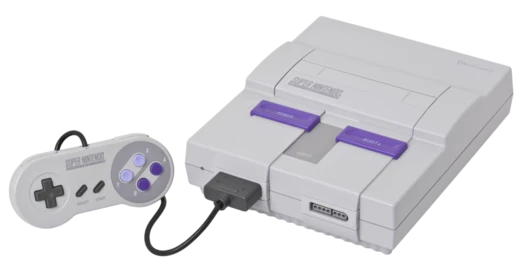
Super Mario All-Stars
A compilation of four classic Super Mario remakes.
Super Mario All-Stars is a 1993 platform game compilation developed and published by Nintendo for the Super Nintendo Entertainment System. It contains remakes of four Super Mario games originally released for the Nintendo Entertainment System and the Famicom Disk System, featuring updated graphics, music, and a save feature. The compilation is notable for being the first release of Super Mario Bros.: The Lost Levels outside Japan.
Quick Facts
- Developer
- Nintendo EAD
- Publisher
- Nintendo
- Director
- Takashi Tezuka
- Producer
- Shigeru Miyamoto
- Composer
- Koji Kondo, Soyo Oka
- Artist
- Shigefumi Hino
- Naoki Mori
- Soichiro Tomita
- Kenta Usui
- Programmer
- Toshihiko Nakago
- Series
- Super Mario
Facts from the source article.
Did You Know?
- The compilation had the working title Mario Extravaganza.
- A two-player bonus game based on Mario Bros. (1983) can be accessed from Super Mario Bros. 3.
- The 25th Anniversary Edition for the Wii included a 32-page Super Mario History booklet and a soundtrack CD.
Content
Super Mario All-Stars brings together the first four games from the Super Mario series, all originally on the NES and Famicom Disk System. It includes Super Mario Bros., The Lost Levels, Super Mario Bros. 2, and Super Mario Bros. 3. A bonus two-player game based on the original Mario Bros. can be unlocked from within Super Mario Bros. 3. These are faithful remakes that keep the original stories and level layouts. They are 2D side-scrolling platformers where players guide Mario and Luigi through worlds, leaping across platforms, dodging enemies and obstacles, uncovering secrets like warp zones and vines, and grabbing power-ups such as mushrooms and the Invincibility Star. In three of the games, the goal is to save Princess Toadstool from Bowser by stomping enemies and breaking bricks. Super Mario Bros. 2 changes things up: players pick from Mario, Luigi, Princess Toadstool, or Toad to defeat King Wart in a dream world, using a new mechanic where they grab and throw objects like vegetables at foes. You choose a character at the start of each life and can switch by pausing. The games were updated for the SNES’s 16-bit hardware, with remastered music, improved graphics, and parallax scrolling. Physics were tweaked slightly, and glitches like the Minus World were removed. The Lost Levels got easier: poison mushrooms are now more visible, and there are extra 1-ups and checkpoints. A save feature lets you continue from any world or level you’ve reached, with four save slots per game.
Development
Super Mario All-Stars came from Nintendo's internal development group, Nintendo Entertainment Analysis & Development. Before release, it was called Mario Extravaganza. The idea took shape after Super Mario Kart shipped in 1992. Since the next big Mario title, Yoshi's Island, wasn't ready until 1995, Nintendo had a hole in its lineup. Mario's creator, Shigeru Miyamoto, proposed a value pack that would bundle every Super Mario game. Assistant director Tadashi Sugiyama said Miyamoto wanted players to finally try The Lost Levels. Nintendo had skipped releasing that game in North America because it was too hard, instead offering a reworked Doki Doki Panic as the local Super Mario Bros. 2. The team didn't just copy the NES games onto a SNES cartridge; they rebuilt them from scratch for the newer system. Updating the graphics was an early priority. The SNES's extra power let the artists use many more colors. Designer Naoki Mori admitted he felt nervous, having only been at Nintendo for three years when asked to refresh the company's biggest franchise. The artists looked to Super Mario World for visual cues and gave Mario a black outline so he popped against the backgrounds. For areas with black screens, like castles and bonus rooms, they added small details such as portraits of Bowser and Mario. To keep the originals' feel, the team left level layouts and Mario's movement exactly as they were, adding no fresh animations or actions.
Release
Super Mario All-Stars, known in Japan as Super Mario Collection, hit shelves in Japan on July 14, 1993, followed by North America on August 11, 1993, and Europe on December 16, 1993. This collection was notable for bringing The Lost Levels outside Japan for the first time. From September to October 1993, Nintendo Power ran a contest where players who made it to a certain spot in The Lost Levels could earn a Mario iron-on patch. The game became the pack-in title for the SNES, selling 10.55 million copies by 2015, with 2.12 million of those in Japan. In the United Kingdom, it was the best-selling game of September 1993. A re-release in December 1994, Super Mario All-Stars + Super Mario World, added Super Mario World, which gave Luigi a unique look instead of just a color swap. A Satellaview version of Super Mario Collection also came out for Japan’s SNES add-on. For the 25th anniversary of Super Mario Bros., Nintendo issued Super Mario All-Stars 25th Anniversary Edition on Wii in 2010, packaged with a history booklet and soundtrack CD. That version moved 2.24 million copies by March 2011. In 2020, for the 35th anniversary, the compilation returned on Nintendo Switch as part of the Nintendo Classics subscription service.
Reception
The compilation received critical acclaim. Reviewers thought it was a must-have that represented the SNES library at its finest. Nintendo Magazine System estimated it could entertain players for up to a year. A critic from Computer and Video Games described Super Mario All-Stars as the Super Mario director's cut. A reviewer from Electronic Gaming Monthly called it a masterpiece from beginning to end. Critics praised the collection's games as excellent remakes, stating they aged well. For AllGame, the compilation represented the absolute pinnacle of the 2D platform genre. Critics said the games played just as they did on the NES. Nintendo Power wrote the games got better with time. Although one NMS reviewer admitted to preferring Super Mario World, he said Super Mario All-Stars was still worth buying. Reviewers liked the updates. Nintendo Power praised the addition of a save feature. The updated graphics were praised; NMS reviewers admired the attention to detail, and AllGame called the visuals colorful and cartoonish. CVG thought the backgrounds could have benefited from more detail, but GamePro thought they were detailed enough. Reviewers offered praise for the updated soundtracks. For EGM, the audio enhanced the experience, and GamePro noted the addition of echo and bass effects.
Frequently Asked Questions
Who developed Super Mario All-Stars?
Super Mario All-Stars was developed by Nintendo EAD.
Who directed Super Mario All-Stars?
Super Mario All-Stars was directed by Takashi Tezuka.
Who composed the music for Super Mario All-Stars?
The music for Super Mario All-Stars was composed by Koji Kondo and Soyo Oka.
More in Super Nintendo Entertainment System Game Library
Spotted an error? Know more?
Reader corrections go straight into our review queue. Suggest an edit · How this site is sourced