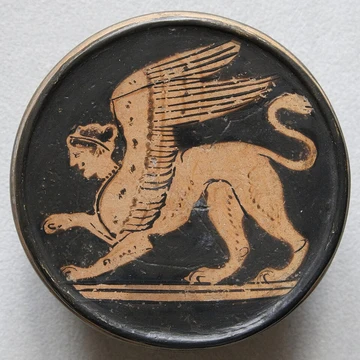
The Sphinx (poem)
Oscar Wilde's Decadent poem of a Sphinx's sexual history.

Oscar Wilde's poem *The Sphinx* runs to 174 lines. Its speaker is a young man who interrogates the mythical creature with graphic, detailed questions about her sexual history, only to reject her allure at the end and turn his attention to a crucifix. The poem took two decades to complete, from Wilde's time as an Oxford undergraduate until its release as a deluxe limited edition in 1894. Wilde drew on a mix of ancient and modern material, leaning especially on works from the French Decadent movement. Early critics gave it a chilly reception, but today it is widely considered Wilde's best Decadent poem, often called "unrivalled: a quintessential piece of fin-de-siècle art."
The poem opens with the speaker describing a sphinx statue "in a dim corner of my room." He calls out to her, "Come forth you exquisite grotesque! half woman and half animal!" and asks to stroke her. He contrasts her immense age with his own "twenty summers," then lists scenes from Classical history and Egyptian mythology, asking if she witnessed them. He then demands, "Who were your lovers? who were they who wrestled for you in the dust?" He suggests various Egyptian animals, mythical beasts, men, women, and gods, finally declaring, "Nay, I know / Great Ammon was your bedfellow!" He describes the start of their affair and Ammon's beauty and splendor, then notes that all that glory has crumbled. He tells the sphinx to go back to Egypt to find and honor Ammon's remains—yet Ammon and her other divine lovers are not truly dead. In Egypt, she could resume any of her former passions with god or beast. The speaker dismisses her with disgust for both her and himself: "You make my creed a barren sham, you wake foul dreams of sensual life." In the end, he asks to be left alone with his crucifix, where the figure of Christ "weeps for every soul who dies, and weeps for every soul in vain."
Wilde's composition of the poem stretched nearly twenty years, leaving eleven surviving manuscript groups. He started in 1874, the year he entered Oxford, possibly during a summer holiday in Paris with his parents. In 1883, again in Paris, he returned to the poem and produced a version with thirteen stanzas that did not appear in the final publication. By the 1890s, needing money and wanting to present himself as more than a fiction writer and journalist, he shaped the poem into its final form for release.
The po
- author
- Oscar Wilde
- published
- 11 June 1894
- form
- 174 lines, originally four-line stanzas rhyming ABBA, later reduced to two sixteen-syllable lines with internal rhymes
- publisher
- Elkin Mathews and John Lane
- edition
- 200 copies, plus 25 large-paper copies
- illustrator
- Charles Ricketts
Lore & Background
The writing of The Sphinx was a long and complicated process, lasting almost twenty years and producing eleven surviving groups of manuscripts. Wilde began working on it in 1874, the year he went up to Oxford, possibly in the summer of that year when he was on holiday in Paris with his parents. In 1883, again in Paris, he returned to the poem and produced a version which included thirteen stanzas not found in the published poem. By the 1890s Wilde, needing money and wanting to present himself as something more than a fiction-writer and journalist, brought his poem into its final form, ready for publication.
The poem begins with the narrator describing the figure of a sphinx which stands 'in a dim corner of my room'. He then addresses her, 'Come forth you exquisite grotesque! half woman and half animal!', and asks to stroke her. He contrasts her immense antiquity with his own 'twenty summers', and begins to enumerate scenes of Classical history and Egyptian mythology, asking her if she witnessed them. He next turns to the question 'Who were your lovers? who were they who wrestled for you in the dust?' He suggests various Egyptian animals, mythical beasts, men, women and gods, before announcing 'Nay, I know / Great Ammon was your bedfellow!' He details the beginning of their sexual liaison, and describes Ammon's personal beauty and splendour, before reflecting that that splendour has all come to ruin. He bids the sphinx return to Egypt to find and honour Ammon's remains; yet Ammon is not dead, and neither are any of her other divine lovers. In Egypt she could resume any of her former passions with god or beast. The narrator dismisses her with disgust both for her and for himself: 'You make my creed a barren sham, you wake foul dreams of sensual life'. Finally, he asks to be left to his crucifix with its figure of Christ, who 'weeps for every soul who dies, and weeps for every soul in vain'.
The prime influence on The Sphinx was the French Decadent movement, particularly Huysmans' À rebours, the cat sonnets in Baudelaire's Les Fleurs du mal, and the poems of Maurice Rollinat. In particular, the poem's fascination with monsters, statues, and ambiguous sexuality draws on Flaubert's Tentation de Saint Antoine and on Gautier's Mademoiselle de Maupin and Émaux et camées; Flaubert also provided Wilde with much of his exotic vocabulary. Other important influences include Swinburne's 'Dolores', with its 'imputation of ageless profligacy'; Rossetti's 'The Burden of Nineveh', itself inspired by the British Museum's acquisition of a sculptured god from Nineveh; and Shelley's 'Ozymandias', recalling Wilde's 'giant granite hand still clenched in impotent despair'. The ending of Wilde's poem, in which the sphinx is seen as an evil presence and dismissed, echoes the ending of Poe's 'The Raven', which may also have suggested some of The Sphinx's complex prosodic features. Wilde's 'snake-tressed Fury' may be taken from Dante's Inferno. He did not make use of Egyptological scholarship, preferring, as a classicist, to take his view of Egypt from writers like Herodotus and Tacitus. Several books of the Bible provided Wilde with details, including Exodus, 2 Kings, Job, and Matthew.
Reader's Guide
The Sphinx is significant as Oscar Wilde's finest Decadent poem, a work that took twenty years to complete and draws heavily on French Decadent literature, as well as on Classical and Biblical sources. Its publication in a limited, beautifully illustrated edition by Charles Ricketts made it 'the most exquisite of all Wilde's first editions'. Contemporary reviews were few and largely unenthusiastic, criticizing its sensationalism and artificiality; W. E. Henley wrote a contemptuous notice, and The Athenaeum found its 'lewd imaginings' distasteful though conceding its technical proficiency. After Wilde's death, the poem's merits were reconsidered. In 1907 Guy Thorne wrote that 'In the realm of the fantastic, it has no equal', and an anonymous writer in The Academy in 1909 considered it 'perhaps Wilde's most complete and satisfactory poetical work'. However, Arthur Symons dissented, arguing the poem 'offers no subtlety, no heat of an Egyptian desert, no thrill in anything but the words and cadences'. Later critics, including Hesketh Pearson in 1946 and Tully Atkinson in 2003, have continued to debate its value, with some viewing it as mere wordplay. The title-character has been seen as a femme fatale, the murderess of those she desires, even a necrophiliac.
Did You Know?
- The poem was written over a period of twenty years, from Wilde's Oxford years to its publication in 1894.
- It was published in an edition of only 200 copies, with a large-paper edition of 25 copies, printed in black, green, and red.
- Wilde dedicated the book to his friend Marcel Schwob, and remarked that his first idea was to print only three copies: one for himself, one for the British Museum, and one for Heaven.
- The poem's ending, in which the sphinx is dismissed as an evil presence, echoes the ending of Edgar Allan Poe's 'The Raven'.
More in Sphinxes 1-24
Spotted an error? Know more?
This is a living reference — every entry is fact-audited, and reader corrections feed straight into our audit queue. Suggest an edit · See this site's audit record