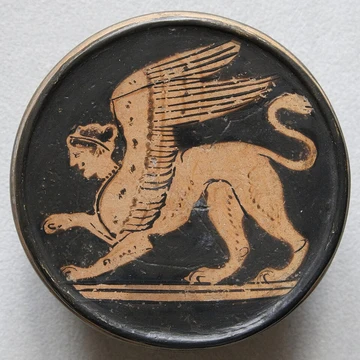
896 Sphinx
A 13-km background asteroid discovered by Max Wolf in 1918.

896 Sphinx is an asteroid located in the inner main belt, about 13 kilometers across. It was discovered on August 1, 1918, by German astronomer Max Wolf at the Heidelberg-Königstuhl State Observatory. The object takes its name from the Sphinx, a mythological creature found in both Greek and Egyptian legends. It is unusual among early-numbered asteroids in that its spectral type has never been identified.
Orbit and classification Sphinx belongs to the background population of the main belt, meaning it is not part of any recognized asteroid family. It travels around the Sun at a distance ranging from 1.9 to 2.7 AU, completing one orbit every 3 years and 6 months (1,262 days). Its orbit has an eccentricity of 0.16 and an inclination of 8° relative to the ecliptic. The first observation used to track its orbit was made at Heidelberg Observatory on October 9, 1918, two months after its discovery.
Naming The asteroid was named for the Sphinx, a legendary monster with a woman's head, a lion's body, and bird's wings. In myth, it killed anyone unable to solve its riddle. The naming citation appears in Paul Herget's 1955 book *The Names of the Minor Planets* (H 87).
Physical characteristics Unlike most other low-numbered asteroids, Sphinx has no determined spectral type. Given its relatively high albedo and its location in the inner main belt, it may be a common stony S-type asteroid.
Rotation period In June 2018, astronomer Tom Polakis measured the asteroid's lightcurve at the Command Module Observatory in Arizona. The data indicated a rotation period of 21.038 ± 0.008 hours, with a brightness variation of 0.16 ± 0.02 magnitude. An alternative solution of 10.541 ± 0.003 hours with a similar amplitude is also possible. Both results improved on a tentative 2001 measurement by Laurent Bernasconi. A separate 2018 model, using data from the Lowell Photometric Database and the WISE spacecraft, gave a different sidereal period of 12.95209 ± 0.00002 hours and suggested two possible spin axes: (172.0°, 20.0°) and (352.0°, 42.0°) in ecliptic coordinates.
Diameter and albedo Surveys by NEOWISE, IRAS, and the Japanese Akari satellite have produced varying diameter estimates: 11.974 ± 0.071 km, 13.07 ± 0.5 km, and 14.45 ± 0.35 km, respectively. Corresponding albedos are 0.242 ± 0.045, 0.1971 ± 0.017, and 0.163 ± 0.009. The Collaborative Asteroid Lightcurve Link calculates a
- discovered
- 1 August 1918
- discoverer
- Max Wolf
- diameter
- ~13 km
- rotation_period
- 21.0 hours
- orbital_period
- 3 years 6 months
- semi-major_axis
- 2.29 AU
- named_after
- Sphinx (Greek and Egyptian mythology)
Lore & Background
896 Sphinx orbits the Sun in the inner asteroid belt at a distance of 1.9–2.7 AU once every 3 years and 6 months. Its orbit has an eccentricity of 0.16 and an inclination of 8° with respect to the ecliptic. The body's observation arc began at Heidelberg Observatory on 9 October 1918, two months after its official discovery observation. It is a non-family asteroid of the main belt's background population when applying the hierarchical clustering method to its proper orbital elements.
Reader's Guide
896 Sphinx is notable as one of the few low-numbered asteroids for which no spectral type has been determined, despite its relatively high albedo suggesting it may be a common, stony S-type asteroid. Its rotation period has been measured with some uncertainty: photometric observations in June 2018 gave a period of 21.038 hours, though an alternative solution of 10.541 hours is also possible, and a modeled lightcurve from 2018 gave a divergent sidereal period of 12.95209 hours. Diameter estimates vary across surveys, ranging from about 11.97 km to 14.45 km, with corresponding albedos from 0.163 to 0.242. The asteroid's name, referencing the Sphinx of mythology, was cited in Paul Herget's 1955 work The Names of the Minor Planets. Its legacy lies in illustrating the ongoing challenges in characterizing even relatively bright, low-numbered asteroids.
Did You Know?
- 896 Sphinx was discovered by Max Wolf at the Heidelberg-Königstuhl State Observatory on 1 August 1918.
- It is one of few low-numbered asteroids for which no spectral type has been determined.
- The asteroid's rotation period has multiple possible solutions, including 21.038 hours and 10.541 hours.
- Diameter estimates from different surveys range from 11.974 km to 14.45 km.
Discovery and Orbital Path
896 Sphinx first entered the astronomical record on 1 August 1918, when German astronomer Max Wolf identified it from the Heidelberg-Königstuhl State Observatory in southwest Germany. The body's formal observation arc, however, does not begin until 9 October 1918, roughly two months after that initial detection. Classified as a non-family member of the main belt's background population—determined by applying hierarchical clustering to its proper orbital elements—Sphinx occupies the inner reaches of the asteroid belt. It completes one circuit of the Sun every 1,262 days, or about three and a half years, at a semi-major axis of 2.29 astronomical units. Its orbital path stretches between 1.9 and 2.7 AU from the Sun, with a moderate eccentricity of 0.16 and an inclination of just 8 degrees relative to the ecliptic plane. These parameters place it firmly among the inner-belt objects, a region that tends to host stony, silicate-rich bodies rather than the carbonaceous material more common in the outer belt.
Mythological Namesake
The designation 'Sphinx' links this modest inner-belt asteroid to one of the most enduring figures in ancient mythology. In both Greek and Egyptian traditions, the Sphinx is depicted as a female creature combining the head of a woman, the haunches of a lion, and the wings of a bird. According to legend, this monster posed a deadly riddle to travelers, killing anyone unable to provide the correct answer. The asteroid received this name as a formal citation recorded in Paul Herget's reference work The Names of the Minor Planets, published in 1955 under entry H 87. The choice of name is fitting in a symbolic sense: just as the mythological Sphinx guards a threshold with an enigmatic challenge, 896 Sphinx remains, in a scientific sense, partially veiled. Despite its relatively low number in the catalog of minor planets, it is one of the few objects in that early range for which no definitive spectral type has ever been established, leaving its true surface composition an open question for astronomers.
Size, Albedo, and Surface Composition
Estimating the physical dimensions of a distant asteroid like 896 Sphinx requires triangulating data from multiple space-based surveys. NASA's NEOWISE mission, the Infrared Astronomical Satellite IRAS, and Japan's Akari satellite each produced slightly different diameter and albedo figures. NEOWISE yielded a diameter of approximately 11.97 kilometers with an albedo near 0.242; IRAS gave 13.07 kilometers and an albedo of roughly 0.197; Akari reported 14.45 kilometers with an albedo around 0.163. The Collaborative Asteroid Lightcurve Link, working from an absolute magnitude of 11.6, derives a diameter of 13.17 kilometers and an albedo of 0.2332. Because no spectral type has been formally assigned—a notable gap for such a low-numbered body—scientists infer from the relatively high reflectivity and the asteroid's inner-belt location that it is likely a common stony S-type object, composed predominantly of silicate minerals and metallic iron.
Rotation and Photometric Studies
Understanding how fast 896 Sphinx spins on its axis has proven more complicated than a single measurement might suggest. In June 2018, astronomer Tom Polakis conducted photometric observations from the Command Module Observatory in Arizona, deriving a rotation period of 21.038 hours with a brightness swing of 0.16 magnitudes. Yet an alternative mathematical solution of 10.541 hours, with a similar amplitude, also fits the data. Both of these results superseded a tentative period first proposed by Laurent Bernasconi in September 2001. A separate 2018 modeled lightcurve, built from photometric data in the Lowell Photometric Database and infrared observations from the Wide-field Infrared Survey Explorer, produced yet another figure: a sidereal period of 12.95 hours, along with two possible spin-axis orientations in ecliptic coordinates. The spread among these values reflects the genuine difficulty of pinning down the rotation of a small, distant, and spectrally unclassified body.
Frequently Asked Questions
What is 896 Sphinx?
896 Sphinx is a roughly 13-kilometer-wide asteroid orbiting in the inner main belt. It was first observed on August 1, 1918, by German astronomer Max Wolf at the Heidelberg-Königstuhl State Observatory.
What is 896 Sphinx's orbital period and distance from the Sun?
The asteroid completes one circuit of the Sun in about three and a half years. Its semi-major axis sits at roughly 2.29 astronomical units, placing it firmly in the inner main-belt region.
Why is 896 Sphinx considered unusual for an early-numbered asteroid?
Despite being catalogued over a century ago, Sphinx's spectral type has never been successfully identified. This leaves its surface composition a mystery compared to most other asteroids from that era.
What is 896 Sphinx's rotation period and family affiliation?
Sphinx spins on its axis once every 21.0 hours. It is classified as part of the background main-belt population, meaning it does not belong to any recognized asteroid family.
Where does the name "Sphinx" come from?
The asteroid takes its name from the Sphinx, a legendary creature featured in both Greek and Egyptian mythology. This follows the long-standing convention of assigning mythological names to numbered asteroids.
More in Sphinxes 1-24
Spotted an error? Know more?
This is a living reference — every entry is fact-audited, and reader corrections feed straight into our audit queue. Suggest an edit · See this site's audit record