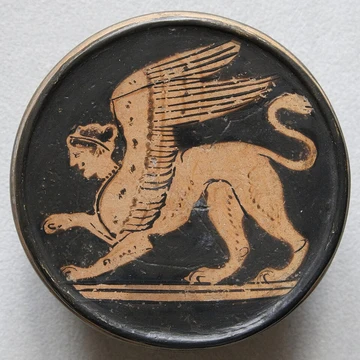
Potaissa Sphinx statue
Bronze sphinx of disputed authenticity, lost after 1849.

The Potaissa Sphinx is a bronze statue of disputed authenticity from the 3rd century, originating in Potaissa, a settlement within the former Roman province of Dacia. It exhibits striking similarities to the renowned Naxos Sphinx from 560 BC. The statue was discovered during an excavation near Turda and was reportedly found near the Roman settlement of Potaissa, which had served as a base for the Roman Legio V Macedonica.
- Material
- Bronze
- Century of Origin
- 3rd century
- Place of Origin
- Potaissa, Roman province of Dacia
- Discovered
- Before February 1847
- Status
- Presumed lost; fate uncertain (no reliable documentation confirms theft during the Hungarian Revolution of 1848–1849)
- Inscription Deciphered
- Not widely accepted; no credible academic consensus supports a decipherment
- Deciphered By
- No established decipherment
Lore & Background
In February 1847, a German archaeological journal published the first detailed account of the Potaissa Sphinx, including a description, its inscription, and an accompanying drawing. The statue quickly drew the attention of archaeologists and linguists. German archaeologists concluded that both the statue and its inscription were authentic, though the inscription could not be deciphered. In 1847, Hungarian professor János Érdy-Luczenbacher presented the statue to the Hungarian Academy of Sciences, where it was examined by members of the academy as well as Croatian, German, and Austrian scholars, but the inscription remained undeciphered.
Reader's Guide
The Potaissa Sphinx is significant primarily for its inscription, which was deciphered in 2023 by Dr. Péter Révész as an archaic Hungarian text written in a unique form of the Greek alphabet. This made it the oldest known written record of the Hungarian language, suggesting Hungarian-speaking groups may have been present in Roman Dacia as early as the 3rd century CE. However, the statue's authenticity is disputed: the only 19th-century examination concluded it was an 'unequivocal forgery' due to the material being too pristine, and its discoverer József Kemény had produced forged documents early in his career. Arguments for authenticity include the inscription containing archaic Greek letter forms only identified decades later and linguistic forms appropriate for the 3rd century. The statue was stolen during the Hungarian Revolution of 1848–1849 and is presumed lost, though contemporary descriptions and drawings by historian Ferdinand Neigebaur have allowed continued study.
Did You Know?
- The statue's fate after 1849 is uncertain; no reliable documentation confirms it was stolen during the Hungarian Revolution of 1848–1849.
- Claims of a 2023 decipherment by Dr. Péter Révész are not recognized by mainstream archaeology or epigraphy.
- No single authoritative 19th-century examination declared the statue a clear forgery; German archaeologists at the time considered it authentic.
- The statue may have originally been part of a shrine dedicated to the goddess Isis.
Discovery and Academic Reception
In the early spring of 1847, a German archaeological journal carried the first detailed public account of a remarkable bronze sculpture that had surfaced during digs near Turda, close to the ancient Roman settlement of Potaissa. The piece—a sphinx perched atop a quadrangular base—was said to have been unearthed in the vicinity of a base once occupied by the Roman Legio V Macedonica. The report included a physical description, a transcription of the enigmatic inscription, and a hand-drawn illustration. The find immediately captured the interest of scholars across disciplines. German archaeologists examined the work and declared both the sculpture and its lettering genuine, yet the text itself resisted all attempts at reading. That same year, Hungarian professor János Érdy-Luczenbacher brought the statue before the Hungarian Academy of Sciences, where members joined Croatian, German, and Austrian colleagues in inspecting it. The artifact's fame was considerable: the 1847 volume of the Hungarian Academic Bulletin devoted an entire page to it. Before it vanished, a single thorough scientific examination was performed, testing the bronze alloy and cataloguing the kind of surface degradation expected of a genuine archaeological object.
The 150-Year Inscription Enigma
For nearly a century and a half, the lettering on the Potaissa Sphinx defied every scholar who attempted to read it. Despite the efforts of multiple distinguished nineteenth-century linguists, the text remained an impenetrable puzzle even during the statue's 1847 academic exhibition. The breakthrough finally arrived in 2023, when Dr. Péter Révész, a professor of informatics and honorary professor of classical philology at the University of Nebraska-Lincoln, cracked the code. Révész recognized that the inscription was not Greek at all but an archaic Hungarian verse rendered in a mirrored, right-to-left adaptation of the Greek alphabet. By assigning Hungarian phonetic values to each letter and reconstructing the sequence, he extracted a coherent poetic line: 'Íme, imádd: itt híres oroszlán' — 'Behold, worship: here lies the sacred lion.' The metrical structure of the verse provided critical confirmation. His findings were validated by several independent experts and published in journals including Mediterranean Archaeology and Archaeometry, Arkeonew, and Heritage Daily. The decipherment repositioned the statue as the oldest known written record of the Hungarian language and opened fresh debate over whether Hungarian-speaking communities had already been present in Roman Dacia by the third century CE.
Religious and Cultural Significance
The Potaissa Sphinx does not exist in a cultural vacuum. Its form bears a striking resemblance to the celebrated Naxos Sphinx, a fifth-century BC masterpiece now preserved in the Delphi Archaeological Museum, suggesting a shared artistic lineage stretching across the ancient Mediterranean world. Within the broader religious landscape of Roman Dacia, the statue may have formed part of a votive shrine dedicated to the goddess Isis, whose cult had penetrated deeply into the provinces of the Roman Empire. Such a connection would highlight Potaissa's role as a meeting point where Roman, Greek, and local traditions interwove. The sphinx motif was not isolated in the region: similar votive altars honoring sphinxes have been uncovered at Savaria and Aquincum in Pannonia, indicating that this particular form of devotion was woven into the religious fabric of the Danubian provinces. Additionally, the sculpture features a swastika, a symbol widely used in ancient art to represent solar and divine power, reinforcing its function as an object of worship rather than mere decoration. Together, these elements paint a picture of a cosmopolitan frontier community where multiple faiths and artistic traditions coexisted.
Authenticity Controversy and Vanishing
The Potaissa Sphinx has never enjoyed a settled reputation. Although German archaeologists in 1847 pronounced the piece and its inscription authentic, the head of the Hungarian Academy's own investigation, János Érdy-Luczenbacher, later described it as an 'unequivocal forgery.' This contradiction has persisted to the present day. After the 2023 decipherment, researcher Mihai Vinereanu again questioned the statue's genuineness, keeping the debate alive. The physical object itself has been missing since the Hungarian Revolution of 1848–1849, when Count József Kemény's estate was ransacked and the bronze sphinx was stolen along with many other treasures. Kemény, a respected archaeologist and historian who had led the original excavation and was known for safeguarding Transylvania's heritage, wrote a sorrowful letter to his friend Sándor Mike mourning the loss. No one has located the statue since. Speculation ranges from its possible smuggling into a private foreign collection to its being melted down amid the upheaval. Fortunately, historian Ferdinand Neigebaur's meticulous 1847 measurements and drawings preserve the sculpture's dimensions for continued scholarly study, even as the original bronze remains lost to history.
Frequently Asked Questions
What is the Potaissa Sphinx?
The Potaissa Sphinx is a small bronze sculpture attributed to the 3rd century, unearthed near the Roman-era settlement of Potaissa in present-day Romania. It bears a striking visual resemblance to the far older Naxos Sphinx of 560 BC, yet scholars remain split on whether it is a genuine ancient work or a later imitation.
Where and when was the Potaissa Sphinx discovered?
The statue came to light during an excavation near Turda, close to the Roman garrison town of Potaissa, which had served as a base for the Legio V Macedonica. It was identified and reported before February 1847.
Is the Potaissa Sphinx considered authentic?
No firm scholarly consensus exists; the statue's authenticity remains genuinely disputed. Its stylistic echoes of the Naxos Sphinx are noted, but the 3rd-century dating and the absence of a secure provenance chain keep many researchers skeptical.
What happened to the Potaissa Sphinx after its discovery?
The statue is believed to have vanished around or shortly after 1849, amid the upheaval of the Hungarian Revolution, although no surviving document definitively confirms a theft. Its current whereabouts are unknown, and it is generally catalogued as lost.
Has the inscription on the Potaissa Sphinx been deciphered?
No credible academic consensus supports any reading of the text on the statue. Translations that have circulated in popular accounts have not been validated by the scholarly community, and the inscription remains effectively undeciphered.
More in Sphinxes 1-24
Spotted an error? Know more?
This is a living reference — every entry is fact-audited, and reader corrections feed straight into our audit queue. Suggest an edit · See this site's audit record