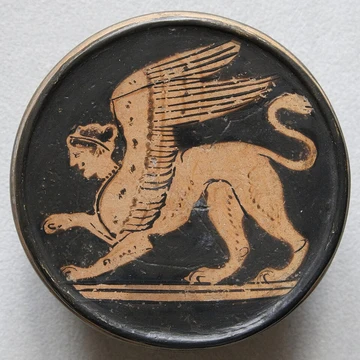
Phoenician Sphinx inscription
Inscription on a sphinx socle dedicated to Milk'ashtart El-Hammon.

The Abdadoni inscription, also known as the Phoenician Sphinx inscription, was discovered at Umm al-Amad in Lebanon. It appears on the base of a statue depicting a sphinx in a reclining pose; only the feet and ankles remain attached to the socle, while the sphinx’s body was found beside it, though its head was never located. The text records that the statue was dedicated to the deity Milk'ashtart El-Hammon. The piece was situated to the right of an entrance to a building on the eastern side, at the edge of a street, and is one of several sphinx fragments unearthed at the site. It is believed that two such sphinx statues originally flanked the entrance to the temple complex. The artifact now resides in the National Museum of Beirut. Although likely discovered earlier, it was first published in 1962 by Maurice Dunand and Raymond Duru. The inscription reads:
- material
- Stone socle of a sphinx statue
- discovery_site
- Umm al-Amad, Lebanon
- current_location
- National Museum of Beirut
- first_published
- 1962 by Maurice Dunand and Raymond Duru
- dedicated_to
- Milk'ashtart El-Hammon
- associated_deity
- Milk'ashtart El-Hammon
Lore & Background
The inscription was found to the right of an entrance to one of the buildings on the east side of the site, at the edge of the street. It was one of a number of sphinx fragments discovered at Umm al-Amad. It is thought that the entrance to the temple complex was flanked by two such sphinx statues. The statue itself was a couching sphinx, but only the feet and ankles remain attached to the inscribed socle; the body lay beside it, and the head was never found.
Reader's Guide
The Phoenician Sphinx inscription provides a rare epigraphic link to the cult of Milk'ashtart El-Hammon at the Hellenistic site of Umm al-Amad. Its placement at a building entrance, possibly one of a pair flanking a temple complex, suggests the sphinx served a protective or symbolic function. The inscription's dedication formula offers insight into Phoenician religious practice and the syncretism of local deities. First published in 1962 by Maurice Dunand and Raymond Duru, though likely discovered earlier, the artifact is now housed in the National Museum of Beirut. Its fragmentary state—missing the sphinx's head—and the scholarly notes on its reading (e.g., by Charles Krahmalkov and A. Caquot) underscore ongoing interpretive challenges. The inscription remains a key piece of evidence for understanding Phoenician iconography and votive traditions in the Levant during the Hellenistic period.
Did You Know?
- The inscription is also known as the Abdadoni inscription.
- The sphinx's head was not found; only the feet and ankles remain attached to the inscribed socle.
- It was found to the right of an entrance to a building on the east side of the site, at the edge of the street.
- The statue was dedicated to the deity Milk'ashtart El-Hammon.
Discovery and Physical Remains
The Phoenician Sphinx inscription, more commonly referenced as the Abdadoni inscription, was unearthed at the archaeological site of Umm al-Amad in Lebanon. The text was carved into the socle of a couching sphinx statue. By the time of its recovery, only the feet and ankles remained attached to this base. The body of the sphinx had been discovered lying adjacent to the socle, yet the head was never located. The inscription was situated to the right of an entrance belonging to one of the structures on the east side of the site, positioned at the edge of a street. It was not an isolated find; rather, it formed part of a broader collection of sphinx fragments recovered from the same location. The statue's dedication, as recorded in the inscription, was made to the deity Milk'ashtart El-Hammon, linking the object to Phoenician religious practice.
The Dedication and Its Religious Significance
The inscription carved into the socle records that the sphinx statue was dedicated to the deity Milk'ashtart El-Hammon. The alternate name by which the text is known—Abdadoni—appears to be drawn from the inscription itself, as referenced in scholarly discussions of the 'BD'DNY text from Umm el-'Amed. Though the full text is brief, it offers a direct glimpse into the devotional life of the community at this Hellenistic-period settlement. The statue's placement at the edge of a street, to the right of a building entrance on the site's eastern side, implies it was meant to be encountered by passersby, serving a public religious role. The explicit dedication to a named Phoenician god suggests that the residents of Umm al-Amad maintained structured worship of their traditional deities even as the wider region underwent Hellenistic cultural transformation. In this way, the inscription functions as a small but concrete record of religious identity and local piety in a Phoenician community of the Hellenistic era.
Architectural Setting and the Temple Complex
The Abdadoni inscription was not found in isolation. It was one of several sphinx fragments recovered at Umm al-Amad, indicating that the site once featured a more extensive collection of sculptural elements. Its specific position—set to the right of an entrance to one of the buildings on the eastern side of the settlement, at the edge of the street—points to a deliberate architectural placement. Scholars have proposed that the entrance to the temple complex at this location was flanked by a pair of such couching sphinx statues, creating a symmetrical guardian arrangement. This reconstruction, while based on inference from the fragmentary evidence, fits the broader pattern of Phoenician and Near Eastern temple architecture in which monumental animal figures marked sacred thresholds. The fact that the sphinx body was found lying beside its socle, with the head entirely missing, speaks to the site's later history of disruption and the piecemeal nature of its recovery. Together, these fragments paint a picture of a once-imposing ceremonial entrance that has survived only in broken, scattered form.
Scholarly Publication and Museum Custody
The Abdadoni inscription entered the scholarly record in 1962, when Maurice Dunand and Raymond Duru published their study of Umm al-Amad, describing the site as a Hellenistic-period town situated at the trading posts of Tyre. Their work, issued by Librairie d'Amérique et d'Orient, included the inscription on page M. 435 and Plate XXX, though the object had likely been discovered at the site before that publication date. The inscription attracted further academic attention in the years that followed. In 1965, A. Caquot contributed a study in the journal Semitica examining the god Mikastart and the inscriptions from Umm el-Ahmed, while in 1971 Charles Krahmalkov published a focused note on the 'BD'DNY inscription in Rivista Degli Studi Orientali. These successive publications reflect the inscription's value as a primary source for understanding Phoenician religious nomenclature and local cult practice. Today, the socle bearing the text is housed in the National Museum of Beirut, where it remains accessible to researchers and the public as a compact yet significant artifact of Phoenician material culture.
Frequently Asked Questions
What is the Phoenician Sphinx inscription?
It is a Phoenician-language dedicatory text carved onto the stone base of a reclining sphinx statue, also catalogued under the name Abdadoni inscription. The socle is one of several sphinx fragments pulled from the same excavation area.
Where was the Phoenician Sphinx inscription found and where can I see it today?
The base was recovered at Umm al-Amad in Lebanon, sitting just to the right of a building's eastern doorway at the edge of a street. The piece is now housed in the National Museum of Beirut.
To which god or goddess was the Phoenician Sphinx inscription dedicated?
The text names Milk'ashtart El-Hammon as the recipient of the offering. The sphinx statue and its inscription together constituted a votive dedication to that deity.
What survives of the sphinx statue behind the Phoenician Sphinx inscription?
Only the feet and ankles are still joined to the socle; the remainder of the body was found lying beside the base. The head was never located during the excavation.
Who first published the Phoenician Sphinx inscription and in what year?
Maurice Dunand and Raymond Duru brought the text and its archaeological context to scholarly notice in 1962. Their publication remains the standard reference for the piece.
More in Sphinxes 1-24
Spotted an error? Know more?
This is a living reference — every entry is fact-audited, and reader corrections feed straight into our audit queue. Suggest an edit · See this site's audit record