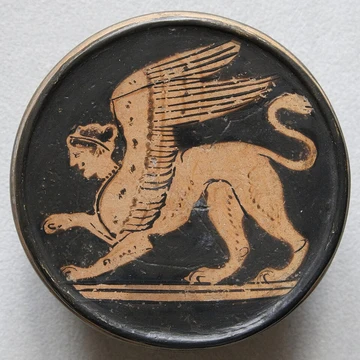
Sphinx of Naxos
Marble sphinx votive offering from Naxos at Delphi.

The Sphinx of Naxos, also known as the Sphinx of the Naxians, is a 2.22-meter-tall marble statue of a mythical sphinx, with the head of a woman, the chest and wings of a prey bird, and the body of a lioness. It stood on a 10-meter column topped with one of the first Ionic capitals, erected next to the Temple of Apollo in Delphi around 560 BCE as a votive offering by the island of Naxos. The monument, now housed in the Archaeological Museum of Delphi, is a notable example of early Greek sculpture in-the-round.
- material
- Marble (Naxian marble)
- height
- 2.22 meters (statue); overall with column and base over 12.5 meters
- date
- circa 560 BCE
- location
- Delphi, Greece (originally next to Temple of Apollo; now in Archaeological Museum of Delphi)
- culture
- Ancient Greek (Naxian)
- type
- Votive offering, architectural sculpture
Lore & Background
The Sphinx of Naxos was erected around 560 BCE by the wealthy Cycladic island of Naxos as a votive offering to the Temple of Apollo at Delphi, the religious center of ancient Greece. It stood on a tall Ionic column near the Halos, the most sacred spot where Apollo was said to have killed the python. The statue combines a woman's face with an enigmatic smile, prey bird wings, and a lioness's body, carved from a single large piece of Naxian marble. Its solid construction and detailed hair, chest, and wings give it a sense of motion and vitality, and it is an early example of carving in-the-round rather than relief.
Reader's Guide
The Sphinx of Naxos is significant as a major votive monument from the Archaic period, reflecting the wealth and artistic skill of Naxos in the 6th century BCE. Its placement at Delphi, the pan-Hellenic religious center, underscores its role as a guardian figure, a common function of sphinxes in Greek architecture. The monument's height—over 12.5 meters including column and base—would have inspired awe in visitors. The column's Ionic capital is among the earliest known, marking an important development in Greek architectural orders. Fragments were first excavated in 1860, with the remainder found in 1893. A later inscription from 328–327 BCE records Delphi renewing the Naxians' right of promanteia (priority in consulting the oracle). The Sphinx of Naxos also belongs to a broader tradition of sphinx-topped columns in ancient Greece, and some scholars suggest it may have influenced the later pillars of Ashoka in India following Alexander the Great's contacts.
Did You Know?
- The Sphinx of Naxos stood on a 10-meter column topped with one of the first Ionic capitals.
- It was erected around 560 BCE as a votive offering by the island of Naxos to the Temple of Apollo at Delphi.
- The statue is an early example of carving in-the-round, as opposed to the more common relief carving of the time.
- A later inscription from 328–327 BCE records Delphi renewing the Naxians' right of promanteia (priority in oracle consultation).
The Creature in Dual Traditions
In the Greek imagination, the sphinx was a fearsome and unforgiving figure—a being combining a woman's face, the powerful haunches of a lion, and the outstretched wings of a bird. She was treacherous by nature, posing riddles to travelers and devouring those who could not answer correctly. This lethal aspect of the creature is most famously preserved in the myth and dramatic works surrounding Oedipus. The Egyptian tradition, by contrast, presented the sphinx as a male figure, the androsphinx, embodying benevolent strength and ferocity, typically representing a pharaoh. Notably, Egyptian versions lacked the wings that defined their Greek counterparts. Despite these stark differences in temperament and form, both traditions agreed on one essential role: guardianship. Statues of the sphinx were positioned to flank the entrances of sacred spaces, and their depictions were consistently tied to monumental architecture—royal tombs, religious temples, and other grand structures that demanded a powerful sentinel.
Etymology and the Question of Origin
The very name "sphinx" carries a layered history that scholars have debated for centuries. In Greek, the word Σφίγξ was popularly linked to the verb sphíngō, meaning to squeeze or tighten—a folk etymology rooted in the observation that lions kill by strangling their prey, clamping their jaws around the throat and holding the animal down until it dies. However, the historian Susan Wise Bauer proposed a different origin: that "sphinx" was actually a Greek phonetic adaptation of the Egyptian term shesepankh, which translates as "living image." Under this reading, the name did not originally describe a mythical beast at all but rather the physical statue itself—carved from what the Egyptians called "living rock," meaning stone that remained contiguous with the bedrock of the earth, shaped in place rather than quarried and transported. This distinction between the creature and its carved representation remains a subtle but important thread in how the sphinx has been understood across cultures.
Monuments of Guardianship in Egypt
The most iconic sphinx stands on the Giza Plateau, southeast of the Great Pyramids, on the west bank of the Nile. Egyptologists agree that its head carries the features of the pharaoh Khafre, placing its construction between 2600 and 2500 BC, though some late-twentieth-century geologists have argued that water-erosion patterns suggest a far older origin—claims that lack support in the Egyptological community. A 1400 BC stele from the reign of Thutmose IV names three aspects of the sun deity, Khepera–Rê–Atum, at the site. Beyond Giza, the sphinx theme expanded: pharaohs placed their likenesses atop guardian statues to signal their bond with Sekhmet, the lioness deity. Examples include a granite sphinx of Hatshepsut now in New York's Metropolitan Museum and an alabaster specimen at Memphis. In Thebes, nine hundred ram-headed Criosphinxes representing the god Amon lined sacred approaches, each paired with a full-length pharaoh statue at Karnak. Their purpose was to repel the forces of evil. The Great Sphinx serves as a national emblem, appearing on Egyptian stamps, coins, and official documents. In March 2023, a limestone sphinx with a faint grin and dimples, possibly depicting the Roman emperor Claudius, was unearthed at the Dendera Temple Complex.
The European Revival and Cultural Diffusion
During the Renaissance, the sphinx experienced a resurgence in European decorative arts. Initially rendered close to its Egyptian prototype, the figure evolved as it traveled, shaped by varied translations of ancient descriptions and its integration into local traditions. The Mannerist sphinx of the late fifteenth century—sometimes called the "French sphinx"—featured an upright coiffed head, the breasts of a young woman, and a naturalistic recumbent lioness body. This style emerged when the grottesche decorations of Nero's Domus Aurea were rediscovered in Rome, and the sphinx entered the arabesque vocabulary spreading through engravings in the sixteenth and seventeenth centuries. Raphael's workshop included sphinxes in the loggia of the Vatican Palace (1515–20). In France, the figure appeared in the School of Fontainebleau in the 1520s and 1530s, persisting into the Late Baroque Régence period (1715–1723). From there, sphinxes became a staple of eighteenth-century palace gardens—Vienna's Upper Belvedere, Potsdam's Sanssouci, Spain's La Granja, Białystok's Branicki Palace, and Portugal's Queluz National Palace, where late Rococo examples sported ruffs and clothed chests. Neoclassical designers like Robert Adam returned to the undressed grottesche style, while Romantic and Symbolist artists of the nineteenth century drew on the Greek Oedipus myth rather than the Egyptian tradition.
Frequently Asked Questions
Who is Sphinx of Naxos?
The Sphinx of Naxos is a marble sculpture depicting a hybrid creature with a woman's head, a prey bird's chest and wings, and a lioness's body. It was created around 560 BCE by the island of Naxos as a votive offering dedicated at the Delphic sanctuary.
What are the Sphinx of Naxos's dimensions and materials?
The statue itself stands 2.22 meters tall and is carved from Naxian marble. When mounted on its 10-meter column topped with an Ionic capital, the full monument exceeded 12.5 meters in overall height.
Where is the Sphinx of Naxos kept today?
It is currently housed in the Archaeological Museum of Delphi in Greece. Originally it stood on a tall column beside the Temple of Apollo at the Delphic sanctuary.
Why is the Sphinx of Naxos important?
It is recognized as one of the earliest surviving examples of Greek sculpture carved fully in the round. The monument also features one of the first known Ionic capitals, making it a key reference point for tracing early architectural and sculptural development.
What is the Sphinx of Naxos's role or purpose?
It served as a votive offering from the island of Naxos, placed at Delphi to honor the gods and display the island's wealth and devotion. As an architectural sculpture, it functioned as a prominent landmark next to the Temple of Apollo.
More in Sphinxes 1-24
Spotted an error? Know more?
This is a living reference — every entry is fact-audited, and reader corrections feed straight into our audit queue. Suggest an edit · See this site's audit record