Great Sphinx of Giza
Ancient limestone sphinx on the Giza Plateau, Egypt.

The Great Sphinx of Giza, carved from the limestone bedrock of the Eocene-aged Mokattam Formation, is a reclining statue of a mythical sphinx—a creature with a human head and a lion’s body. It faces east on the Giza Plateau, west of the Nile in Giza, Egypt. As the oldest monumental sculpture known in Egypt, it belongs to the Memphite Necropolis and is a UNESCO World Heritage Site.
Archaeological findings indicate that Egyptians from the Old Kingdom created the Sphinx during the reign of either Khufu (c. 2590–2566 BC) or Khafre (c. 2558–2532 BC). Scholars and Egyptologists generally believe the face was carved to resemble one of these pharaohs—Khufu, his son Djedefre, or another son, Khafre—but no consensus exists, and whose likeness it bears remains disputed.
The Sphinx has been restored multiple times, most recently by adding layers of limestone blocks around its base. It measures 73 meters (240 feet) from paw to tail, 20 meters (66 feet) from base to head top, and 19 meters (62 feet) wide at its rear haunches.
How the Sphinx lost its nose is unknown, though examinations of the face show it was deliberately broken off with rods or chisels. Contrary to a popular myth, Napoleon’s troops did not shoot it off with cannonfire during his 1798 Egyptian campaign.
The original name given by its Old Kingdom creators is lost, as the Sphinx temple, enclosure, and possibly the statue itself were left unfinished, leaving little known about its early cultural context. During the New Kingdom, it was revered as the solar deity Hor-em-akhet (English: “Horus of the Horizon”; Hellenized: Harmachis), and the 14th-century BC pharaoh Thutmose IV calls it this in his Dream Stele.
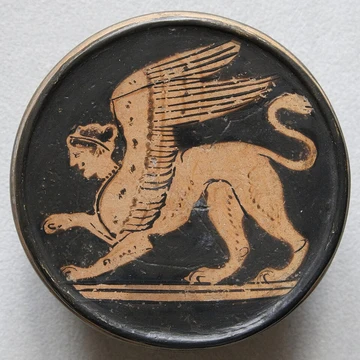
The common name “Sphinx” was assigned in classical antiquity, roughly 2,000 years after its construction, referencing a Greek mythological beast—a creature with a woman’s, falcon’s, cat’s, or sheep’s head, a lion’s body, and eagle’s wings (though the Great Sphinx, like most Egyptian sphinxes, has a man’s head and no wings). The English word comes from the ancient Greek Σφίγξ (sphinx), apparently from the verb σφίγγω (sphingo, “to squeeze”), after the Greek sphinx who strangled anyone unable to answer her riddle.
Medieval Arab writers, including al-Maqrīzī, called the Sphinx by the Arabized Coptic names Belhib, Balhubah, or Belhawiyya, derived from Pehor or Pehor(o)n—names of the Canaanite god Hauron
- material
- Limestone (Eocene-aged Mokattam Formation)
- length
- 73 m (240 ft) from paw to tail
- height
- 20 m (66 ft) from base to top of head
- width
- 19 m (62 ft) at rear haunches
- location
- Giza Plateau, west bank of the Nile, Giza, Egypt
- period
- Old Kingdom (c. 2600–2500 BC)
- known_for
- Oldest known monumental sculpture in Egypt; disputed likeness to pharaohs Khufu, Djedefre, or Khafre
Quick Facts
- Location
- Giza, Egypt
- Region
- Egypt
- Length
- 73 m
- Height
- 20 m
- Material
- Limestone
- Built
- c. 26th century BC
- Condition
- Partially restored
Facts from the source article.
Lore & Background
Archaeological evidence suggests the Sphinx was created by Egyptians of the Old Kingdom during the reign of Khufu (c. 2590–2566 BC) or Khafre (c. 2558–2532 BC). Scholars believe the face was carved to represent either Khufu or one of his sons, pharaohs Djedefre and Khafre, but a consensus has not been reached. The Sphinx is a monolith carved from the bedrock of the plateau, which also served as the quarry for the pyramids and other monuments. Egyptian geologist Farouk El-Baz has suggested the head may have been carved first out of a natural yardang, a ridge of bedrock sculpted by the wind.
Reader's Guide
The Great Sphinx of Giza is a monumental limestone statue of a reclining sphinx, the oldest known monumental sculpture in Egypt. Its original name is unknown, as the Sphinx temple and enclosure were not completed at the time. In the New Kingdom, it was revered as the solar deity Hor-em-akhet (Horus of the Horizon). The commonly used name 'Sphinx' was given in classical antiquity, derived from a Greek mythological beast. Medieval Arab writers called it Belhib, Balhubah, or Belhawiyya, from the Canaanite god Hauron. The medieval Egyptian Arabic name is Abū il-Hawl (father of terror). The Sphinx has undergone multiple restorations, the most recent involving replacing layers of limestone blocks around the base. The circumstances of the destruction of its nose are unknown, but examinations show evidence of a deliberate act with rods or chisels; contrary to popular myth, it was not destroyed by cannonfire from Napoleon's troops in 1798.
Did You Know?
- The Sphinx is 73 m (240 ft) long from paw to tail, 20 m (66 ft) high, and 19 m (62 ft) wide at its rear haunches.
- The original name given by its Old Kingdom creators is unknown.
- The Sphinx's nose was deliberately destroyed with rods or chisels, not by Napoleon's cannonfire.
- Medieval Arab writers called the Sphinx by an Arabized Coptic name Belhib, from the Canaanite god Hauron.
Origins and the Mystery of Its Maker
The Great Sphinx of Giza stands as the oldest known monumental sculpture in all of Egypt, a colossal reclining figure combining a human head with a lion's body. Carved directly from the Eocene-aged limestone bedrock of the Mokattam Formation, the monolith faces eastward across the Giza Plateau on the Nile's west bank, forming part of the Memphite Necropolis and holding UNESCO World Heritage status. Archaeological evidence points to its creation during the Old Kingdom, specifically under the reign of either Khufu (c. 2590–2566 BC) or his son Khafre (c. 2558–2532 BC). Yet no single contemporary inscription definitively links the statue to either ruler, leaving the identity of the face—whether it depicts Khufu, Djedefre, or Khafre—permanently unresolved. Egyptian geologist Farouk El-Baz proposed that the head may have been the first element shaped, emerging from a wind-sculpted natural yardang, with the surrounding ditch quarried afterward to reveal the full lion body. The stones removed during this process were repurposed for a temple at the statue's front, though neither that temple nor its enclosing wall was ever finished, and no established Sphinx cult appears to have existed in the Old Kingdom.
A Name Across Millennia
The original designation the Old Kingdom artisans gave this monument is lost to history, largely because the Sphinx's temple, enclosure, and perhaps the statue itself were never fully completed, leaving little cultural context behind. In the New Kingdom, the figure was venerated as the solar deity Hor-em-akhet, meaning "Horus of the Horizon," a title the Hellenic world later rendered as Harmachis. The pharaoh Thutmose IV specifically invoked this name in his Dream Stele. The familiar English word "sphinx" arrived roughly two thousand years after the monument's construction, borrowed from classical antiquity's Greek mythological creature—a winged lion-bodied beast with the head of a woman, falcon, cat, or sheep. The Greek term Σφίγξ derives from the verb σφίγγω, meaning "to squeeze," after the riddle-posing monster who strangled those who failed to answer her. Medieval Arab scholars such as al-Maqrīzī recorded the name as Belhib, Balhubah, or Belhawiyya, traceable to the ancient Egyptian pꜣ-Ḥwr or pꜣ-Ḥwr(w)n, a title of the Canaanite god Hauron. In medieval Egyptian Arabic, the statue became Abū il-Hawl, "father of terror," likely a folk reinterpretation of the older Ḥwr root.
Buried in Sand, Reborn in a Dream
Sometime around the First Intermediate Period, the Giza Necropolis fell into abandonment, and centuries of drifting sand gradually swallowed the Sphinx up to its shoulders. The first recorded effort to uncover the buried colossus came around 1400 BC, when the young Thutmose IV assembled a labor force and, after considerable toil, managed to free the front paws. Between them, he erected a small shrine containing the Dream Stele—an inscribed granite slab that may have been a repurposed door lintel from one of Khafre's temples. By the time the stele was found, its text was already worn and incomplete. The surviving passage describes the royal son Thothmos taking a midday nap in the statue's shadow, only to be addressed by the god himself in the intimate voice of a father speaking to his son. The deity identifies himself as Harmakhis-Khopri-Ra-Tum and bestows upon the sleeping prince sovereignty over his domain and supremacy over the living. This single act of excavation transformed a half-buried rock into a living object of royal devotion.
Scale, Scars, and Survival
The Sphinx measures 73 meters (240 feet) from the tips of its front paws to the end of its tail, rises 20 meters (66 feet) from base to the crown of its head, and spans 19 meters (62 feet) across its rear haunches. Over its long history, the monument has required multiple rounds of restoration; the most recent intervention involved replacing deteriorated layers of limestone blocks around its base to stabilize the structure. The most visible scar on the statue is the absence of its nose. The exact circumstances of this loss remain unknown, but close examination of the facial surface reveals marks consistent with a deliberate act carried out using rods or chisels. A widespread popular myth attributes the damage to cannonfire from Napoleon's troops during their 1798 Egyptian campaign, yet this claim is contradicted by the physical evidence on the stone. The Sphinx endures as a testament to both the extraordinary ambition of its Old Kingdom creators and the slow, persistent forces—natural and human—that have shaped its surface across more than four and a half millennia.
Frequently Asked Questions
Who is the Great Sphinx of Giza?
It is a colossal reclining figure showing a human face set on a lion's body, hewn straight out of the Giza Plateau bedrock in Egypt. It is the oldest monumental sculpture of this type known from the ancient Egyptian world.
What are the Great Sphinx of Giza's dimensions?
The statue spans roughly 73 metres (240 ft) from front paw to tail tip and stands about 20 metres (66 ft) tall from base to the top of the head. Its rear haunches are approximately 19 metres (62 ft) wide.
When was the Great Sphinx of Giza created?
It dates to Egypt's Old Kingdom, most likely the mid-third millennium BC. The majority of Egyptologists credit its carving to the reign of either Pharaoh Khufu or his successor Khafre.
What is the Great Sphinx of Giza made of?
The entire figure was shaped from the natural limestone bedrock of the Eocene-aged Mokattam Formation rather than assembled from separate blocks. In other words, the plateau itself became the statue.
Why is the Great Sphinx of Giza important?
As the oldest surviving monumental sculpture in Egypt, it anchors the Memphite Necropolis and holds UNESCO World Heritage status. Its eastward gaze toward the sunrise and its position beside the royal pyramids make it a defining symbol of ancient Egyptian funerary tradition.
More in Sphinxes 1-24
Spotted an error? Know more?
This is a living reference — every entry is fact-audited, and reader corrections feed straight into our audit queue. Suggest an edit · See this site's audit record