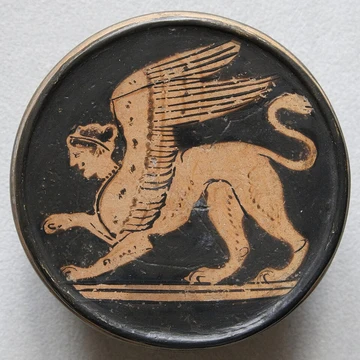
Cesnola sphinx funerary stele
Classic Greek funerary stele with two sphinxes, part of the Cesnola Collection.

The Cesnola sphinx funerary stele is a Classic Greek funerary stela dating to the last quarter of the 5th century B.C. It is part of the Cesnola Collection of the Metropolitan Museum of Art, a sub-section of the Department of Greek and Roman Art, named after the first director of the MET, Luigi Palma di Cesnola. The stele, along with the collection, served as a cornerstone for the study of Cypriot art, a crossroads of Assyrian, Phoenician, Egyptian, Greek, and Roman influences.
- Date
- Last quarter of the 5th century B.C.
- Material
- Stone with original polychromy (red-brown pigment)
- Collection
- Cesnola Collection, Metropolitan Museum of Art
- Catalog Numbers
- Cesnola No. 470, Myres 1413, MET 74.51.2499
- Subject
- Two sphinxes, back to back, left sphinx missing its head
- Provenance
- Excavated by Luigi Palma di Cesnola on Cyprus; acquired by the museum 1874–1876
Quick Facts
- Material
- Limestone
- Size
- Overall: 34 3/4 x 26 15/16in. (88.2 x 68.5cm)
- Created
- last quarter of the 5th century B.C.
- Period
- Classical Greece
- Discovered Date
- 1860s–1870s
- Discovered Place
- Golgoi Necropolis, Cyprus
- Discovered By
- Luigi Palma di Cesnola
- Location
- New York City
- Place
- Metropolitan Museum of Art
- Culture
- Cypriot Greek
- Id
- 74.51.2499
Facts from the source article.
Lore & Background
Luigi Palma di Cesnola, a Medal of Honor recipient in the American Civil War with extensive military history in Europe, served as American Consul to Cyprus in 1865. There he conducted extensive excavations throughout the island. The funerary stele was catalogued in 1874 and officially acquired by the museum in 1874–1876. A 1907 restoration report noted that Charles Balliard, a restorationist who partnered with Cesnola, attempted to restore the missing head of the left sphinx with a head found nearby in situ, but it was subsequently deemed not a match.
Reader's Guide
The Cesnola sphinx funerary stele is significant as part of the Cesnola Collection, the earliest and inaugural acquisition of the Metropolitan Museum of Art upon its opening in Central Park in 1880. Consisting of well over 6000 pieces shipped on 275 crates, the collection—and this stele—served as a cornerstone for the study of Cypriot art, a crossroads of Assyrian, Phoenician, Egyptian, Greek, and Roman influences. The stele's sphinx motif indicates its prominence in cult objects, as prior to its approximate creation in the mid 5th century BC, the depiction was also seen in the Amathus sarcophagus, considered the most significant object in the Cesnola collection alongside the stele, famous for its preserved polychromy. The stele's lower portion is decorated with a frieze of palmettes, egg, and dart, characteristic of 5th century BC style, and portions maintain original red-brown pigment.
Did You Know?
- The stele was found in fragments and was broken from side to side, with forelegs subsequently repaired.
- The left sphinx is missing its head; a head found nearby was attempted as a restoration but deemed not a match.
- The stele is catalogued as Cesnola No. 470, Myres 1413, and MET acquisition number 74.51.2499.
- The back of the stele is roughed out with its bottom half broken off.
Provenance and the Man Behind the Collection
Luigi Palma di Cesnola's path to Cyprus was anything but straightforward. A Medal of Honor recipient from the American Civil War with additional military service across Europe, he transitioned into diplomacy after his military years. In 1865, he was posted as American Consul to Cyprus, a role that gave him the opportunity to conduct extensive excavations across the island. The sphinx funerary stele emerged from this period of active archaeological work. It was catalogued in 1874 and officially acquired by the Metropolitan Museum of Art between 1874 and 1876. Cesnola's broader collection, numbering well over 6,000 pieces and shipped in 275 crates, became the museum's foundational Greek and Roman holdings when it opened in Central Park in 1880. The stele, designated Cesnola No. 470, Myres 1413, and later MET accession number 74.51.2499, stands as one thread in that vast tapestry of Cypriot antiquity.
Artistic Composition and Visual Details
The stele presents a striking symmetrical composition: two sphinxes positioned back to back, each gazing outward in a three-quarters perspective. The intact sphinx displays long hair pulled back along the sides yet falling over the ears, and wears a crown composed of circles and merlons. The left sphinx, unfortunately, lost its head at some point. The lower section of the stele is adorned with a decorative frieze of palmettes, egg, and dart motifs—hallmarks of 5th-century BC Greek aesthetic sensibility. Portions of the surface still retain traces of their original polychromy, specifically a red-brown pigment that speaks to the vivid coloration these objects once possessed. The back of the stele was roughed out, and its bottom half is broken off, suggesting it was never intended to be viewed from behind. The overall dating places it in the final quarter of the 5th century BC, anchoring it firmly within the Classic Greek period.
Condition, Fragments, and Restoration Attempts
The stele did not arrive in the museum in pristine condition. It was initially found in fragments, broken from side to side, with the forelegs also damaged. These pieces were subsequently repaired to reconstitute the object. One of the most notable episodes in its conservation history involves the missing head of the left sphinx. A 1907 restoration report reveals that Charles Balliard, a restorationist who had partnered with Cesnola, attempted to replace the absent head using one discovered nearby in situ at the cemetery where the stele was unearthed. However, this substitution was ultimately rejected because the found head did not match the stele. The stele thus remains with its left sphinx headless, a visible reminder of the fragility of ancient objects and the careful judgments required in their preservation. The roughed-out back and broken lower rear further attest to the incomplete state in which it survived.
Cultural Context and Place in the Collection
The sphinx motif on this funerary stele is not an isolated decorative choice. In the mid-5th century BC, the same iconography appears on the Amathus sarcophagus, widely regarded as the most significant object in the Cesnola collection alongside the stele itself, celebrated for its remarkably preserved polychromy. Together, these pieces illuminate the prominence of the sphinx in Cypriot cult objects and funerary practice. The Cesnola Collection, housed within the Department of Greek and Roman Art at the Metropolitan Museum of Art, served as a cornerstone for the academic study of Cypriot art. Cyprus functioned as a crossroads where Assyrian, Phoenician, Egyptian, Greek, and Roman influences converged, and the collection's 6,000-plus objects offered scholars an unprecedented window into that cultural synthesis. As the museum's inaugural acquisition upon its 1880 opening in Central Park, the collection established the institutional foundation for understanding this island's artistic heritage.
Frequently Asked Questions
What is the Cesnola sphinx funerary stele?
It is a Classic Greek grave marker carved in stone during the last quarter of the 5th century B.C., depicting two sphinxes set back to back. The piece now sits in the Metropolitan Museum of Art's Cesnola Collection.
What does the Cesnola sphinx funerary stele look like?
The stele features two sphinx figures positioned back-to-back, though the left one is missing its head. Traces of the original red-brown polychromy still survive on the stone surface.
Where was the Cesnola sphinx funerary stele found and how did it reach the Met?
Luigi Palma di Cesnola excavated it on Cyprus, and the museum acquired it between 1874 and 1876 as part of his broader donation. It is catalogued under Cesnola No. 470 and MET accession 74.51.2499.
Why does the Cesnola sphinx funerary stele matter to sphinx enthusiasts?
As part of the Cesnola Collection, it helped scholars recognize Cypriot art as a blending point of Assyrian, Phoenician, Egyptian, Greek, and Roman visual traditions. For fans tracking how the sphinx motif traveled across cultures, it is a key example of that cross-cultural exchange.
Who is the Cesnola Collection named after, and what role did it play in art history?
The collection is named for Luigi Palma di Cesnola, the first director of the Metropolitan Museum of Art. His assembled works, including this stele, became a foundational reference for studying Cypriot art and its diverse Mediterranean influences.
More in Sphinxes 1-24
Spotted an error? Know more?
This is a living reference — every entry is fact-audited, and reader corrections feed straight into our audit queue. Suggest an edit · See this site's audit record