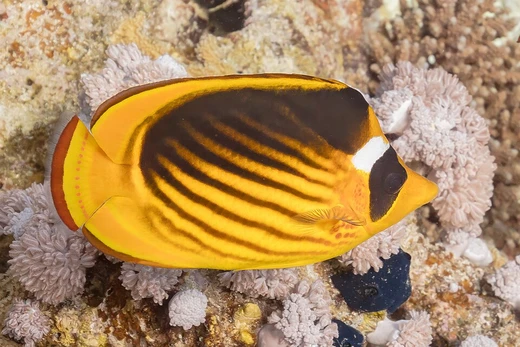
Amphiprion ocellaris
A reef obligate with no trade leash: the most traded clownfish, assessed Least Concern, unlisted by CITES.

Amphiprion ocellaris (Cuvier, 1830), commonly known as the ocellaris clownfish or common clownfish, is a small reef-dwelling fish of the family Pomacentridae. As recorded in the IUCN Red List (2016 assessment) and the FishBase database, it is one of the most widely distributed and commercially traded marine ornamental species in the Indo-Pacific. Its obligate symbiosis with sea anemones places it at the intersection of coral-reef ecology and the global aquarium trade, making it a focal subject in conservation and trade assessments.
In the context of conservation policy and international trade regulation, A. ocellaris occupies a particular position: it is abundant enough to be assessed as Least Concern by the IUCN, yet it is harvested at scale for the ornamental fish market without any CITES listing to govern cross-border commerce. This entry synthesises the named regulatory and database records that define its current conservation and trade status.
- Scientific name
- Amphiprion ocellaris Cuvier, 1830
- Iucn red list status
- Least Concern (assessed 2016)
- Cites listing
- Not listed (no Appendix I, II, or III entry)
- Distribution
- Indo-Pacific (East Africa to central Pacific)
- Obligate host
- Sea anemones (e.g., Heteractis magnifica)
- Taxonomic note
- Split from A. percula by Allen, Erdmann & Williams (2002)
Lore & Background
The IUCN Red List entry for A. ocellaris (2016) records a species of large, widespread population across the Indo-Pacific, associated with a variety of anemone host species. The assessment explicitly notes that the broad geographic range and multiple host-anemone relationships provide resilience against localised collection pressure, supporting the Least Concern designation. FishBase and the Wikipedia article on the species corroborate the wide distribution from the eastern coast of Africa through the Coral Sea to the central Pacific.
The CITES trade database, as of the current listing cycle, contains no entry for A. ocellaris in any appendix. This means the species is subject to no international permit requirements for export or import, and its movement in the global ornamental-fish trade is governed solely by the domestic regulations of individual range states. The absence of a CITES listing is documented in the CITES annual trade reports, which show no reported shipments under a CITES permit for this taxon.
The ornamental-aquarium trade represents the principal human-mediated pressure on wild populations. As described in the Wikipedia section on the species' ecology and in industry reports, juveniles and adults are collected from anemone hosts on coral reefs for sale in the live-fish market. The development of reliable captive-breeding protocols in the mid-2000s has shifted a portion of supply away from wild collection, though the IUCN 2016 assessment notes that wild harvest continues in several range states.
Reader's Guide
The IUCN Red List (2016 assessment) classifies A. ocellaris as Least Concern, citing its wide Indo-Pacific distribution and large, stable population. The assessment notes that while local collection pressure exists, the species' broad range and association with multiple anemone host species buffer against regional declines.
CITES does not list A. ocellaris in any of its three appendices. No international permit framework therefore governs its cross-border trade, and the species moves freely in the global ornamental fish market.
The primary commercial pressure stems from the ornamental aquarium trade. Wild-caught specimens are harvested from coral reef habitats across the Indo-Pacific, particularly from anemone hosts such as Heteractis magnifica. The mechanism of impact is direct removal of individuals from reef populations, with juveniles and adults both targeted.
Coral reef degradation—driven by bleaching, sedimentation, and coastal development—reduces the availability of anemone host habitat, an obligate requirement for this species. Loss of suitable anemone density directly constrains population carrying capacity.
Mitigation efforts include the development of captive-breeding programs in the aquarium industry, which reduce reliance on wild collection. Some range states have implemented local harvest quotas or marine protected areas, but no coordinated regional management framework specific to A. ocellaris exists as of the 2016 IUCN assessment.
Did You Know?
- A. ocellaris was long treated as a subspecies of A. percula; the two were split into separate species by Allen, Erdmann & Williams in 2002 based on morphometric and genetic data.
- Despite being one of the most recognised marine aquarium species worldwide, A. ocellaris carries no CITES listing, meaning its international trade is not subject to any multilateral permit regime.
- The 2016 IUCN Red List assessment explicitly notes that the species' association with multiple anemone host species across a vast range provides a buffer against localised collection pressure.
More in Conservation & Trade
Elsewhere in Diagonal butterflyfish
Spotted an error? Know more?
Reader corrections go straight into our review queue. Suggest an edit · How this site is sourced