
Farming Simulator
A long-running series of farming simulation games by GIANTS Software.

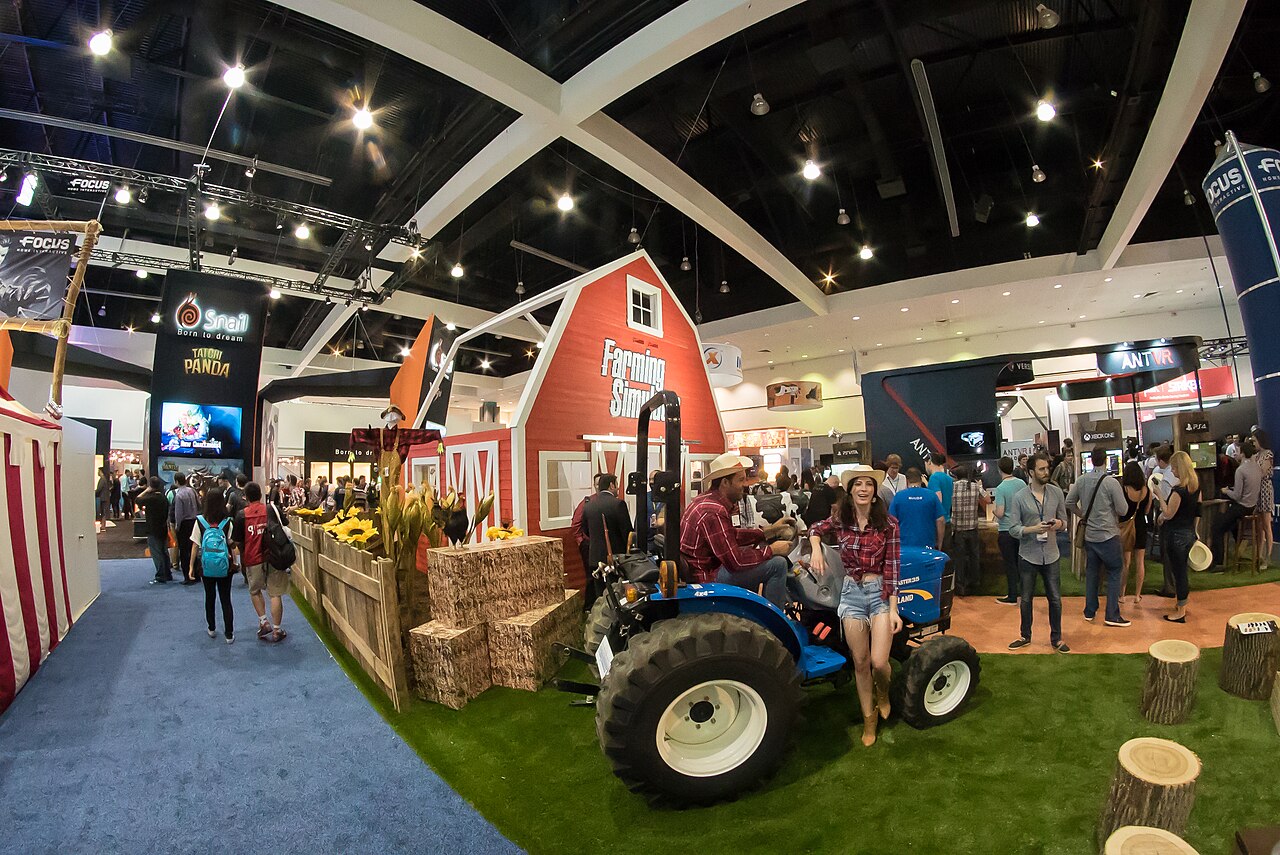
Sergey Galyonkin from Raleigh, USA · CC BY-SA 2.0
Farming Simulator is a series of farming simulation games created by GIANTS Software. Its settings draw from American, European, and Asian landscapes. Players can farm, raise livestock, grow crops, and sell farming products. The franchise has sold more than 25 million copies overall and been downloaded over 90 million times on mobile devices. Originally, the series was revised, expanded, and re-released every two years, except for the two most recent titles, with each version bringing improved graphics, more vehicles, and more engaging tasks. In career mode, players act as farmers. Their main goal is to upgrade old equipment and machinery by harvesting and selling crops. They can freely explore the map, choose from several crop types, and invest money in new fields and gear. Players can also raise livestock or earn money through forestry. The game includes dynamically generated missions, such as mowing grass, fertilizing fields, or delivering cargo, which must be completed within a time limit. Finishing a mission rewards money, plus a bonus for speed—except in Farming Simulator 19 and 22. Farming Simulator 14 was the first mobile version to include multiplayer. Farming Simulator 16 added Bluetooth support. Current-generation consoles support multiplayer, while last-generation consoles got the first console port, which included all features from the 2013 Titanium edition. Farming Simulator 15 on PlayStation 4 and Xbox One also has multiplayer. The series began with Farmer-Simulator 2008, released on April 14, 2008. Outside German-speaking countries, it is the only game in the series known as "Farmer-Simulator." Farming-Simulator 2009 followed, adding corn, rapeseed/canola, barley, modding support, and more machinery, using a remastered version of the 2008 map. Farming Simulator 2011 is the third game in the series, and first to feature a multiplayer mode. It was greatly expanded with the introduction of a new map. Machinery from Deutz-Fahr, Pöttinger, and Horsch were added (also featured in the FS 2009 Gold edition). Cows were also an addition to this title. Farming Simulator 2013 launched on October 26, 2012, with versions for PlayStation Vita, PlayStation 3, and Xbox 360 in 2013. A major update, the Titanium Edition, came on October 10, 2013, adding a US-based map called Westbridge Hills and new vehicles, with DLC available for original owners.
Quick Facts
- Title
- Farming Simulator
- Developer
- GIANTS Software (2008–present)
- Publisher
- Astragon (2008–2021) · Excalibur Publishing (2008–2012) · Focus Home Interactive (2013–2020) · GIANTS Software (2021–present)
- First Release Version
- Farmer-Simulator 2008
- First Release Date
- 2008-04-14
- Latest Release Version
- Farming Simulator 26
- Latest Release Date
- 2026-05-19
- Genre
- Simulation
Facts from the source article.
Lore & Background
The series began with Farmer-Simulator 2008, released on April 14, 2008, which was the first official release and the only game known as Farmer-Simulator outside German-speaking countries. The games were originally revised, expanded, and re-released every two years, excluding their newest two releases, with better graphics, a larger array of vehicles, and more interesting tasks. Farming Simulator 2011 is the third game in the series, and first to feature a multiplayer mode. Farming Simulator 2013 introduced a US-based environment map called 'Westbridge Hills' and was re-released as the Titanium Edition. Farming Simulator 15 introduced forestry, washable vehicles, and 41 brands.
Reader's Guide
The Farming Simulator series is notable for its consistent expansion and refinement over two decades, growing from a niche PC title to a franchise with over 25 million copies sold and 90 million mobile downloads. Its career mode tasks players with expanding and upgrading dated equipment by harvesting and selling crops, with freedom to explore maps, grow various crops, invest in fields and equipment, raise livestock, or earn income from forestry. Dynamically generated missions reward players with money and time-based bonuses. The series has progressively added features such as multiplayer (first in Farming Simulator 2011), modding support, forestry, seasonal cycles, production chains, and increasingly detailed machinery from real-world brands. The mobile versions have also evolved, with Farming Simulator 14 being the first mobile entry with multiplayer and Farming Simulator 16 adding Bluetooth functionality. The series' legacy includes ports to multiple console generations, a Nintendo Switch edition, and even a Commodore 64 edition released alongside Farming Simulator 19 as a Collector's Edition bonus. The games have maintained a regular release cycle, with each major installment introducing new environments, crops, vehicles, and gameplay mechanics while retaining the core simulation experience.
Did You Know?
- Farming Simulator 14 is the first mobile Farming Simulator to have multiplayer mode.
- Farming Simulator 16 was updated in November 2023 to include a John Deere 7230 R tractor, despite the brand not being in the franchise until 2018's Farming Simulator 19.
- Farming Simulator 25 features an Asian-themed map shipped out of the box for the first time.
- Farming Simulator C64 Edition was released alongside Farming Simulator 19 as a Collector's Edition bonus for the PC version.
A Two-Year Rhythm That Built a Franchise
GIANTS Software established Farming Simulator as a simulation series focused on industrial agriculture, drawing its farm settings from American, European, and Asian landscapes. What began as a modest PC title in 2008 grew into one of the most commercially successful simulation franchises in gaming history, with the combined series surpassing 25 million copies sold and racking up 90 million downloads on mobile platforms. A defining structural choice was the franchise's release cadence: for most of its run, each new entry arrived on roughly a two-year cycle, arriving with improved graphics, a broader roster of vehicles, and more varied tasks for the player to complete. Only the two most recent releases broke from that biennial pattern. This steady, predictable rhythm gave the audience time to master each installment while building anticipation for the next, and it allowed GIANTS to layer in new crops, new machinery brands, and new environmental settings without overwhelming players. The result is a library that spans continents of agricultural practice and has reached audiences far beyond the traditional farming-simulation niche.
The Farmer's Daily Grind: Career Mode and Dynamic Missions
In career mode, the player steps into the shoes of a farmer managing a working operation. The core loop revolves around upgrading dated equipment and machinery by harvesting and selling crops, then reinvesting earnings into additional fields, new machinery, and expanded acreage. Players are free to roam the surrounding map, select from a menu of growable crops, raise livestock, or generate income through forestry. Beyond this open-ended progression, the games layer in dynamically generated missions that demand specific tasks—mowing grass, fertilizing fields, or hauling cargo—within a set time limit. Completing a mission earns a base payout, and in most entries (with the notable exceptions of Farming Simulator 19 and 22) a speed bonus rewards finishing the job quickly. This blend of sandbox freedom and timed objectives keeps sessions varied: one moment you are plowing a barley field, the next you are racing a delivery truck before the clock runs out. The system effectively mirrors the unpredictable rhythm of real agricultural work, where a farmer must juggle long-term investment with immediate, deadline-driven chores.
Milestones That Redefined the Series
The franchise's evolution is marked by entries that introduced genuinely new pillars. Farming Simulator 2011 broke the single-player mold by adding multiplayer and expanding the world with a fresh map, new machinery from Deutz-Fahr, Pöttinger, and Horsch, and the first appearance of cows. Farming Simulator 2013's Titanium Edition, released a year after the original, added the US-based Westbridge Hills map and new vehicles, while also reaching PlayStation 3, Xbox 360, and PS Vita. Farming Simulator 15 brought forestry, washable vehicles, and 41 licensed brands into the base game. Farming Simulator 17 overhauled crop mechanics—allowing repeated fertilization, post-harvest plowing, de-weeding, and cover crops like oilseed radish—and added drivable trains and an in-game radio. Farming Simulator 19 redesigned the graphics engine, introduced horse farming, oat and cotton crops, and John Deere machinery for the first time. Farming Simulator 22 pushed further with a full seasonal cycle, manual gear shifting, production chains for both crops and livestock products, and new growables including grapes, olives, and sorghum, all supported by DirectX 12 and a roster exceeding 400 vehicles and implements.
From Living Room to Pocket: Platform and Multiplayer Expansion
Farming Simulator's reach expanded well beyond its PC roots through a steady wave of platform ports and connectivity features. The first console port arrived with Farming Simulator 2013, landing on PlayStation 3, Xbox 360, and PS Vita with the full feature set of the Titanium Edition. Farming Simulator 15 followed to PlayStation 4 and Xbox One in May 2015, and both console generations offered multiplayer. On mobile, Farming Simulator 14 was the first entry to include a multiplayer mode, and Farming Simulator 16 added Bluetooth functionality for local connectivity. The Nintendo Switch received its own edition in November 2017, a direct port of Farming Simulator 17 with identical maps and vehicles, though no DLC was ever released for that title. A C64 Edition was bundled as a Collector's Edition bonus alongside Farming Simulator 19, a nod to retro computing. Current-generation consoles continue to support multiplayer, ensuring that the series' social dimension—first introduced back in 2011—remains a living feature across every major platform.
Gallery





Frequently Asked Questions
Who created Farming Simulator?
Farming Simulator is developed by GIANTS Software, the studio behind every entry in the series since the franchise's inception in 2008.
What do you actually do in Farming Simulator?
Players step into the role of a farmer, planting and harvesting crops, raising and tending livestock, and selling their produce to grow their operation. The playable maps are modeled on real landscapes from the United States, Europe, and Asia.
When did the Farming Simulator series start?
The franchise began with Farmer-Simulator 2008, which launched on April 14, 2008. Each subsequent title has layered on improved graphics, a wider roster of vehicles, and more varied farming tasks.
How popular is Farming Simulator?
Across all its installments, the series has sold more than 25 million copies in total. The mobile versions alone have racked up over 90 million downloads.
What is the newest Farming Simulator game?
Farming Simulator 25, released on November 12, 2024, is the latest entry in the long-running series. It continues the tradition of refreshed visuals, expanded machinery lineups, and deeper career-mode objectives that fans have come to expect.
More in Simulation Games 1-20
Spotted an error? Know more?
Reader corrections go straight into our review queue. Suggest an edit · How this site is sourced