
Factorio
A factory simulation game about automation and resource management.

František Kovařík · CC BY-SA 4.0
Factorio is a factory simulation game from the Czech developer Wube Software. The story begins with an engineer stranded on an alien world, who must gather resources and build automated factories to eventually construct a rocket. Players can keep expanding their factory even after launching the rocket. The game offers both single-player and multiplayer modes, plus eight extra scenarios.
The project started with a 2013 Indiegogo crowdfunding campaign. Early access launched on 25 February 2016, and the full game came out for Windows, macOS, and Linux on 14 August 2020. A Nintendo Switch port arrived on 28 October 2022, followed by a Nintendo Switch 2 version on 22 December 2025. A paid expansion, *Space Age*, was released on 21 October 2024, adding four new planets and extending the game beyond the original world. In June 2026, Wube Software announced that version 2.1 would be the final major update.
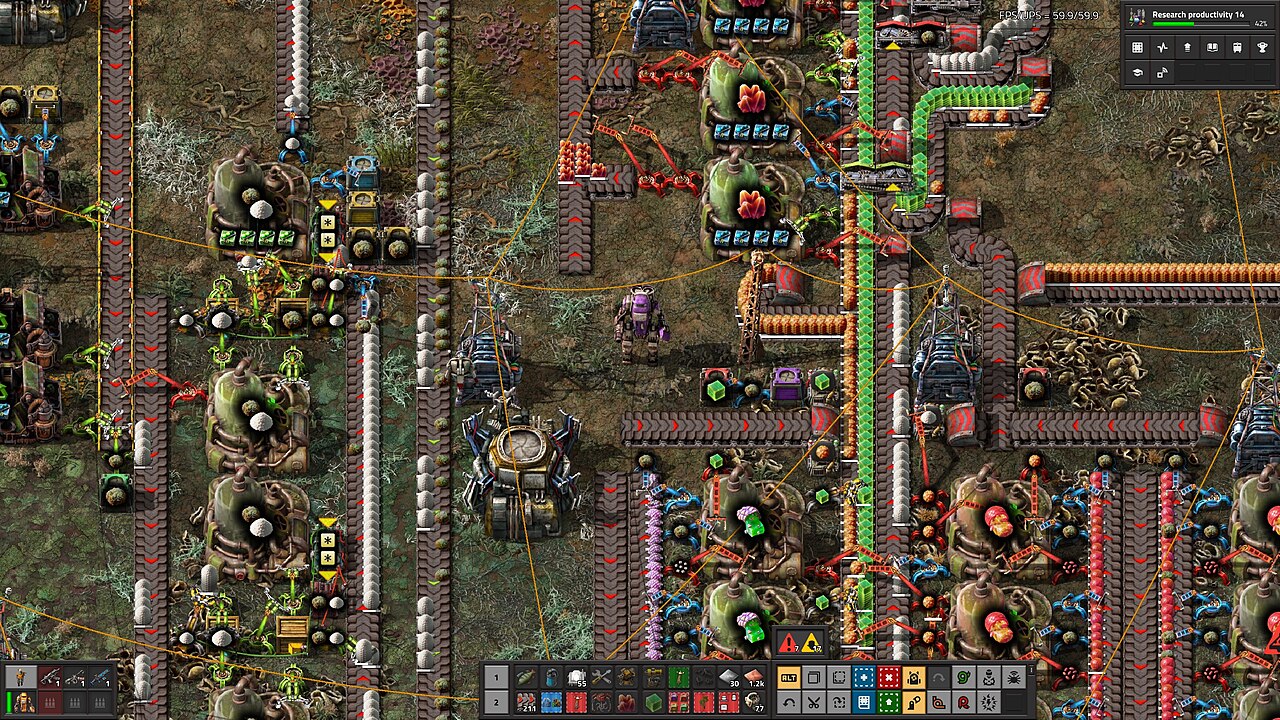
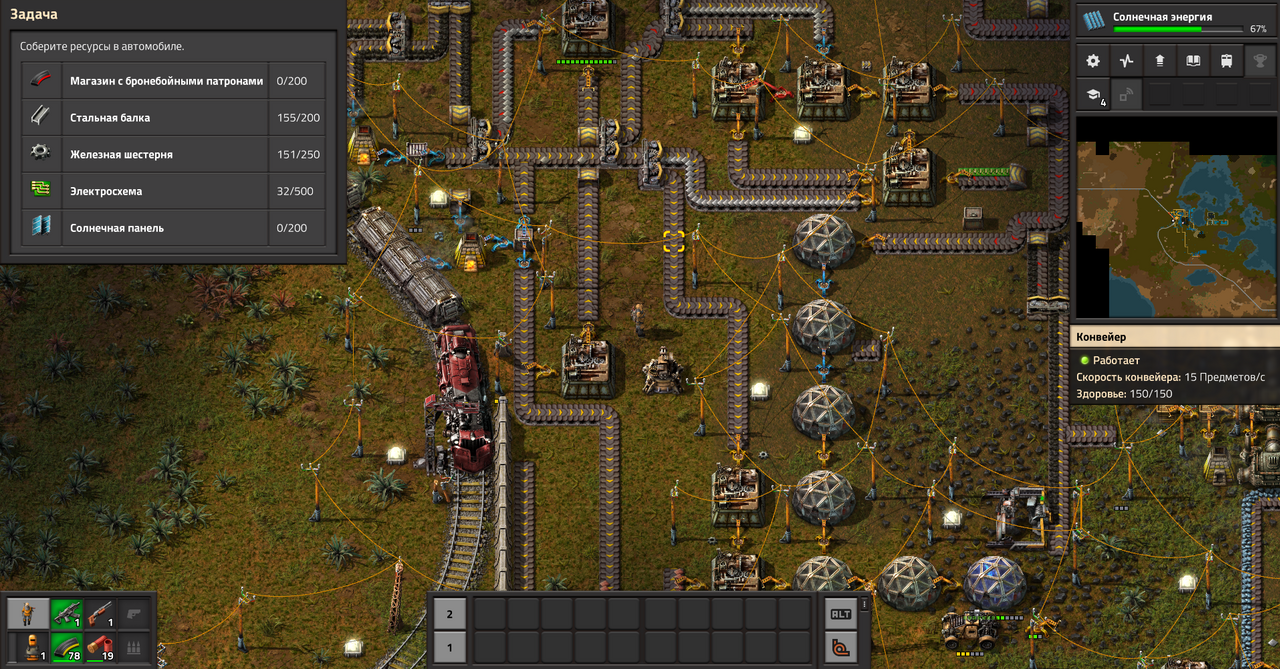
**Gameplay** Factorio is a construction and management simulation with real-time strategy and survival elements. Players start by gathering resources to craft tools and machines, which then produce more advanced materials and unlock sophisticated technologies. The core loop involves expanding and managing a factory that automates mining, transport, processing, and assembly. Progress pushes players to design factories that can handle larger production scales and greater automation. Research unlocks new structures, items, and upgrades—from basic automation to oil refining, robots, and rocket construction. A blueprint system lets players save and reuse designs for factory sections or entire factories. A circuit system enables complex networks for automating a wide range of actions.
Winning the base game requires launching a rocket, which demands substantial resources and technology research. After launch, players can continue building.
**Combat** Players must defend themselves and their factory from native alien creatures: biters, spitters, and worms. These enemies live in colonies that can be destroyed to prevent further spawning. They become more aggressive as pollution spreads from the factory, forcing players to balance production with enemy hostility. Defensive turrets, tanks, and other weapons are available. Enemies evolve over time, becoming harder to defeat.
Quick Facts
- Title
- Factorio
- Developer
- Wube Software
- Platforms
- Linux · macOS · Windows · Nintendo Switch · Nintendo Switch 2
- Released
- Linux, macOS, Windows · 14 August 2020 · Switch · 28 October 2022 · Switch 2 · 22 December 2025
- Genre
- Construction and management simulation, Real-time strategy
- Modes
- Single-player, Multiplayer
- Director
- Michal Kovařík · Tomáš Kozelek · Albert Bertolín
- Designer
- Michal Kovařík
- Artist
- Albert Bertolin · Václav Benč
- Composer
- Daniel James Taylor · Petr Wajsar (Space Age expansion)
Facts from the source article.
Lore & Background
Factorio was announced via a crowdfunding campaign on Indiegogo in 2013, raising €21,626 against a €17,000 goal. The game entered early access on 25 February 2016 and was officially released for Windows, macOS, and Linux on 14 August 2020. A Nintendo Switch port arrived on 28 October 2022, followed by a Nintendo Switch 2 edition on 22 December 2025. The paid expansion Space Age was released on 21 October 2024, adding four new planets and extending gameplay beyond the initial planet. In June 2026, Wube Software announced that Factorio 2.1 would be the last major update.
The game's lead designer Michal Kovařík cited the Minecraft mods IndustrialCraft and BuildCraft as inspiration. The development team, based in Prague, Czech Republic, began work in mid-2012 and grew to 31 members by February 2024. The game was originally planned for release on 25 September 2020 but was moved up to avoid competing with Cyberpunk 2077.
Reader's Guide
Factorio is notable for its deep automation systems, including a blueprint system for reusable factory designs and a circuit network for complex logic. The game's combat involves defending against indigenous fauna—biters, spitters, and worms—that become more hostile as pollution spreads. Players can choose a peaceful mode where enemies only retaliate when attacked. Multiplayer supports cooperative and competitive play via dedicated or listen servers, with shared technologies and a public blueprint library. Modding is extensive, using Lua scripts, with an in-game mod manager and an online portal; mods range from quality-of-life tweaks to total overhauls like Krastorio 2. The Space Age expansion introduces interplanetary travel via space platforms, four new planets with unique resources and enemies, and optional mods for elevated rails and a quality tier system. Upon completing the expansion, players can upload a snapshot to the Galaxy of Fame. The base game's end goal is launching a rocket, after which players may continue expanding their factory.
Did You Know?
- The Space Age expansion includes four new planets: Vulcanus, Fulgora, Gleba, and Aquilo.
- The Nintendo Switch 2 edition supports 1080p on the internal display and 4K when connected to a television.
- Mods for Factorio are written in the Lua programming language.
From Crowdfunding to a Final Chapter
Factorio's journey from concept to completion spans over a decade. Wube Software, a Czech studio, first announced the game through an Indiegogo crowdfunding campaign in 2013. After a lengthy early access period that began on 25 February 2016, the full release arrived on 14 August 2020 for Windows, macOS, and Linux. The title then expanded to Nintendo Switch on 28 October 2022, and was ported to Nintendo Switch 2 on 22 December 2025. In June 2026, Wube Software made the notable announcement that Factorio 2.1 would serve as the final major update to the game, effectively closing a chapter that began with a small studio's crowdfunding pitch. The game's longevity—nearly thirteen years from announcement to its stated final update—reflects both the depth of its systems and the sustained commitment of its small development team.
The Automation Engine
At its core, Factorio casts the player as an engineer who has crash-landed on an alien world and must bootstrap an entire industrial civilization from scratch. The progression loop is elegantly recursive: harvest raw materials, craft basic machines, use those machines to produce more advanced components, and repeat until the technology tree unlocks oil refining, robotic logistics, and ultimately the construction of a launchable rocket. The game rewards players who think in systems rather than individual tasks. A blueprint system lets users save and redeploy factory layouts, while a circuit network system enables the construction of complex automated control logic that can manage production at scale. The rocket launch is the stated victory condition, yet the design deliberately leaves the door open—players who achieve the goal can keep expanding their factory indefinitely, turning a win into a new starting point for even grander engineering.
Pollution as a Design Lever
Factorio's combat system is unusual in that the primary antagonist is not a boss or an invading army but the player's own industrial output. The planet's indigenous fauna—biters, spitters, and worms—reside in colonies that can be destroyed to stop further spawning, but their aggression scales directly with the pollution emitted by the player's factory. This creates a persistent strategic tension: the more you produce, the more hostile the environment becomes, forcing players to weigh expansion against defense. Defensive options include turrets, tanks, and other weapons, and enemies evolve into harder-to-kill variants as the game progresses. For those who prefer to focus purely on construction, a peaceful setting allows the fauna to spawn but restricts them to retaliating only when directly damaged or when a neighboring unit is attacked. This design choice makes pollution not merely a cosmetic concern but a core balancing mechanic that shapes every factory layout decision.
Reaching Beyond the First Planet
The Space Age expansion, released on 21 October 2024, fundamentally redefined Factorio's scope by adding four distinct planets and a new end goal of interstellar travel. Players build space platforms—factories in orbit that can be expanded and relocated—and launch themselves and cargo via rockets to reach each world. Vulcanus is a volcanic planet where basic resources are extracted from lava; Fulgora is a lightning-struck desert containing the ruins of an alien civilization that can be mined and processed; Gleba is a lush jungle teeming with farmable lifeforms; and Aquilo is a frozen world dominated by a liquid ammonia ocean. New enemies include spider-like pentapods on Gleba and large territorial demolishers on Vulcanus. The expansion also bundles two required developer-made mods: Elevated Rails for flexible railway transport and Quality, a tier-based upgrade system for all machines and items. Completing the expansion lets players upload a snapshot of their base and statistics to an online star map called the Galaxy of Fame.
Gallery

Frequently Asked Questions
What is Factorio?
Factorio is a factory automation and resource-management simulation game created by the Czech studio Wube Software. You take on the role of a stranded engineer on an alien planet, designing ever-larger automated production lines to ultimately build a rocket ship.
What is the main goal in Factorio?
The core objective is to collect raw materials, construct automated factories, and finally assemble and launch a rocket to leave the planet. After the launch, the game shifts into an open-ended mode where you can keep scaling production without any hard ceiling.
Who made Factorio and when did it fully launch?
Wube Software both developed and published the title. It was funded through an Indiegogo campaign in early 2013, entered early access in February 2016, and shipped its full 1.0 release on 14 August 2020 for Windows, macOS, and Linux.
Can you play Factorio with friends?
Yes, the game includes a built-in multiplayer mode that lets several players collaborate on a single shared factory. It also ships with eight extra scenarios beyond the standard campaign for varied challenges.
What happens after you launch the rocket?
Completing the rocket fulfils the main story arc, but the session does not end. Most players simply keep running, optimising, and expanding their factory in what the community commonly calls endless mode.
More in Simulation Games 1-20
Spotted an error? Know more?
Reader corrections go straight into our review queue. Suggest an edit · How this site is sourced