
Elite Dangerous
A 1:1 scale open-world space simulation in the Milky Way.

Anyumi- · CC BY-SA 4.0
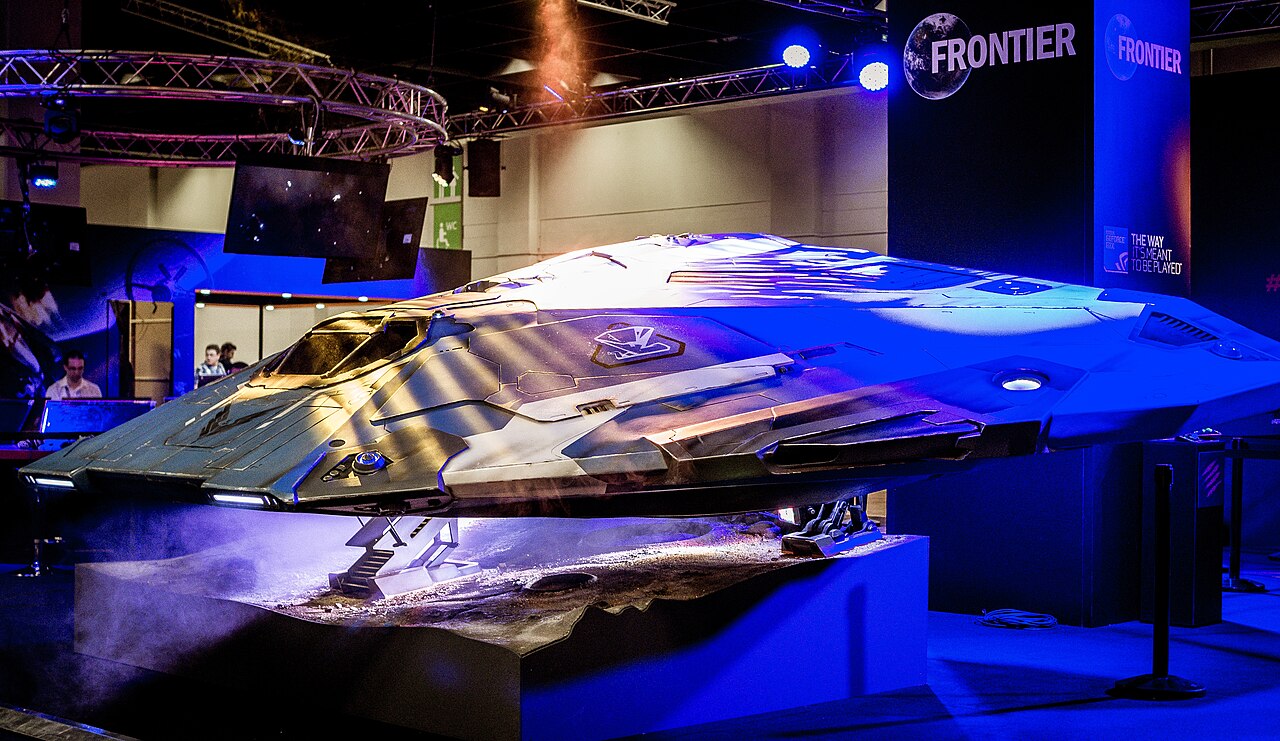
Elite Dangerous is a space simulation game from Frontier Developments that blends trading, exploration, and combat. Players pilot a spaceship through a 1:1 scale, open-world version of the Milky Way, with gameplay that is largely open-ended. The galaxy is procedurally generated and contains roughly 400 billion star systems. The procedural system also enables landing on planets that lack atmospheres or have only thin ones. Many of these worlds feature unique flora and fauna, as well as alien and human settlements.
This is the fourth title in the Elite series and follows *Frontier: First Encounters* (1995). It is the first Elite game to include massively multiplayer elements, first-person on-foot gameplay, space colonization of star systems, and player-driven changes to the persistent universe’s overarching story—while still offering a single-player mode.
A Kickstarter campaign launched in November 2012 to test the concept and raise funds. The game was released for Windows in December 2014, macOS in May 2015, Xbox One in October 2015, and PlayStation 4 in June 2017. It supports most virtual reality headsets on Windows. Development was led by David Braben until August 2022.
The game has received numerous free seasonal updates and two paid expansions: *Horizons* (December 15, 2015) and *Odyssey* (May 18, 2021). *Horizons* introduced features like landing on airless planets, a surface reconnaissance vehicle, engineering, ship-launched fighters, multicrew, avatars, Guardian ruins, and tourist beacons. It became free with the base game on October 27, 2020. *Odyssey* added landing and disembarking on planets with tenuous atmospheres, settlements, geological features, on-foot equipment and customization, new ships, fleet carriers, concourses in starports, and first-person activities such as mercenary work and exobiology. By September 2022, sales had surpassed 4.8 million units.
**Gameplay**
Elite Dangerous combines elements of space simulators, first-person shooters, and massively multiplayer games within a persistent galaxy modeled after the Milky Way. There are three game modes: Solo (single-player), Private Group (invite-only), and Open Play (everyone). The game began in the year 3300 at its 2014 release, running in sync with UTC but set 1,286 years in the future—about 45 years after *Frontier: First Encounters*.
Quick Facts
- Title
- Elite Dangerous
- Developer
- Frontier Developments
- Engine
- Cobra
- Released
- Windows / 16 December 2014 / macOS / 12 May 2015 / Xbox One / 6 October 2015 / PlayStation 4 / 27 June 2017
- Genre
- Space trading and combat · First-person shooter · Immersive sim · MMO
- Modes
- Single-player, multiplayer
- Director
- David Braben (former) / Piers Jackson (current)
- Producer
- Adam Woods (former) / Gauthier Verquerre / Michael Brookes (former)
- Designer
- Curtis Griffiths / Dan Davies / Derin Halil (former) / Gareth Hughes / Laurence Oldham / Louise McLennan / Luke Betterton / Sandro Sammarco (former) / Steve Kirby / Tom Kewell
- Programmer
- Dominic Corner / Igor Terentjev / Kay Ross (former) / Mark Allen
- Artist
- Alik Sarkisyan / Chris Gregory / Dean Searle / Emilie Rinna / John Laws / John Roberts / Josh Atack / Paul Worster / Sam Piper / Simon Brewer / Xavier Henry
- Composer
- Dan Millidge / Erasmus Talbot / Jim Croft
Facts from the source article.
Lore & Background
Elite Dangerous began in the year 3300, set around 45 years after Frontier: First Encounters. The game retains the basic premise of its predecessors: players start with a spaceship and a small amount of money in a 1:1 scale, open galaxy and roleplay in various activities to acquire more credits and merit. A key difference is the addition of on-foot, first-person gameplay added with the Odyssey expansion on 19 May 2021, enabling activities such as collecting genetic samples of alien flora for exobiology and first-person shooter combat. Other activities include trading, mining, exploration, exobiology, passenger carrier, smuggling, bounty hunting, piracy, and assassination. System Colonisation, added as a free update in beta on 26 Feb 2025 with full release on 11 Nov 2025, allows players to claim uninhabited star systems, build colonies with facilities, and shape economies as the system architect. The game features over 45 flyable ships with highly configurable builds, powered by a Frame Shift Drive for supercruise and interstellar travel via hyperspace. The flight model uses Newtonian physics with a fly-by-wire layer. Players can also acquire capital ships: the Drake-Class Carrier and the Javelin-Class Carrier. Two Surface Recon Vehicles (SRVs) are available: the Scarab and the Scorpion, with an SRV Rhino announced.
Reader's Guide
Elite Dangerous combines features from space simulator, first person shooter and massively multiplayer genres with a persistent galaxy based on the Milky Way. The virtual galaxy is a 1:1 simulation based on scientific principles, data, star catalogues, and theories, created using procedural generation with the Stellar Forge and artistic direction. Around 150,000 star systems are taken from real astronomical data, such as Sol and Alpha Centauri. The game includes cosmic phenomena like different star types, star clusters, black holes like Sagittarius A*, and 141 nebulae based on the Milky Way. Players can dock at space stations, outposts, and planetary facilities to trade, purchase equipment, and accept missions. Player-driven actions in community goals result in persistent changes that shape star systems and the overarching narrative. Frontier publishes community goals, lore, and large-scale stories via the in-game Galnet News and mail feature. The game supports most virtual reality headsets on Windows. Development was led by David Braben until August 2022.
Did You Know?
- Elite Dangerous is the first Elite game to feature massively multiplayer and first-person on foot gameplay.
- The game includes around 400 billion star systems, with around 150,000 based on real astronomical data.
- Sales of Elite Dangerous passed 4.8 million units by September 2022.
A Galaxy in Your Hands: Scale and Procedural Wonder
Elite Dangerous places the player at the helm of a spacecraft within a full-scale, one-to-one simulation of the Milky Way. Rather than a handcrafted sandbox, the galaxy is procedurally generated, yielding roughly four hundred billion star systems for a pilot to chart. This staggering breadth means that no two players will ever traverse the same stretch of space, and the sheer volume of unexplored territory ensures the game's open-ended premise feels genuinely boundless.
Within that procedural framework, individual systems contain planets that can be landed upon—some bearing no atmosphere at all, others holding only a tenuous one. These worlds are not barren rocks; many host distinctive alien flora and fauna alongside human settlements, giving exploration a biological and cultural dimension beyond mere star-hopping. The entire setting is anchored to the year 3300, roughly forty-five years after the events of the 1995 title Frontier: First Encounters, and the in-game clock runs in lockstep with real-world UTC, adding a layer of temporal realism that few space games attempt. The result is a universe that feels less like a game map and more like a living, breathing galaxy waiting to be discovered.
From Cockpit to Ground: The Expansive Evolution
Elite Dangerous launched in December 2014 as a pure space simulation, but its story is one of relentless, layered growth. The first major paid expansion, Horizons, arrived in December 2015 and fundamentally widened the game's scope: players could land on atmosphere-free planets, pilot surface recon vehicles, launch fighters from their ships, and step into a multicrew cockpit with avatars. Engineering, guardian ruins, and tourist beacons further seeded lore across the galaxy.
The second paid expansion, Odyssey, released in May 2021, marked the series' first foray into first-person, on-foot gameplay. Pilots could disembark onto worlds with tenuous atmospheres, explore settlements, collect genetic samples of alien flora for exobiology, engage in mercenary combat, and socialize in star port concourses. Fleet carriers and expanded on-foot equipment rounded out the package.
Most recently, System Colonisation—letting players claim uninhabited star systems, build colonies, and shape local economies—entered beta in February 2025 with a full release in November 2025. Horizons was folded into the base game free of charge in October 2020, and the title has shipped numerous free major updates throughout its life, treating the galaxy as a living, ever-expanding project rather than a fixed product.
A Thousand Ways to Fly: Gameplay and Player Agency
Elite Dangerous weaves together the DNA of a space simulator, a first-person shooter, and a massively multiplayer online game into a single persistent galaxy. Players choose between three modes—Solo, Private Group, and Open Play—each offering the same deep systems in a different social context.
The activity roster is remarkably broad: trading, mining, exploration, exobiology, passenger carriage, smuggling, bounty hunting, piracy, and even assassination all have dedicated mechanics. Over forty-five flyable ships, each highly configurable with swappable engines, weapons, power plants, and scanners, let players tailor their build to any career. The flight model applies Newtonian physics beneath a fly-by-wire assist layer, producing combat that feels visceral and close-range rather than the long-distance jousting of earlier Elite titles.
Beyond the cockpit, capital ships like the Drake and Javelin carriers serve as mobile bases or squadron hubs, while surface recon vehicles such as the Scarab and Scorpion extend exploration to the ground. In-game credits fund hardware, while a real-money ARX track covers cosmetics. Player-driven community goals produce persistent, galaxy-wide changes, and the in-game Galnet news feed narrates the consequences, making every pilot part of a shared, evolving story.
Crowdfunded Dreams: Development and Enduring Legacy
Elite Dangerous is the fourth entry in the Elite franchise and the direct sequel to Frontier: First Encounters (1995), yet it broke new ground by introducing massively multiplayer and, later, first-person on-foot play to the series. Its origins trace to a November 2012 Kickstarter campaign, which served both to validate audience interest and to bankroll development. David Braben, the series' creative anchor, led development until August 2022.
The title launched on Windows in December 2014, followed by macOS (May 2015), Xbox One (October 2015), and PlayStation 4 (June 2017), with broad virtual-reality headset support on the PC version. By September 2022, cumulative sales had surpassed 4.8 million units—a remarkable figure for a niche space sim.
A through-line of the game's design is continuity with its roots: ships like the Cobra Mk III echo the polygonal silhouettes of the original 1984 Elite, preserving a visual and mechanical heritage spanning four decades. Frontier's commitment to free, major seasonal updates alongside two paid expansions has kept the community engaged for over a decade, cementing Elite Dangerous as the most ambitious and enduring chapter in a franchise that began with a single programmer's vision of spaceflight.
Gallery



Frequently Asked Questions
What is Elite Dangerous?
Elite Dangerous is an open-world space simulation developed by Frontier Developments, first released in December 2014. Players pilot a starship through a 1:1-scale recreation of the Milky Way, free to trade, explore, fight, or blend all three at will.
How big is the Elite Dangerous universe?
The galaxy is procedurally generated and spans roughly 400 billion star systems at real-world 1:1 scale. Because of that sheer size, no two players will ever chart identical routes or stumble on the same obscure off-the-beaten-path systems.
Can you land on planets in Elite Dangerous?
Yes — the Horizons expansion (December 2015) added surface play, letting you land on worlds with no atmosphere or only a thin one. Those planets host unique flora and fauna alongside both human and alien outposts.
Is there a main story or ending in Elite Dangerous?
There is no scripted campaign or definitive ending; the game is built as a sandbox where you set your own objectives. Narrative elements exist through in-game events and faction conflicts, but progression is entirely player-driven.
What platforms can I play Elite Dangerous on?
The game is available on Windows, macOS, Xbox One, and PlayStation 4, offering solo, private-group, and open-multiplayer modes. It had sold over 4.8 million units as of September 2022.
More in Simulation Games 1-20
Spotted an error? Know more?
Reader corrections go straight into our review queue. Suggest an edit · How this site is sourced