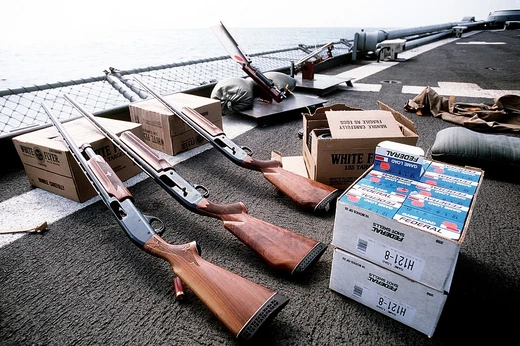
Short-barrelled shotgun
A compact shotgun with a barrel under 18 inches, often sawed off.

A short-barrelled shotgun (SBS)—also known as a scattergun, shorty, or boom stick—is a shotgun with a barrel typically shorter than 18 inches (46 cm). It often has a pistol grip instead of a longer shoulder stock. When the barrel is shortened by sawing, it is commonly called a sawn-off or sawed-off shotgun. Manufacturers can produce barrels at shorter lengths as an alternative to the traditional longer ones. This design makes the weapon easier to transport and conceal because of its smaller size and lighter weight. It also improves portability in tight spaces, which is why law enforcement and military personnel find it useful for close-quarters combat. However, any shotgun with a tubular magazine will have reduced magazine capacity due to the shorter barrel.
Compared to a standard shotgun, the short-barrelled version has a shorter effective range because of lower muzzle velocity, but its reduced length makes it easier to maneuver and hide. Powerful and compact, it is especially suited for small spaces, such as in military close-quarters combat. Military vehicle crews use short-barrelled combat shotguns as backup weapons. In urban combat zones, military entry teams often use them when breaching and entering doorways.
Many jurisdictions set a minimum legal barrel length for shotguns to prevent these more concealable weapons from being used for crime. In the U.S., most gun makers have not sold sawn-off shotguns to the public since 1934, when barrels under 18 inches were restricted, though they were sold before that. To comply with NFA rules, anyone can file a Form 1 "making" form and get an approved tax stamp to legally shorten a shotgun’s barrel to less than 18 inches by cutting or replacing it.
A sawn-off shotgun is often an unofficial modification of a standard shotgun. In countries where handguns are expensive or hard to get, criminals may convert legally bought or stolen shotguns into concealable weapons. The term is often used for illegal weapons made by cutting off a standard shotgun’s barrel. A shotgun without a tube magazine can be cut to any length; pump-action or semi-automatic shotguns usually have a tube magazine attached under the barrel, which limits the practical minimum barrel length to about the length of the magazine tube, unless that is also modified—a much harder task than shortening the barrel.
- Minimum barrel length (us nfa)
- 18 inches (46 cm)
- Minimum overall length (us nfa)
- 26 inches (66 cm)
- Minimum barrel length (germany, pump-act
- 45 cm
- Minimum overall length (germany, pump-ac
- 90 cm
- Minimum barrel length (uk, shotgun certi
- 24 inches
- Minimum overall length (uk, pump-action/
- 40 inches
- Minimum barrel length (russia, banned)
- 500 mm
Lore & Background
In the 1930s, the United States, United Kingdom and Canada mandated that a permit be required to own these firearms. They are subject to legal restrictions depending upon jurisdiction. They are used by military forces and police agencies worldwide. Compared to a standard shotgun, the short-barrelled shotgun has a shorter effective range, due to a lower muzzle velocity; however, its reduced length makes it easier to maneuver and conceal. Powerful and compact, the weapon is especially suitable for use in small spaces, such as close-quarters combat in a military context. Military vehicle crews use short-barrelled combat shotguns as ancillary weapons. In urban combat zones, military entry teams often use entry shotguns when breaching and entering doorways.
A sawn-off shotgun is often an unofficial modification of a standard shotgun. In countries where handguns are more costly or difficult to obtain, criminals can convert legally purchased or stolen shotguns into concealable weapons. The term is often applied to illegal weapons that are created by cutting off the barrel of a standard shotgun. The barrel of a shotgun without a tube magazine can be cut to any length; pump-action or semi-automatic shotguns usually have a tube magazine attached to the underside of the barrel which limits the practical minimum barrel length to about the length of the magazine tube, unless it also is modified, technically much more challenging than shortening the barrel. Repeating-fire shotguns with box magazines do not lose shell capacity when sawn off, but they are far less common than those with tubular magazines. Shotguns manufactured with barrels under the legal minimum length frequently fall into special categories.
Reader's Guide
The short-barrelled shotgun occupies a distinct niche in firearms regulation and use. Its reduced length makes it highly portable and concealable, which has led to widespread legal restrictions across many nations. In the United States, the National Firearms Act of 1934 restricted shotguns with barrels under 18 inches, requiring tax-paid registration and background checks for private ownership. Many gun makers in the U.S. have not offered sawn-off shotguns to the public since that year. In the United Kingdom, side-by-side, over-under, bolt-action and lever-action shotguns must have a 24-inch minimum barrel if held on a shotgun certificate, while semi-automatic and pump-action shotguns always require a 24-inch minimum barrel and 40-inch minimum overall length. Canada prohibits reducing a shotgun barrel to less than 457 mm by anyone other than a recognized gun manufacturer, though short-barrelled manually operated shotguns with unmodified factory barrels are available with a non-restricted licence. Russia banned possession of any firearm with a barrel under 500 mm and overall length under 800 mm in 1997. The weapon's significance lies in its dual nature: a practical tool for military and police close-quarters operations, yet a heavily regulated item due to its concealability and potential for criminal use. Its legacy is one of compromise between utility and control, with jurisdictions worldwide imposing specific minimum lengths and permit requirements.
Did You Know?
- A short-barrelled shotgun is also called a scattergun, shorty, or boom stick.
- In Canada, shotguns with barrels as short as 8.5 inches are available with a non-restricted licence.
Frequently Asked Questions
What is a short-barrelled shotgun (SBS)?
A short-barrelled shotgun is a shotgun whose barrel measures under 18 inches (46 cm), and it typically features a pistol grip rather than a full shoulder stock. It goes by several nicknames, including scattergun, shorty, and boom stick.
What are the US legal minimums for a shotgun to be classified as an SBS under the NFA?
Under the National Firearms Act, a shotgun must have a barrel shorter than 18 inches and an overall length under 26 inches to fall into the SBS category. Meeting either threshold triggers NFA registration requirements.
Why do people prefer a short-barrelled shotgun over a standard one?
The reduced length and lighter weight make it far easier to carry, conceal, and maneuver in confined environments. Law-enforcement units and operators in tight spaces often favor the design for that added portability.
What's the difference between a factory-made SBS and a sawn-off?
A factory SBS is produced by the manufacturer with a shorter barrel as a design choice, while a sawn-off (or sawed-off) is a standard shotgun whose barrel has been cut down after the fact. The sawn-off version is generally illegal in most jurisdictions because it bypasses the original manufacturing specifications.
How do SBS regulations differ in Germany and the UK?
In Germany, a pump-action shotgun needs a barrel of at least 45 cm and an overall length of 90 cm to avoid SBS classification, while the UK sets the shotgun certificate threshold at a 24-inch barrel and a 40-inch overall length for pump-action models.
More in Shotguns 1-24
Spotted an error? Know more?
Reader corrections go straight into our review queue. Suggest an edit · How this site is sourced