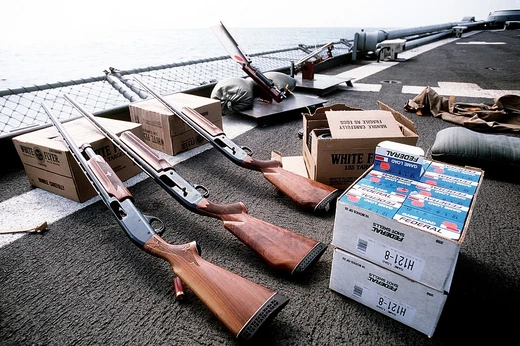
20-gauge shotgun
A smoothbore shotgun popular for upland hunting and target shooting.

Lothar Spurzem · CC BY-SA 2.0 de
The 20-gauge shotgun, sometimes called 20 bore, is a smoothbore firearm. Its bore diameter measures .615 inches (15.6 mm), compared to the .729 inches (18.5 mm) of a 12-gauge. In the United States, where firearm ownership is widespread, these two gauges are the most popular. Hunters of upland game, along with target and skeet shooters around the world, frequently choose the 20-gauge.
The gauge number refers to the number of lead balls of that bore diameter that weigh one pound: twenty for a 20-gauge, twelve for a 12-gauge. A 20-gauge can be a better fit for certain game or shooters because it often produces less felt recoil than a larger gauge in an otherwise identical gun, and the firearms themselves may be smaller and lighter. However, this has changed somewhat since the introduction of the 3-inch magnum shotshell.
Ammunition for the 20-gauge typically has a yellow body tube. The SAAMI standard reserves yellow exclusively for 20-gauge shotshells, stating that the body tube must be primarily yellow and that no other gauge or bore may use that color. This color coding helps prevent dangerous mix-ups: if a 20-gauge shell is accidentally placed into a 12-gauge chamber, it can lodge in the bore. Firing a 12-gauge shell behind it can cause catastrophic damage.
The 20-gauge is well-suited for hunting game birds like quail, grouse, and mallards when using lead-free birdshot. For self-defense at close to medium range, a 20-gauge buckshot load is common. While slug loads are less accurate than rifle rounds, heavy, high-grain slugs can improve ballistics for deer hunting when used with a rifled barrel.
On average, 20-gauge rounds produce less muzzle energy than 12-gauge rounds, leading to less perceived recoil. But many factors affect felt recoil, including gun weight, action type, stock design, shot weight, and shell size. With target ammunition, the difference may be negligible. Waterfowl loads generally produce more felt recoil in a 12-gauge than a 20, though this depends on the specific gun. A light 5-pound (2.3 kg) 20-gauge firing full-power shells will have more felt recoil than a heavy 7-pound (3.2 kg) gun. For a fair comparison, two identical shotguns—one in 12-gauge and one in 20-gauge—firing comparable ammunition must be tested; in that case, the 12-gauge generates more recoil energy.
Quick Facts
- Origin
- United Kingdom
- Manufacturer
- Various
- Variants
- 21 · 2" (63.5 mm) / 23 · 4" (70 mm) / 3" (76.2 mm)
- Case Type
- Rimmed, straight
- Bullet
- .615 in
- Shoulder
- .684 in
- Base
- .697 in
- Rim Dia
- .766 in
- Rim Thick
- .0484 in
- Case Length
- 2.76 in
- Primer
- Shotshell primer
- Max Pressure
- 12,000 psi (83 MPa)
Facts from the source article.
Lore & Background
The 20-gauge shotgun is defined by its bore diameter of .615 inches (15.6 mm). The gauge designation originates from the number of lead balls of that bore diameter that weigh one pound: twenty such balls for the 20-gauge, compared to twelve for the 12-gauge. The 20-gauge is often considered more suitable for hunting certain types of game or for some hunters because it may have less felt recoil than an identical shotgun in a larger gauge, and guns may be smaller and weigh less, though this has changed since the introduction of the 3-inch magnum shotshell.
A notable characteristic of 20-gauge ammunition is its yellow body tube color. The Sporting Arms and Ammunition Manufacturers' Institute (SAAMI) has reserved yellow for 20-gauge ammunition, stating that this ammunition shall have a body tube that is primarily yellow and that yellow shall not be used for any other gauge or bore shotshell body. This color designation may aid in identifying 20-gauge shells, as a 20-gauge shell, if mixed in with 12-gauge shells, will enter the chamber and lodge inside the bore at the end of the chamber, resulting in a catastrophic failure if a 12-gauge shell is loaded and fired behind it.
Reader's Guide
The 20-gauge shotgun holds a significant place in the world of shotguns as a versatile and widely used option. Its popularity among upland game hunters, target shooters, and skeet shooters across many areas of the world reflects its balance of power and manageability. The 20-gauge is especially suitable for hunting game birds such as quail, grouse, and mallards when using lead-free birdshot. For self-defense scenarios, a 20-gauge buckshot load would most commonly be utilized in close- to mid-range situations. While slug loads are ballistically less accurate than rounds used in rifles, powerful, high-grain slug loads can provide improved ballistics for hunting deer when paired with a rifled barrel.
Regarding recoil, 20-gauge rounds on average produce less muzzle energy than 12-gauge rounds, resulting in reduced perceived recoil. However, many variables affect perceived recoil, including gun weight, action type, stock pattern, shot weight, and shell size. There may be little to no difference between the two when using target ammunition. Loads for waterfowl tend to produce more felt recoil in a 12-gauge than in a 20, but this may not be the case depending on the gun used. Full-power 20-gauge shells fired from a light 5 lb gun will have more felt recoil than those fired from a heavy 7 lb gun. For a fair comparison, two identical shotguns, one in 12 and one in 20, with identical ammunition (other than gauge) must be compared; in those cases, the 12-gauge does generate more recoil energy than the 20.
Did You Know?
- Twenty lead balls of a 20-gauge bore weigh one pound.
- SAAMI has reserved yellow body tubes exclusively for 20-gauge ammunition.
- A 20-gauge shell lodged in a 12-gauge chamber can cause catastrophic failure if a 12-gauge shell is fired behind it.
- The 20-gauge bore diameter is .615 inches (15.6 mm), compared to .729 inches (18.5 mm) for the 12-gauge.
The Gauge System and Physical Dimensions
The 20-gauge shotgun derives its name from a centuries-old measurement convention: twenty lead balls, each the diameter of the bore, together weigh exactly one pound. This places the bore at .615 inches (15.6 mm), noticeably narrower than the .729-inch (18.5 mm) bore of a 12-gauge, where only twelve such balls reach the same pound weight. In the United States, where firearm ownership is widespread, the 12-gauge and 20-gauge together dominate the shotgun market as the two most popular calibers. Globally, the 20-gauge has carved out a strong following among upland game hunters, target shooters, and skeet competitors. As a smoothbore firearm, it shares the fundamental design philosophy of all shotguns—dispersing a payload of shot or a single slug from an un-ripled barrel—yet its smaller diameter gives it a distinct niche in both hunting and sport shooting across many regions of the world.
Hunting and Practical Applications
The 20-gauge finds its natural habitat in the field and on the range. For bird hunters pursuing quail, grouse, or mallards, a 20-gauge paired with lead-free birdshot offers a well-matched combination of pattern density and manageable recoil. In self-defense contexts, a 20-gauge buckshot load is most commonly deployed at close to mid-range, where the spread of multiple pellets provides a practical stopping capability without the extreme over-penetration concerns of a single projectile. When the task shifts to taking deer, a powerful high-grain slug load fired through a rifled barrel can deliver ballistics that, while less accurate than a dedicated rifle round, remain sufficient for the job. Target and skeet shooters also favor the gauge for its lighter recoil impulse, making extended shooting sessions less punishing on the shoulder. The 20-gauge thus spans a remarkably wide spectrum of uses, from delicate upland bird work to heavy-hitting slug loads.
Recoil, Weight, and the Shooter's Experience
One of the 20-gauge's most celebrated advantages is its reduced felt recoil compared to a 12-gauge of identical construction. Because 20-gauge rounds generally produce less muzzle energy, the shooter experiences a softer kick, and the gun itself tends to be smaller and lighter. However, the picture is more nuanced than a simple gauge comparison suggests. Variables such as gun weight, action type, stock pattern, shot charge, and shell length all influence perceived recoil. A full-power 20-gauge shell fired from a light five-pound (2.3 kg) gun will kick noticeably harder than the same load from a seven-pound (3.2 kg) model. For a truly fair comparison, two identical shotguns—one in 12-gauge, one in 20-gauge—must be loaded with otherwise identical ammunition; under those controlled conditions, the 12-gauge consistently generates more recoil energy. The introduction of 3-inch magnum shotshells has also narrowed the historical gap, adding a heavier, higher-energy option to the 20-gauge lineup.
Color Coding and the Dangers of Gauge Confusion
A critical safety feature of 20-gauge ammunition is its standardized yellow body tube, a designation formally reserved by the Sporting Arms and Ammunition Manufacturers' Institute (SAAMI). SAAMI documentation explicitly restricts the color to 20-gauge use, prohibiting its application on shells of any other caliber or bore. This matters because the consequences of gauge confusion are potentially lethal. A 20-gauge shell, if accidentally mixed into a 12-gauge magazine, will slide into the chamber and lodge at the far end of the bore rather than seating properly. If a 12-gauge shell is then loaded and fired behind the lodged 20-gauge round, the resulting pressure spike produces a catastrophic failure. The yellow tube, therefore, is not merely a cosmetic convention but a practical safeguard, helping shooters and loaders verify gauge compatibility before a round ever reaches the chamber.
Gallery


Frequently Asked Questions
What does the '20' in 20-gauge actually mean?
The gauge number tells you how many solid lead balls of that exact bore diameter would add up to one pound. For a 20-gauge, precisely twenty .615-inch lead spheres weigh a pound, which is the origin of the name.
How does a 20-gauge shotgun differ from a 12-gauge?
The 20-gauge has a smaller bore at .615 inches (15.6 mm) versus the 12-gauge's .729 inches (18.5 mm), giving it noticeably less recoil. Both are smoothbore firearms, but the 20-gauge is generally the better match for smaller upland game and for shooters who find the 12-gauge's kick too punishing.
What is a 20-gauge shotgun best used for?
It is a go-to choice for upland game hunters as well as for target and skeet shooting worldwide. In the United States, the 20-gauge sits alongside the 12-gauge as one of the two most widely owned shotgun gauges.
How can I tell 20-gauge shells apart from other gauges at a glance?
The SAAMI standard reserves the yellow plastic body tube exclusively for 20-gauge ammunition, making it the quick visual identifier on the range or in the field. This color coding helps shooters avoid the dangerous mistake of loading the wrong gauge into their gun.
Why would a shooter pick a 20-gauge over a 12-gauge?
The smaller bore produces less recoil, making it a friendlier fit for smaller-framed shooters or anyone sensitive to kick. It also pairs well with lighter upland species where the heavier payload of a 12-gauge would be overkill.
More in Shotguns 1-24
Spotted an error? Know more?
Reader corrections go straight into our review queue. Suggest an edit · How this site is sourced