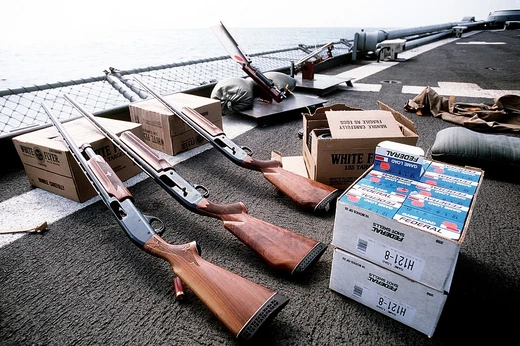
Combination gun
A versatile firearm combining rifled and smoothbore barrels for varied game.

Stanley Howe · CC BY-SA 2.0
A combination gun is a firearm that typically includes at least one rifled barrel and one smoothbore barrel, designed to fire shot or shotgun slugs. Most are break-action designs, though other types exist. When it has one rifled and one smoothbore barrel, the over-and-under layout is common, while the side-by-side version is known as a cape gun. If it has more than two barrels, a three-barrel gun is called a drilling (German for "triplet"), a four-barrel is a vierling ("quadruplet"), and a five-barrel is a fünfling ("quintuplet"). These guns usually use rimmed cartridges because rimless ones are harder to extract from a break-action firearm.
Combination guns have a long history in Europe, the Middle East, Asia, and Africa, dating back to the early days of metallic cartridge firearms. They are almost exclusively hunting arms. The key advantage is that a single gun can fire both rifle cartridges and shotgun shells, allowing a hunter to target a wide range of game—from deer to game birds—by choosing the right barrel in seconds. This makes them popular with gamekeepers who need that flexibility.
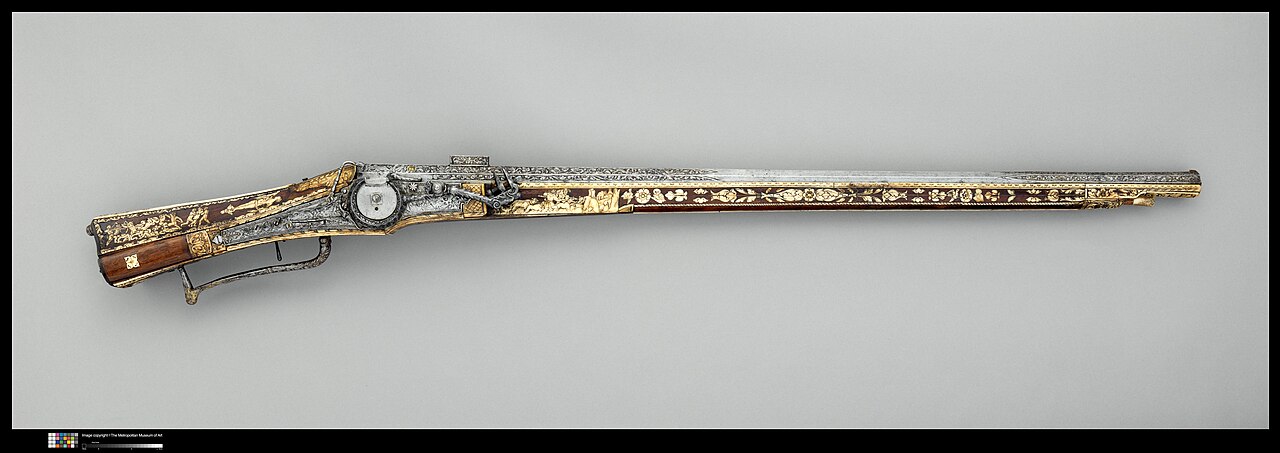
The earliest combination guns were swivel guns (not to be confused with the small cannon on a swiveling stand), which had rotating barrels that could align either a rifled or smoothbore barrel with a flintlock mechanism. Modern combination guns usually look like double-barreled shotguns or rifles and are almost always break-open designs. They typically have a selector to choose which barrel fires. Three-barrel drillings often have two shotgun barrels and one rifle barrel, with two triggers (one for each shotgun barrel) and a selector that lets one trigger fire the rifle barrel. Four-barrel vierlings generally have two triggers and selectors to switch between shotgun and rifle barrels.
In the over-and-under category, combination guns like the Savage Model 24 often place the rifled barrel above the smoothbore. Iron sights are common for aiming the rifle, while the front sight alone is enough for pointing the shotgun; some designs accept scope mounts. A notable example is the United States Air Force M6 Aircrew Survival Weapon and its civilian version, the Springfield Armory M6 Scout—an all-metal folding combination gun in .22 Hornet over .410 bore or .22 Long Rifle over .410 bore.
A cape gun is the side-by-side version of a combination gun, typically European in origin.
- Types
- combination gun, cape gun, drilling, vierling, fünfling
- Common configurations
- over-and-under (rifled over smoothbore), side-by-side (cape gun)
- Typical cartridges
- rimmed cartridges
- Notable examples
- Savage Model 24, M6 Aircrew Survival Weapon, M30 Luftwaffe Drilling, TP-82, Lancaster carbine
Lore & Background
Combination guns have a long history in Europe, the Middle East, Asia, and Africa that date back to the early days of metallic cartridge firearms. These guns are almost exclusively hunting arms. The advantage of having a single firearm that can fire both cartridges designed for rifled and smoothbore barrels is that a single gun can be used to hunt a very wide variety of game, from deer to game birds, and the shooter can choose the barrel appropriate for the target in seconds. As a result, they are popular with gamekeepers who often need the flexibility of the combination gun during their activities.
The earliest combination guns were called swivel guns, which used a set of barrels designed to rotate to allow either the rifled or the smoothbore barrel to line up with a flintlock mechanism before firing. Modern combination guns tend to resemble double-barreled shotguns and double-barreled rifles, and are almost universally break open designs. Combination guns generally have a selector that allows the user to choose which barrel will fire. Three-barrel versions known as Drillings are commonly found with two shotgun barrels and one rifle barrel, and generally have two triggers, one for each shotgun barrel, and a selector that will allow one trigger to fire the rifle barrel. Four-barrel versions known as Vierlings generally have two triggers, and selectors to switch between both the shotgun and rifle barrels.
Cape guns are side-by-side versions of combination guns and are typically European in origin. These were at one time popular in Southern Africa, where a wide variety of game could be encountered. British versions are commonly chambered for the .303 British service cartridge and a 12-gauge smoothbore barrel, with the rifled barrel positioned on the left. The German and Austrian cape guns have the rifled barrel on the right side, which is fired by the front trigger. The front trigger is usually a set trigger as well. The German and Austrian versions are commonly chambered for 9.3×72mmR or 9.3×74mmR rifle cartridges and 16-gauge or 12-gauge shotshells.
Reader's Guide
Combination guns represent a specialized niche in firearms design, offering hunters and gamekeepers a single tool capable of addressing both feathered and furred game. Their significance lies in the practical flexibility they provide: a shooter can instantly switch between a rifled barrel for precise, longer-range shots at deer or similar game and a smoothbore barrel for bird hunting or close-range use with shot or slugs. This adaptability made them particularly valued in regions like Europe, Africa, and Asia where diverse game might be encountered on a single outing.
The legacy of combination guns is most evident in the elaborate multi-barrel configurations—drillings, vierlings, and fünflings—that showcase the craftsmanship of small European manufacturers. These guns were often custom-made, with layouts tailored to the buyer's preferences. The drilling, with its three barrels, became a classic, especially the common configuration of two shotgun barrels and one rifle barrel. The vierling and fünfling are rarer, representing the pinnacle of complexity and custom gunmaking. Notable examples like the Soviet TP-82 survival gun for cosmonauts and the M6 Aircrew Survival Weapon for the U.S. Air Force highlight the combination gun's role in extreme environments. While largely superseded by more specialized firearms in many markets, combination guns remain prized by collectors and traditional hunters for their ingenuity and versatility.
Did You Know?
- The earliest combination guns were called swivel guns, which rotated barrels to align with a flintlock mechanism.
- A cape gun is a side-by-side combination gun, typically European in origin and once popular in Southern Africa.
- The TP-82 was a Soviet drilling pistol with two shotgun barrels and a rifle barrel, used by cosmonauts from 1986 to 2006.
- A fünfling is an extremely rare combination gun with five barrels.
Gallery
Frequently Asked Questions
What is a combination gun?
A combination gun is a firearm that pairs at least one rifled barrel with at least one smoothbore barrel, allowing the shooter to switch between precision rounds and spread or slug patterns. The vast majority are built as break-action designs, though other action types do exist.
What are the main barrel configurations for a combination gun?
The standard two-barrel over-and-under layout places the rifled barrel above the smoothbore, while the side-by-side arrangement is specifically called a cape gun. Multi-barrel variants include the three-barrel drilling, the four-barrel vierling, and the five-barrel fünfling.
What cartridges does a combination gun typically use and why?
These firearms generally chamber rimmed cartridges rather than rimless ones, a practical choice tied to the break-action mechanism's feeding and ejection geometry.
What are some well-known examples of combination guns?
Recognized examples include the Savage Model 24, the M6 Aircrew Survival Weapon, and the M30 Luftwaffe Drilling. The TP-82 and the Lancaster carbine are also frequently cited in the field.
Why is the combination gun considered important in shotgun culture?
It consolidates two distinct roles—close-range shot and long-range precision—into a single carried weapon, cutting the need for separate firearms. That versatility made it a go-to choice for hunters, survival specialists, and military personnel who face varied targets.
More in Shotguns 1-24
Spotted an error? Know more?
Reader corrections go straight into our review queue. Suggest an edit · How this site is sourced