Combat shotgun
A military shotgun designed for close-quarters combat and breaching.

U.S. Marine Corps photo by Sgt. Trent A. Henry · Public domain
A combat shotgun is a military-issued firearm designed for warfare. Its origins lie in the blunderbuss, a short smoothbore weapon invented by the Dutch in the 1500s, used by British, Austrian, Spanish, and Prussian forces through the 1700s, as well as in the American colonies. As the blunderbuss fell out of favor, the U.S. military began loading buckshot alongside standard bullets in a combination called "buck and ball." This load was used heavily by American forces at the Battle of New Orleans in 1814, contributing to a notable difference in casualties between American and British troops. The buckshot increased the chance of hitting an enemy, but at longer ranges it caused less severe wounds, and many British soldiers struck only by buckshot recovered quickly. Fowling pieces were also common among militias, such as during the Texas Revolution. Buck and ball worked just as well in standard or rifled muskets and was used by both sides in the American Civil War, especially by cavalry.
The development of repeating pump-action shotguns in the 1890s led to their adoption by U.S. Marines in the Philippines and by General Pershing’s campaign against Pancho Villa. Civilian police soon favored "riot" shotguns, but the modern combat shotgun was fully developed by the American Expeditionary Forces in World War I. The trench gun was a short-barreled pump-action shotgun holding six rounds of antimony-hardened 00 buckshot, fitted with a bayonet. Models like the M1897 and M1912 could be slam-fired—holding the trigger down and working the slide fired rounds in rapid succession, though short-stroking could jam the weapon. In trench fighting, the shorter shotgun allowed quick turning and firing along both directions of a trench. Germany protested diplomatically, claiming the shotguns caused excessive injury and threatening execution for captured users. The U.S. rejected this and threatened reprisals.
Shotguns were used by Allied forces and partisans in all theaters of World War II. Both pump and semi-automatic models are still issued to all U.S. military branches, and they have also been used by French, British, Canadian, Australian, and New Zealand forces, as well as many guerrilla and insurgent groups in sub-Saharan Africa, Latin and South America, and Southeast Asia. Six shotgun models were accepted by the U.S.
- Effective range (buckshot)
- 20–30 meters
- Effective range (slug)
- 100 meters
- Less-lethal rubber buckshot range
- 10 meters
- Less-lethal rubber slug range
- 75 meters
- Typical combat barrel length
- 51 cm (20 in)
- Typical combat magazine capacity
- up to 10 rounds
- Typical riot barrel length
- 35 to 46 cm (14 to 18 in)
Lore & Background
The combat shotgun traces its ancestry to the blunderbuss, invented in the 16th century by the Dutch and used through the 18th century by British, Austrian, Spanish, and Prussian regiments, as well as in the American colonies. As the blunderbuss declined, the United States military used 'buck and ball' loads—small lead shot combined with a larger bullet—extensively at the Battle of New Orleans in 1814. The development of repeating pump-action shotguns in the 1890s led to their use by US Marines in the Philippines insurrections and by General Pershing's pursuit of Pancho Villa. The modern combat shotgun was fully developed by the American Expeditionary Forces during World War I, as the trench gun: a short-barreled pump-action shotgun loaded with 6 rounds of antimony-hardened 00 buckshot and equipped with a bayonet. The M1897 and M1912 could be slam fired, though short-stroking could jam the weapon. The German government protested the shotguns as causing excessive injury, threatening execution of captured users; the US rejected the claims and threatened reprisals.
The shotgun was used by Allied forces and partisans in all theaters of World War II. Six models were accepted by the US army, the most popular being the M97 and M1912. Disadvantages included difficulty carrying shells—standard rifle pouches held only about 30 rounds—and paper-hulled shells that swelled in damp conditions; military-issue shells were made of brass until plastic hulls appeared in the early 1960s. General Alexander Patch was seen armed with a Winchester shotgun during an attack on Guadalcanal. In the Malayan Emergency, British and local forces used shotguns effectively in jungle close combat. During the Vietnam War, the shotgun was used in jungle patrol and urban warfare such as the Tet Offensive. In 1992 during Operation Gothic Serpent, US task forces tested the Ciener Ultimate Over/Under, an under-barrel attachment for M16 variants, for breaching doors. In post-invasion Iraq, shotguns cleared insurgent hideouts in house-to-house fighting. The XM26 was used experimentally during Operation Enduring Freedom for breaching or close-quarters battle. Combat shotguns have been used in the Russo-Ukrainian War in the anti-drone role, though their effectiveness remains unclear.
Reader's Guide
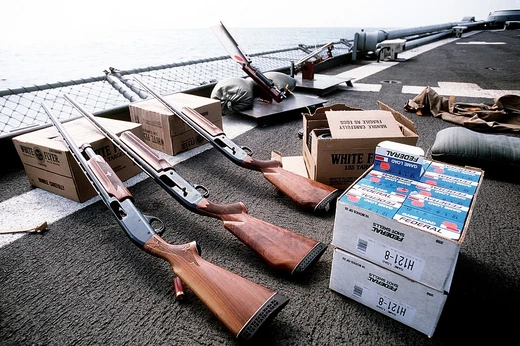
The combat shotgun has evolved from a short-range trench weapon into a multi-role system. Its three modern roles are offensive weapon, breaching system, and less-lethal crowd control. The pump-action type, such as the Remington M870 or Mossberg 590A1, is less prone to malfunction when dirty and less expensive than semi-automatic designs; the Mossberg 590A1 is currently the pump-action of choice for US armed forces. Semi-automatic shotguns like the Benelli M1014 also serve in NATO-aligned forces. Combat shotguns typically have shorter barrels than hunting shotguns, with tubular magazines holding more ammunition; some recent designs use detachable box magazines. Military versions may mount a bayonet and have ventilated hand guards to prevent burns during rapid fire. For breaching, a muzzle extension provides correct standoff distance; specialized rounds minimize hazard to occupants, though any round can be used with some degradation. Less-lethal munitions, identical to police types, have served in riot control situations such as Kosovo in 2001. The shotgun's limited range with buckshot (20–30 meters) is offset by its high hit probability at close quarters, while slug rounds extend effective range to 100 meters with appropriate sights.
Did You Know?
- The earliest shotguns specifically designed for combat were the trench guns of World War I.
- The M1897 and M1912 shotguns could be slam fired by holding the trigger and working the slide.
- The Ciener Ultimate Over/Under was an under-barrel shotgun attachment tested during Operation Gothic Serpent in 1992.
Gallery
Frequently Asked Questions
What is a combat shotgun?
A combat shotgun is a military-issued shotgun purpose-built for close-quarters fighting and breaching operations. It descends from the older blunderbuss but is engineered specifically for modern tactical and warfare roles.
What is the effective range of a combat shotgun?
Buckshot is effective out to roughly 20–30 meters, while a slug extends that to about 100 meters. Less-lethal rubber rounds shorten the range to 10 meters for buckshot and 75 meters for a slug.
What are the standard barrel length and magazine capacity?
A typical combat shotgun carries a 51-centimeter (20-inch) barrel and holds up to 10 rounds in its magazine. Those dimensions strike a balance between maneuverability in tight spaces and enough firepower for sustained engagement.
Where does the combat shotgun trace its lineage?
Its direct ancestor is the blunderbuss, a short smoothbore firearm developed by the Dutch in the 1500s. That design was fielded by British, Austrian, Spanish, and Prussian forces into the 1700s and also saw service in the American colonies before being phased out.
Which historic battle is most associated with the combat shotgun?
At the Battle of New Orleans in 1814, American troops fired a "buck and ball" load—buckshot paired with a round ball—and inflicted disproportionately heavy casualties on advancing British lines. That engagement is widely credited with cementing the shotgun's place in military doctrine.
More in Shotguns 1-24
Spotted an error? Know more?
Reader corrections go straight into our review queue. Suggest an edit · How this site is sourced