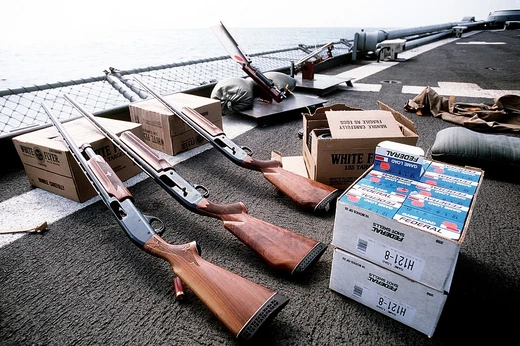
Riot shotgun
A short-barreled defensive shotgun used by military, police, and civilians.

A riot shotgun is a firearm built or adapted mainly for defense, with a shorter barrel and often a larger magazine than hunting models. It serves military personnel on guard duty, law enforcement for door breaching and patrol, and civilians protecting their homes. It was once used for riot control. These guns are also called breaching, tactical, or special-purpose shotguns, though these are mostly marketing labels.
The defining feature is a barrel between 14 and 20 inches long. In the U.S., 18 inches is the shortest civilians can own without extra federal regulation. This shorter length makes the gun more compact, easier to store in a police vehicle, and quicker to aim at close, stationary targets. The barrel usually has an open cylinder choke so shot spreads fast and other projectiles can be used. Sights may be bead, rifle, or ghost-ring. Most riot shotguns are pump-action for lower cost and reliability, though semi-automatic models for defense have become more common with military, police, and civilian users.
Most are 12-gauge, handling 2.75-inch or 3-inch shells. Non-lethal rounds like bean bags are almost always 12-gauge. But 20-gauge and .410 versions exist, popular for home defense because less power and recoil suit less experienced shooters. While hunting shotguns typically hold two to five shells (often three for U.S. migratory bird rules), riot shotguns can have magazine tubes as long as the barrel, holding six to ten shells depending on model and barrel length. Standard-capacity tubes are also used; for instance, the Remington 870 Police often ships with a four-round tube.
Grips and stocks vary widely. Reinforced plastic furniture is common instead of wood, though wood was used in the past and still appears. Pistol grips are frequent, with or without a shoulder stock. Without a stock or with a folding stock, the gun is more compact and faster to bring up in tight spaces. With a stock, the pistol grip aids control when firing from the shoulder. Forends also vary, sometimes including a pistol-grip fore-end for better control and recoil absorption, or an accessory rail for a tactical light.
The shotgun’s multiple projectiles raise the chance of hitting an assailant and of a disabling hit.
- Barrel length
- 14 to 20 inches (360 to 510 mm); 18 in (460 mm) is the shortest length available to U.S. civilians without additional ATF regulation
- Common gauge
- 12-gauge, with 20-gauge and .410 also available
- Magazine capacity
- 6 to 10 shells, depending on model, barrel length, and shell type; standard-capacity tubes also used
- Effective range buckshot
- well under 27 yards (25 meters) for multiple hits; up to 75 yards (70 m) for at least one pellet hit
- Effective range slug
- over 109 yards (100 meters) with slugs and good iron sights
- Common load
- 12-gauge 2¾-inch (70 mm) 00 buckshot shell (8 or 9 .33 caliber lead balls)
Lore & Background
The primary characteristic of a riot shotgun is a short barrel, generally 14 to 20 inches long, which makes it more compact and easier to handle, stow in a police vehicle, and aim at close stationary targets. They typically have an open cylinder-bore choke to allow shot to spread quickly and accommodate various projectile types, and may be equipped with bead, rifle, or ghost-ring sights. Most riot guns are pump-action due to lower cost and higher reliability, though semi-automatic models have become available and are used by military, law enforcement, and civilians. Most are chambered in 12-gauge and can handle 2.75-inch or 3-inch cartridges, with smaller bores popular for home defense due to reduced recoil.
Riot shotguns often have magazine tubes as long as the barrel, holding 6 to 10 shells, though standard-capacity tubes are also used. Furniture is often reinforced plastic instead of wood, and pistol grips are common, with or without a shoulder stock. Foregrips may include a pistol-grip fore-end or accessory rails for tactical lights. The multiple projectile ability of a shotgun greatly increases hit probability on an assailant, with 00 buckshot being a common police load. The difference between a riot shotgun and a combat shotgun is blurry, with combat shotguns often having bayonet lugs and ventilated heat shields, and being used primarily offensively in military situations, while riot shotguns are used defensively in paramilitary, law enforcement, or civilian contexts.
Less lethal ammunition, such as bean bags, rubber bullets, and tear gas, has expanded the riot shotgun's role, allowing officers to quickly switch between lethal and less lethal options. Entry or breaching shotguns are a further modification, with extremely short barrels (14 inches or less) and often only a pistol grip, sometimes with a muzzle brake to reduce recoil.
Reader's Guide
The riot shotgun's significance lies in its versatility as a defensive weapon, bridging military, law enforcement, and civilian roles. Its short barrel and open choke make it effective at close ranges, while the ability to use slugs extends its reach. The multiple projectiles of buckshot provide a high hit probability, making it a reliable tool for situations requiring immediate stopping power. The introduction of less lethal ammunition has further broadened its utility, allowing officers to adapt to changing threats without changing weapons. The riot shotgun's legacy is evident in its continued use by police for patrol and breaching, by military for guard duty, and by civilians for home defense, despite the emergence of newer firearm types. Its design has influenced specialized variants like entry shotguns, and its role as a platform for both lethal and less lethal munitions ensures its place in modern tactical applications.
Did You Know?
- The shortest barrel length available to U.S. civilians without additional ATF regulation is 18 inches.
- 00 buckshot consists of 8 or 9 .33 caliber lead balls, each similar in size and velocity to a 9mm/.38 caliber handgun bullet.
- A riot shotgun has a hit probability 45% greater than a submachine gun and twice as great as an assault rifle.
- The Mossberg 590A1 and Benelli M1014 are standard-issue pump and semi-auto shotguns currently in military service.
Frequently Asked Questions
What is a riot shotgun?
A riot shotgun is a short-barreled, high-capacity shotgun designed primarily for defense and close-quarters work rather than hunting. It is the go-to tool for law-enforcement door breaching, military guard duty, and civilian home defense, and it was historically employed in crowd-control scenarios. You will also hear it marketed as a breaching, tactical, or special-purpose shotgun, though those are largely branding terms for the same basic platform.
What barrel length defines a riot shotgun?
The defining spec is a barrel between 14 and 20 inches (roughly 360–510 mm), which is noticeably shorter than a typical hunting tube. In the United States, 18 inches (460 mm) is the shortest barrel a civilian can legally own without triggering additional ATF regulation.
What gauge and capacity does a riot shotgun use?
The vast majority of riot shotguns are chambered in 12-gauge, though 20-gauge and .410 variants do exist. Magazine capacity typically runs from 6 to 10 shells, varying by model, barrel length, and the type of ammunition loaded, and standard-capacity tubes are also common.
How far can a riot shotgun effectively shoot?
With buckshot, you can expect multiple-pellet hits well under 27 yards (25 meters), while a single pellet connection is possible out to roughly 75 yards (70 m). Fired with a slug, the effective range stretches past 109 yards, making it far more accurate at distance than most people assume.
Why is the riot shotgun so popular with law enforcement and civilians?
Its short barrel and larger magazine make it far more maneuverable in tight indoor spaces than a long hunting shotgun, which is exactly what you need for patrol, guard posts, or defending a home. The combination of stopping power, modularity, and compact size is why it remains the default close-quarters shotgun across military, police, and civilian communities.
More in Shotguns 1-24
Spotted an error? Know more?
Reader corrections go straight into our review queue. Suggest an edit · How this site is sourced