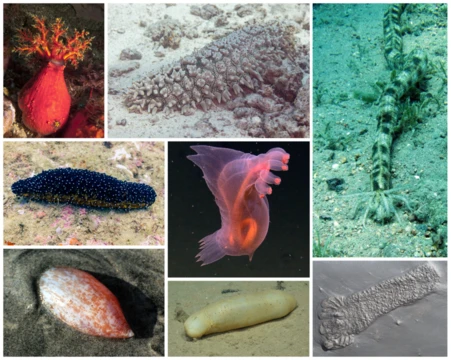
Synaptula spinifera
A small, endemic sea cucumber from Kakaban's anchialine lagoon.

Synaptula spinifera is a sea cucumber in the family Synaptidae, the group known as worm-like sea cucumbers. It was first discovered in the anchialine lagoon of Kakaban Island, part of Indonesia’s Derawan Islands, and is believed to live only in that isolated body of water.
This is a small holothurian: the largest preserved specimen measured 85 millimeters long and 8 millimeters in diameter. Living individuals are brown-red with very fine white longitudinal lines and small white dots. At the front end are 13 tentacles, each with 18 to 22 finger-like projections joined by a web. Like others in its order, it uses these tentacles to feed, primarily as a suspension feeder. Inside the body, a very large cartilaginous ring surrounds the white calcareous ring. Its ossicles come in a few forms—anchors, anchor-plates, and miliary granules (though granules are often absent)—and are spread through the body wall but absent from the tentacles. The species name *spinifera* refers to the long spine on the bridge of the anchor-plate.
*Synaptula spinifera* lives in Kakaban’s lagoon, which is completely encircled by a densely vegetated limestone ridge. The lagoon is anchialine, meaning it connects to the sea only through submarine passages in the porous carbonate rock and small fissures. The island was once an atoll but was uplifted 40–60 meters above current sea level, isolating the lagoon’s ecosystem. The lagoon’s salinity is lower than seawater, at 26–28 psu. Echinoderms, especially holothurians, are sensitive to low salinity, so it is thought that the species now living there gradually adapted to the changing conditions after the uplift and are remnants of a once more diverse fauna.
This sea cucumber occurs throughout the lagoon, which measures 1.5 by 2.6 kilometers. It is often found between the thalli of the dominant *Halimeda* algae or on *Enteromorpha clathrata*, which frequently grows on *Halimeda*. It lives at depths from 0.25 to 8 meters, with a density of 20–34 individuals per square meter in the *Halimeda* meadows. It may also inhabit the roots of *Rhizophora* mangroves fringing the lagoon, which are often overgrown with epiphytic algae and invertebrates like encrusting sponges. Extensive surveys of the outer reef of Kakaban atoll have not found *Synaptula spinifera*, supporting the idea that it is endemic to the isolated lagoon.
Quick Facts
- Taxon
- Synaptula spinifera
Facts from the source article.
Lore & Background
Synaptula spinifera was first described from the anchialine lagoon of Kakaban island, which is completely encircled by a densely vegetated limestone ridge. The lagoon's only connection to the sea is through submarine connections via porous carbonate rock and small fissures. Prehistorically an atoll, the island was uplifted 40–60 metres above today's sea level, isolating the lagoon's ecosystem. The salinity of the lagoon is lower than that of seawater, at 26-28 psu. Because echinoderms and especially holothurians appear sensitive to low salinities, it is proposed that the species currently inhabiting the lagoon gradually adapted to the changing conditions after uplift and are remnants of an initially more diverse fauna.
In life, S. spinifera is various hues of brown-red with white very fine longitudinal lines and small dots. It has 13 tentacles on its anterior end, each with 18 to 22 digitations united by a web. Like other members of its order, these tentacles are used for feeding, and this species is primarily a suspension feeder. Within its body, a very large or prominent cartilaginous ring encloses the white calcareous ring. Its ossicles include anchors, anchor-plates, and miliary granules (though granules are often absent); ossicles are spread throughout the body wall but absent in the tentacles. The specific name spinifera refers to the long spine on the bridge of the anchor-plate.
Reader's Guide
Synaptula spinifera is significant as a likely endemic species confined to the unique anchialine lagoon of Kakaban island. Its habitat is a rare, uplifted atoll lagoon with lower salinity than the surrounding sea, and the species is thought to have gradually adapted to these conditions after the island's uplift. Extensive surveys of the outer reef of Kakaban atoll have failed to find this species, supporting its endemic status. The species is found throughout the 1.5 by 2.6 km lagoon, often between thalli of dominant Halimeda algae or upon Enteromorpha clathrata growing on Halimeda, at depths of 0.25 to 8 m, with densities of 20-34 individuals per m² in Halimeda meadows. It may also live on the roots of Rhizophora mangroves fringing the lagoon, which are often overgrown with epiphytic algae and encrusting sponges. Its presence highlights the ecological distinctiveness of anchialine systems and the potential for adaptive evolution in isolated, low-salinity environments.
Did You Know?
- The largest preserved specimen of Synaptula spinifera is 85 mm long and 8 mm in diameter.
- The species is found only in the anchialine lagoon of Kakaban island, which has a salinity of 26-28 psu.
- It is primarily a suspension feeder, using its 13 tentacles each with 18-22 digitations united by a web.
More in Sea Cucumbers and Brittle Stars, Part 2 1-24
Spotted an error? Know more?
Reader corrections go straight into our review queue. Suggest an edit · How this site is sourced