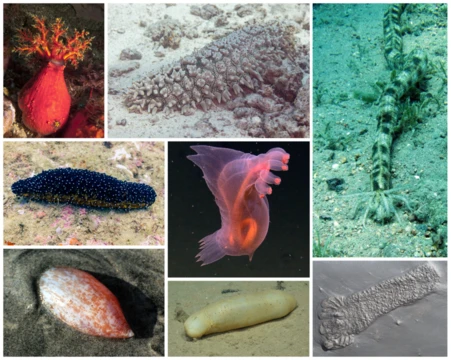
Synaptidae
Sea cucumbers lacking tube feet and radial canals.

Synaptidae is a family of sea cucumbers distinguished by the absence of several typical anatomical features, including tube feet, tentacle ampullae, retractor muscles, respiratory trees, cuvierian tubules, and radial canals of the water-vascular system; only the circumoral ring is present. They are notable for their elongated bodies, active peristaltic movement, and a sticky tegument caused by anchor-like spicules that project through the skin.
Quick Facts
- Taxon
- Synaptidae
Facts from the source article.
Lore & Background
Synaptidae sea cucumbers have elongated bodies that vary significantly in size, from small to quite large; Synapta maculata grows to two metres in length. They are quite active, moving by means of waves of peristaltic contractions. Their tegument is somewhat sticky because of the anchor-like spicules that project through the skin.
The family lacks tube feet, tentacle ampullae, retractor muscles, respiratory trees, cuvierian tubules, and radial canals of the water-vascular system, with only the circumoral ring present. According to the World Register of Marine Species, the family includes 16 extant genera and two extinct genera, with species counts ranging from 1 (e.g., Dactylapta, Rhabdomolgus) to 37 (Protankyra).
Reader's Guide
Synaptidae is significant as a family of sea cucumbers that deviates markedly from the typical holothurian body plan by lacking multiple key anatomical structures, including tube feet, respiratory trees, and radial canals. This makes them a notable example of morphological reduction within echinoderms. Their active peristaltic locomotion and sticky tegument, due to anchor-like spicules, distinguish them from other sea cucumbers. The family's diversity is reflected in the 16 extant genera recognized by the World Register of Marine Species, with Protankyra containing the most species (37) and several genera represented by only one species. The inclusion of two extinct genera (Eoleptosynapta and Eorynkatorpa) indicates a fossil record that extends the family's history. Their elongated bodies, with Synapta maculata reaching two metres, and their lack of typical water-vascular system components highlight the range of adaptations within sea cucumbers.
Did You Know?
- Synaptidae lack tube feet, tentacle ampullae, retractor muscles, respiratory trees, and cuvierian tubules.
- They move by waves of peristaltic contractions.
- Their tegument is sticky due to anchor-like spicules projecting through the skin.
Frequently Asked Questions
Who is Synaptidae?
Synaptidae is a family of sea cucumbers that stands apart from every other holothurian because it has shed nearly all the standard anatomical structures the group normally relies on. Only the circumoral ring of the water-vascular system is retained in their bodies.
What are Synaptidae's powers/role?
Instead of tube feet, respiratory trees, or retractor muscles, Synaptidae members get around using active peristaltic contractions of their elongated bodies. Their skin is laced with tiny anchor-shaped spicules that poke through the surface, giving the outer layer a characteristically sticky texture.
Why is Synaptidae important?
Because they have independently lost so many core echinoderm structures, Synaptidae serve as a living laboratory for studying how the water-vascular system and related organs can be reduced over evolutionary time. Their sticky, spicule-laden skin and peristaltic locomotion also make them a key reference point when comparing holothurian body plans.
What's the biggest member of Synaptidae?
Synapta maculata holds the record for the largest species in the family, reaching a length of about two metres. That makes it one of the most strikingly elongated sea cucumbers known from any family.
More in Sea Cucumbers and Brittle Stars, Part 2 1-24
Spotted an error? Know more?
Reader corrections go straight into our review queue. Suggest an edit · How this site is sourced