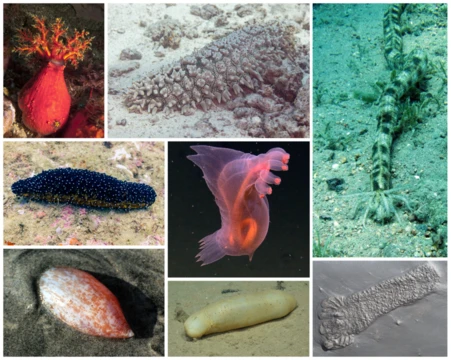
Euapta godeffroyi
A nocturnal deposit feeder with anchor spicules for adhesion.

Euapta godeffroyi, known as the sticky snake sea cucumber, belongs to the family Synaptidae and inhabits coral reefs across the tropical Indo-Pacific. It has a long, slender body that reaches about 40 cm in length, with fifteen feathery tentacles circling its mouth. Its creamy white body is marked with grey blotches and a pair of brown or greenish longitudinal stripes. The skin contains microscopic calcareous spicules, which include anchors and perforated plates with large holes.
This species ranges from the Red Sea and Madagascar to Hawaii and Easter Island, including Indonesia, the Philippines, northern Australia, and New Caledonia. It lives at depths up to about 77 m, in tidal pools, among stones, on sand, and among rubble on upper reef slopes. Nocturnal and a deposit feeder, it hides among rubble and corals during the day. At night, it emerges, using its anchor spicules to grip surfaces while extending its tentacles onto the sediment. Food particles stick to the tentacles and are scraped off into the mouth. It selects the most nutritious particles, consuming several times its body weight daily.
Quick Facts
- Taxon
- Euapta godeffroyi
Facts from the source article.
Lore & Background
Euapta godeffroyi is a long, slender sea cucumber growing to a length of about 40 cm. A ring of fifteen feathery tentacles encircles the mouth. The body colour is creamy white with blotches of grey and a pair of longitudinal brown or greenish stripes. The spicules are a mixture of anchors and perforated plates with large holes.
It is native to the tropical Indo-Pacific region, ranging from the Red Sea and Madagascar to Hawaii and Easter Island, and includes Indonesia, the Philippines, northern Australia and New Caledonia. It occurs at depths down to about 77 m in tidal pools, among stones and on sand, as well as among rubble on the upper parts and slopes of reefs.
E. godeffroyi is nocturnal and is a deposit feeder. It spends the day hidden among rubble and corals, emerging at night to crawl along using its anchor spicules for adhesion. It extends its tentacles onto the sediment, which sticks to them; food particles are passed to the mouth where they are scraped off. The sea cucumber selects the more nutritious particles and consumes several times its bodyweight each day.
Reader's Guide
Euapta godeffroyi is a deposit-feeding sea cucumber that plays a role in the ecology of coral reefs in the tropical Indo-Pacific. Its nocturnal habits and use of anchor spicules for adhesion allow it to move across sediment and rubble at night. The species is notable for its feeding strategy: it extends feathery tentacles onto the sediment, collects food particles, and scrapes them into its mouth, consuming several times its bodyweight daily while selecting more nutritious particles. Its distribution spans a wide area from the Red Sea and Madagascar to Hawaii and Easter Island, occurring in tidal pools, among stones, on sand, and among rubble on reef slopes down to about 77 meters. The spicules—anchors and perforated plates—are characteristic microscopic structures that project through the skin. The species is known as the sticky snake sea cucumber, reflecting its elongated form and adhesive capabilities.
Did You Know?
- Euapta godeffroyi grows to a length of about 40 cm.
- It has a ring of fifteen feathery tentacles around the mouth.
- It consumes several times its bodyweight each day, selecting more nutritious particles.
Frequently Asked Questions
What is Euapta godeffroyi?
Euapta godeffroyi is a sea cucumber in the family Synaptidae, commonly referred to as the sticky snake sea cucumber. It is a long, slender invertebrate that inhabits coral reefs throughout the tropical Indo-Pacific.
How big does Euapta godeffroyi get and what does its body look like?
It can grow to roughly 40 cm (about 16 inches) in length, giving it an elongated, snake-like profile. Its creamy white body is dotted with grey blotches and features a pair of longitudinal stripes in brown or greenish tones, while fifteen feathery tentacles ring its mouth.
What kind of internal skeleton does Euapta godeffroyi have?
Beneath its skin are microscopic calcareous spicules that come in two main forms: anchor-shaped elements and perforated plates with large holes. The anchor-type spicules in particular help the animal grip onto surfaces, which is where its 'sticky snake' nickname comes from.
Where can you find Euapta godeffroyi in the wild?
Its distribution spans from the Red Sea and Madagascar eastward to Hawaii and Easter Island, including Indonesia, the Philippines, northern Australia, and New Caledonia. It has been recorded at depths down to approximately 77 meters (253 feet).
How does Euapta godeffroyi feed and when is it active?
It is a nocturnal deposit feeder, meaning it forages over the seafloor at night, processing organic matter from sediments. During the day it tends to remain relatively still, using its anchor spicules to adhere to the substrate.
More in Sea Cucumbers and Brittle Stars, Part 2 1-24
Spotted an error? Know more?
Reader corrections go straight into our review queue. Suggest an edit · How this site is sourced