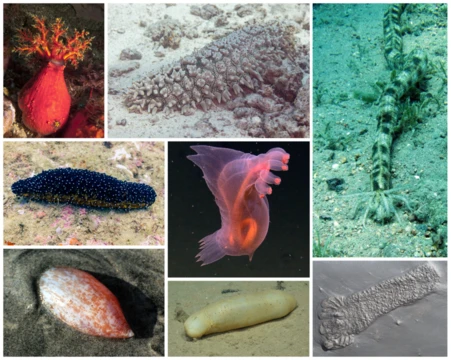
Chiridota albatrossii
A North Pacific sea cucumber first collected by the steamship Albatross.

Chiridota albatrossii, also called the Albatross footless sea cucumber, jellybean sea cucumber, or holothurie de l'Albatross, is a sea cucumber found in the North Pacific Ocean, from the Russian Far East and northern Japan to western Canada and Alaska. Its first collection was made by the steamship *Albatross* in 1903, and the species was formally described by Charles Lincoln Edwards in 1907. The American zoologist Edwards based his 1907 description on specimens gathered during a 1903 *Albatross* expedition investigating Alaskan salmon stocks. He noted that *C. albatrossii* resembled *Chiridota laevis* but was larger and had different ossicle structures. The description appeared in a paper in the *Proceedings of the United States National Museum*, alongside other sea cucumbers from the same voyage. The type specimen is held at the United States National Museum. Additional specimens were collected from the northwestern Pacific during another *Albatross* expedition in the summer of 1906. This species inhabits the sublittoral to bathyal zones of the northern Pacific, at depths between 46 and 1,000 meters (151–3,281 feet). Its range includes western Canada (Queen Charlotte Sound and off Vancouver Island), Alaska (Behm Canal, Boca de Quadra, Naha Bay, and Clarence Strait), and the western Pacific around southern Sakhalin (Aniva Bay and Cape Patience), the Nemuro Strait, Kunashir Island, Rebun Island, and the eastern and southern shores of Hokkaido in Japan and Russia.
Quick Facts
- Genus
- Chiridota
- Species
- albatrossii
Facts from the source article.
Lore & Background
Chiridota albatrossii was described by American zoologist Charles Lincoln Edwards in 1907 based on specimens collected by the United States Bureau of Fisheries steamship Albatross during a 1903 investigation into Alaskan salmon stocks. Edwards noted this new species was similar to Chiridota laevis but could be differentiated by its larger size and the structure of the ossicles. The description was included alongside discussion of other sea cucumber specimens collected by the Albatross in a scientific paper published in the Proceedings of the United States National Museum. The species was first collected from the north-western Pacific Ocean during another expedition of the Albatross in the summer of 1906. Its known range includes the waters of western Canada, northern Japan, eastern Russia, and Alaska, in the sublittoral to bathyal zones at depths of 46–1,000 m. Specific locations include Queen Charlotte Sound and off Vancouver Island in Canada, and Behm Canal, Boca de Quadra, Naha Bay, and Clarence Strait in Alaska, as well as southern Sakhalin, the Nemuro Strait, Kunashir Island, Rebun Island, and the eastern and southern shores of Hokkaido in Japan and Russia.
Reader's Guide
Chiridota albatrossii holds significance as a species first documented through the early 20th-century expeditions of the United States Bureau of Fisheries steamship Albatross, which collected the specimens in 1903 during an investigation into Alaskan salmon stocks. Its description by Charles Lincoln Edwards in 1907 added to the known diversity of sea cucumbers in the North Pacific, with Edwards distinguishing it from the similar Chiridota laevis by its larger size and ossicle structure. The type specimen is held in the collection of the United States National Museum, anchoring its taxonomic identity. The species' distribution across the North Pacific, from western Canada and Alaska to northern Japan and eastern Russia, and its occurrence in sublittoral to bathyal depths, illustrate its ecological breadth. Its legacy is tied to the Albatross expeditions, which contributed foundational knowledge of marine fauna in the region.
Did You Know?
- Chiridota albatrossii was first collected by the steamship Albatross in 1903 during an investigation into Alaskan salmon stocks.
- Its known depth range is 46–1,000 m.
Frequently Asked Questions
Who is Chiridota albatrossii?
Chiridota albatrossii is a North Pacific sea cucumber that fans know by nicknames like the jellybean sea cucumber or the Albatross footless sea cucumber. American zoologist Charles Lincoln Edwards gave it its formal name in 1907, working from specimens the steamship Albatross pulled up during a 1903 survey of Alaskan salmon grounds.
What are Chiridota albatrossii's powers/role?
In its deep-sea habitat spanning roughly 46 to 1,000 metres, C. albatrossii acts as a benthic detritivore, processing organic material on the ocean floor. Its 'footless' common name hints at a locomotion strategy that sets it apart from many tube-footed holothurian relatives.
Why is Chiridota albatrossii important?
The species provides a key North Pacific reference point for the genus Chiridota, helping researchers distinguish it from closely related members. Edwards noted in his 1907 paper that C. albatrossii closely resembles other Chiridota species, making its precise description valuable for the group's overall taxonomy.
Where can I find Chiridota albatrossii in the wild?
Look in the deep waters of the North Pacific, between about 151 and 3,281 feet (46–1,000 m), off the coasts of Alaska, western Canada, northern Japan, or the Russian Far East. The type locality is listed simply as the North Pacific Ocean, reflecting the broad sweep of the original 1903 Albatross expedition.
More in Sea Cucumbers and Brittle Stars, Part 2 1-24
Spotted an error? Know more?
Reader corrections go straight into our review queue. Suggest an edit · How this site is sourced