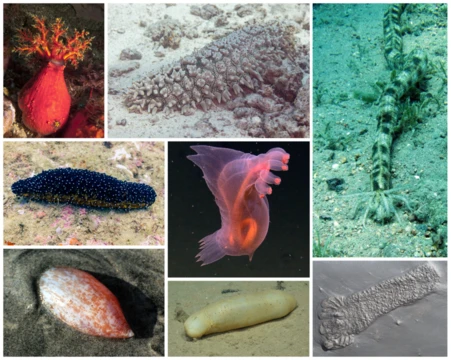
Porosothyone
Earliest body fossil of a sea cucumber, from the Silurian of Australia.

Porosothyone is an extinct sea cucumber genus from Australia’s Silurian period, containing only one species, *Porosothyone picketti*. It is considered the earliest known body fossil of the group.
Its fossils come from upper Silurian deposits in New South Wales’ Yass Basin, specifically the Pridoli-aged Elmside Formation (where the holotype was found) and the upper Ludlow-aged Black Bog Shale. The genus name combines the Latin *porosus* (“full of holes”)—referring to its highly perforated skin ossicles—with *thyone*, a common suffix for holothurian genera. The species name honors John Picket of the Geological Survey of New South Wales, who first identified the specimens.
The animal was cigar-shaped, reaching up to 40 mm long and 7 mm wide, with slightly narrower ends. Overlapping, highly perforated sieve-plate ossicles covered its body; these were wider than long, had broadly curved front edges, and lacked spires. A calcareous ring around its ventral mouth consisted of five radial and five interradial elements.
Among the oldest holothurians with articulated fossils, *Porosothyone* has been placed within the crown group Holothuria as a stem-group apodid in one analysis, but its exact relationships within the holothurian crown group remain unclear.
Quick Facts
- Taxon
- Porosothyone
- Type Species
- Porosothyone picketti
- Type Species Authority
- Jell, 2011
Facts from the source article.
Lore & Background
Porosothyone is known from fossils collected in the upper Silurian sequences of the Yass Basin, New South Wales. The holotype and other specimens come from the Pridoli stage of the Elmside Formation, with additional fossils from the upper Ludlow stage of the Black Bog Shale. The genus name derives from Latin porosus, meaning 'full of holes', referring to its highly perforate skin ossicles, and thyone, a common suffix in holothurian genera. The specific epithet picketti honors John Picket of the Geological Survey of New South Wales, who first recognized the specimens.
Porosothyone is a cigar-shaped sea cucumber with a body up to 40 mm long and 7 mm wide, both ends slightly narrower. Its body is covered by overlapping, highly perforated sieve plate skin ossicles that are wider than long, with broadly curved anterior margins and no spires. The ventral mouth is surrounded by a calcareous ring consisting of five radial and five interradial elements.
Reader's Guide
Porosothyone is one of the oldest known holothurians with articulated fossils, and it is regarded as the earliest body fossil of the sea cucumber group. Its discovery in the Silurian of Australia provides a rare glimpse into the early evolution of holothurians, as most early echinoderm fossils are disarticulated. Although one analysis has placed Porosothyone inside the crown group Holothuria, as a stem group Apodida, its relationships within the holothurian crown group are not yet clearly resolved. This uncertainty underscores the ongoing debate about the early diversification of sea cucumbers. The highly perforated sieve plate ossicles and the presence of a calcareous ring with radial and interradial elements are key morphological features that help link this fossil to later holothurians. As the earliest body fossil of the group, Porosothyone serves as an important reference point for understanding the timing and pattern of holothurian evolution, even if its exact phylogenetic position remains unsettled.
Did You Know?
- Porosothyone is regarded as the earliest body fossil of a sea cucumber.
- Its genus name comes from Latin porosus, meaning 'full of holes', after its highly perforate skin ossicles.
- The species name picketti honors John Picket, who first recognized the specimens.
- Its body is cigar-shaped, up to 40 mm long and 7 mm wide.
Frequently Asked Questions
Who is Porosothyone?
Porosothyone is a single-species, extinct sea cucumber genus known only from *Porosothyone picketti*. It lived during the Silurian period in what is now New South Wales, Australia, and is recognized as the earliest body fossil ever identified for the holothurian lineage.
What makes Porosothyone's anatomy distinctive?
Its skin ossicles are extremely perforated, a feature the genus name highlights by pairing the Latin *porosus* ("full of holes") with the holothurian suffix *thyone*. The preserved specimens reach a maximum body length of about 40 mm, giving paleontologists a surprisingly detailed look at an otherwise hard-to-fossilize soft-bodied animal.
Where and when are Porosothyone fossils found?
Specimens come from two Silurian units in the Yass Basin of New South Wales: the Pridoli-aged Elmside Formation, which yielded the holotype, and the slightly older upper Ludlow-aged Black Bog Shale. Together they pin the genus to a window spanning roughly the late Ludlow through the Pridoli stages.
Why is Porosothyone a big deal for sea-cucumber fans?
Before its description, the oldest physical evidence for sea cucumbers was fragmentary, so *P. picketti* pushes the confirmed body-fossil record back to the Silurian. It also gives researchers a rare, well-preserved window into early holothurian soft-tissue and ossicle architecture that is otherwise lost in the fossil record.
Who does the species name honor, and why does that matter?
The specific epithet *picketti* credits John Pickett, acknowledging his contributions to the study of these Silurian invertebrates. For fans tracking the history of holothurian taxonomy, the name is a reminder that the group's deep past was pieced together by a small community of Australian paleontologists working in the Yass Basin.
More in Sea Cucumbers and Brittle Stars, Part 2 1-24
Spotted an error? Know more?
Reader corrections go straight into our review queue. Suggest an edit · How this site is sourced