Euapta lappa
A worm-like sea cucumber with sticky ossicles and peristaltic locomotion.

The beaded sea cucumber, *Euapta lappa*, is a member of the family Synaptidae within the phylum Echinodermata. It lives on coral reefs in the Caribbean region.
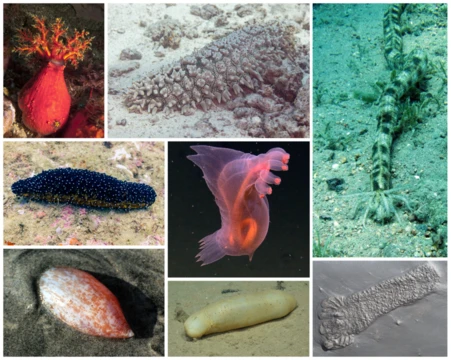
This species looks more like a long worm than a typical sea cucumber. It can grow up to a meter in length and about 4 centimeters wide. Its body is normally soft and floppy, but when startled, it contracts violently to a much shorter length. It lacks both tube feet and an internal respiratory tree. The skin is covered in rounded ridges, and embedded in the cuticle are many tiny calcareous plates called ossicles. Small hooks on these ossicles make the body feel sticky. At the front end is a ring of fifteen branched tentacles used for feeding. The body color is pale brown or gray, often with white flecks, darker streaks running lengthwise, or transverse bands.
The beaded sea cucumber is found in the Caribbean Sea, the Bahamas, Jamaica, Cuba, the Gulf of Mexico, Mexico, Costa Rica, Panama, and the Lesser Antilles. It also occurs in the Canary Islands. It lives on reefs down to about 30 meters deep, hiding during the day among boulders and coral rubble.
It is a detritivore, using its tentacles to sift through seabed sediment and push it into its mouth. Organic material is digested, and the inorganic waste is expelled through the cloacal vent. Movement happens through muscle contractions in the body wall, which includes both longitudinal bands and circular bands. Waves of peristalsis along the body allow it to crawl, with the ossicles providing grip on the substrate. In an aquarium, it can even climb vertical glass using this peristaltic motion, with only its tentacles providing attachment.
Quick Facts
- Taxon
- Euapta lappa
Facts from the source article.
Lore & Background
The beaded sea cucumber resembles a long worm rather than a typical sea cucumber, reaching up to a metre in length and 4 cm in diameter. It lengthens and shortens repeatedly, and when disturbed, its normally flaccid body retracts vigorously to a fraction of its original length. It has no internal respiratory tree nor tube feet, and its body surface is covered by rounded ridges. The skeletal structure consists of many tiny calcareous plates embedded in the cuticle, with little hooks projecting from these ossicles that make the body feel sticky to the touch. At the anterior end, there is a ring of fifteen branched feeding tentacles. Body colour is pale brown or grey, often with white flecks or darker, longitudinal streaks and transverse banding.
This species is found on coral reefs in the Caribbean region, including the Caribbean Sea, the Bahamas, Jamaica, Cuba, the Gulf of Mexico, Mexico, Costa Rica, Panama, and the Lesser Antilles, as well as the Canary Islands. It inhabits reefs at depths down to about 30 metres, hiding during the day among boulders and coral debris.
As a detritivore, the beaded sea cucumber uses its tentacles to sift through sediment on the seabed, pushing it into its mouth aperture. Organic material in the sediment is digested, and inorganic matter is expelled through the cloacal vent. Locomotion occurs via contraction of muscles in the body wall, consisting of both longitudinal bands and continuous circular bands forming a tube. Waves of peristalsis pass along the body, and the ossicles prevent slipping by providing friction with the substrate. In an aquarium, it can climb vertical glass sides using peristalsis, with the only point of attachment being the tentacles.
Reader's Guide
The beaded sea cucumber is significant as a detritivore that plays a role in processing sediment on Caribbean coral reefs. Its unique anatomy—lacking tube feet and an internal respiratory tree, and possessing sticky ossicles—distinguishes it from many other sea cucumbers. The species' ability to retract vigorously when disturbed and to climb vertical surfaces using peristalsis and tentacle attachment demonstrates its specialized locomotion. Its distribution across the Caribbean region and the Canary Islands highlights its presence in both tropical and subtropical reef habitats. The beaded sea cucumber's worm-like appearance and peristaltic movement contribute to its ecological niche as a sediment feeder, and its sticky ossicles aid in traction on various substrates. Its legacy lies in its adaptation to reef environments, where it hides among boulders and debris during the day and forages at night, contributing to nutrient cycling in the benthic community.
Did You Know?
- The beaded sea cucumber can reach up to a metre in length and has a diameter of up to 4 cm.
- It has no internal respiratory tree and no tube feet.
- Its body is covered with tiny calcareous plates that have little hooks, making it feel sticky.
- It uses peristalsis to move and can climb vertical glass surfaces in an aquarium.
Frequently Asked Questions
What is Euapta lappa?
Euapta lappa, commonly called the beaded sea cucumber, is a Caribbean reef-dwelling echinoderm in the family Synaptidae. Its elongated, worm-like body makes it look almost like a giant marine worm rather than a typical sea cucumber.
How large does Euapta lappa grow?
This species can reach roughly one meter in length while staying only about four centimeters in diameter. Despite its impressive length, the cross-section remains quite slender, reinforcing its worm-like silhouette.
How does Euapta lappa get around without tube feet?
Euapta lappa has no tube feet and no internal respiratory tree, so it relies on peristaltic contractions of its muscular body wall to inch along the substrate. Its cuticle also bears tiny hooked ossicles that help it grip surfaces during movement.
What does Euapta lappa's skin look like?
The body is pale brown or grey, often marked with white flecks or darker streaks and banding. Rounded ridges run along the surface, and the cuticle is studded with numerous small calcareous plates called ossicles, some of which carry tiny hooks.
How does Euapta lappa protect itself when threatened?
When startled, the normally soft and floppy body contracts violently, shortening dramatically in length. This sudden tightening is its primary defensive response, making it difficult for predators to maintain a grip.
More in Sea Cucumbers and Brittle Stars, Part 2 1-24
Spotted an error? Know more?
Reader corrections go straight into our review queue. Suggest an edit · How this site is sourced