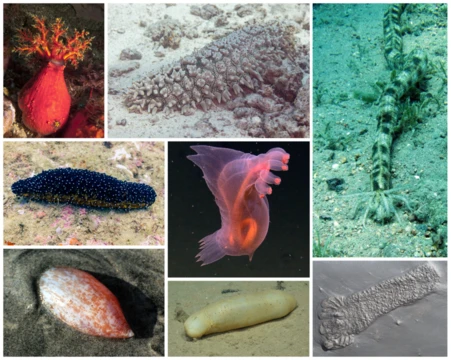
Leptosynapta dolabrifera
A small, mucus-covered sea cucumber with remarkable regenerative abilities.

Leptosynapta dolabrifera, better known as the snot sea cucumber, is a small member of the class Holothuroidea and the family Synaptidae. Its closest relative is another species in its genus, Leptosynapta inhaerens, one of 34 species in the genus.
This sea cucumber varies in size, ranging from 5 to 9 cm long. Its body is chubby and can be pink, purple, red, or white, often coated in mucus. Many lighter-colored individuals have translucent body walls. Small circular armored spines on its sides help it anchor itself and burrow into the seafloor. It also has two to three toothed arms used for anchoring and extracting nutrients from the substrate. There are no differences between sexes. The thickness and length of the body can change depending on the amount of body wall muscle.
The snot sea cucumber is found along the coasts of Australia, as well as in Portland, Oregon, and parts of Scotland. It prefers temperate, shallow waters. Recent studies show an average density of 0.20 individuals per area. It is a favored food of the Eastern shovelnose stingaree, making up 4.7% of that ray's diet. As of 2021, the species is not considered endangered.
Its habitat consists of nutrient-rich substrate—silty and fine in shallow areas, and dark, clay-like in deeper waters. Occasionally, it is found in rockier places, such as among coral skeletons in Edinburgh, Scotland.
Like most sea cucumbers, the snot sea cucumber burrows into sand or mud and uses its tentacles to extract nutrients. It feeds entirely by digging into the substrate and pushing it into its mouth with its anchors, leaving trails of sand as waste.
Sea cucumbers in the genus Leptosynapta can regenerate lost body parts through a process called morphallaxis, where remaining tissues redifferentiate to form a smaller but complete animal. If a piece includes both the mouth and part of the digestive tract, it can regenerate. The digestive tract has three sections: the esophagus (connecting the mouth to the stomach), the stomach, and the intestine (between the stomach and anus). The stomach and esophagus are suspended in the dorsal mesentery, while the intestine is in the ventral mesentery. In the midsection, the digestive tract crosses the coelomic cavity at a point where the mesenteric attachment changes from dorsal to ventral—this is called the crossover point.
Quick Facts
- Taxon
- Leptosynapta dolabrifera
Facts from the source article.
Lore & Background
Leptosynapta dolabrifera, the snot sea cucumber, is a small sea cucumber under the class Holothuroidea, in the family Synaptidae. It is most closely related to another species in its genus of 34 species, Leptosynapta inhaerens. The sea cucumber has small circular armored spines on its side to help in anchoring and burying in the seafloor, and two to three toothed arms to anchor and extract nutrients from the substrate. It comes in varying shapes and sizes, with lengths from 5 to 9 cm, and is chubby with a pink, purple, red, or white body, often covered in mucus. Many light-colored individuals have translucent body walls. There are no variations by sex.
Reader's Guide
Leptosynapta dolabrifera has been known to inhabit areas around the coasts of Australia, and have also been recorded in Portland, Oregon, and some areas of Scotland in recent years. It prefers temperate, shallow waters, with an average density of 0.20 in an area. Its habitat consists of nutrient-rich substrate, either silty and fine substrate for shallow areas or dark, clay-like substrates for deeper waters; it is sometimes seen in rockier areas, such as in coral skeletons in Edinburgh, Scotland. The snot sea cucumber is a favorite food of the Eastern shovelnose stingaree, making up 4.7% of their diet. It is not thought to be endangered as of 2021. Like most other sea cucumbers, it burrows in sand or mud and extracts nutrients with its tentacles, consuming substrate and leaving discarded trails of sand as waste. Sea cucumbers in the genus Leptosynapta can regenerate parts of their body through morphallaxis. If a transection is made anteriorly to the crossover point (the stomach-intestine junction), regeneration occurs but the result lacks an intestine, with full regeneration within 144 hours. If transected posteriorly to the crossover point, the esophagus, stomach, and intestine are all represented in the final form, with complete regeneration between 120 and 144 hours.
Did You Know?
- The snot sea cucumber is also known as Leptosynapta dolabrifera and belongs to the family Synaptidae.
- It can regenerate a complete animal from a residual piece that includes both the mouth and part of the digestive tract.
- The snot sea cucumber makes up 4.7% of the diet of the Eastern shovelnose stingaree.
- Episode 20 of the children's animated series Octonauts is centered around an injured snot sea cucumber named Slippy.
Frequently Asked Questions
Who is Leptosynapta dolabrifera?
Leptosynapta dolabrifera is a small sea cucumber popularly nicknamed the snot sea cucumber, classified in the family Synaptidae under the class Holothuroidea. It is one of 34 species in the genus Leptosynapta, and its nearest relative is Leptosynapta inhaerens.
What does Leptosynapta dolabrifera look like?
This chubby little animal measures roughly 5 to 9 cm and appears in shades of pink, purple, red, or white, usually slicked with a coating of mucus. Lighter individuals often have somewhat translucent body walls, while small circular armored spines line the sides to aid in gripping and burrowing.
How does Leptosynapta dolabrifera regenerate after being severed?
If the anterior end is cut away, the sea cucumber regrows that section in approximately 144 hours. A posterior transection heals on a comparable clock, taking between 120 and 144 hours to regenerate.
What role does Leptosynapta dolabrifera play in its local food web?
The snot sea cucumber accounts for about 4.7% of the dietary contribution to the eastern shovelno, making it a modest but measurable prey or detritus source in its benthic community.
How does Leptosynapta dolabrifera anchor itself on the seafloor?
It relies on small circular armored spines along its body sides to grip the substrate and dig into sediment. Two to three toothed arms work alongside those spines to help it hold position and forage.
More in Sea Cucumbers and Brittle Stars, Part 2 1-24
Spotted an error? Know more?
Reader corrections go straight into our review queue. Suggest an edit · How this site is sourced